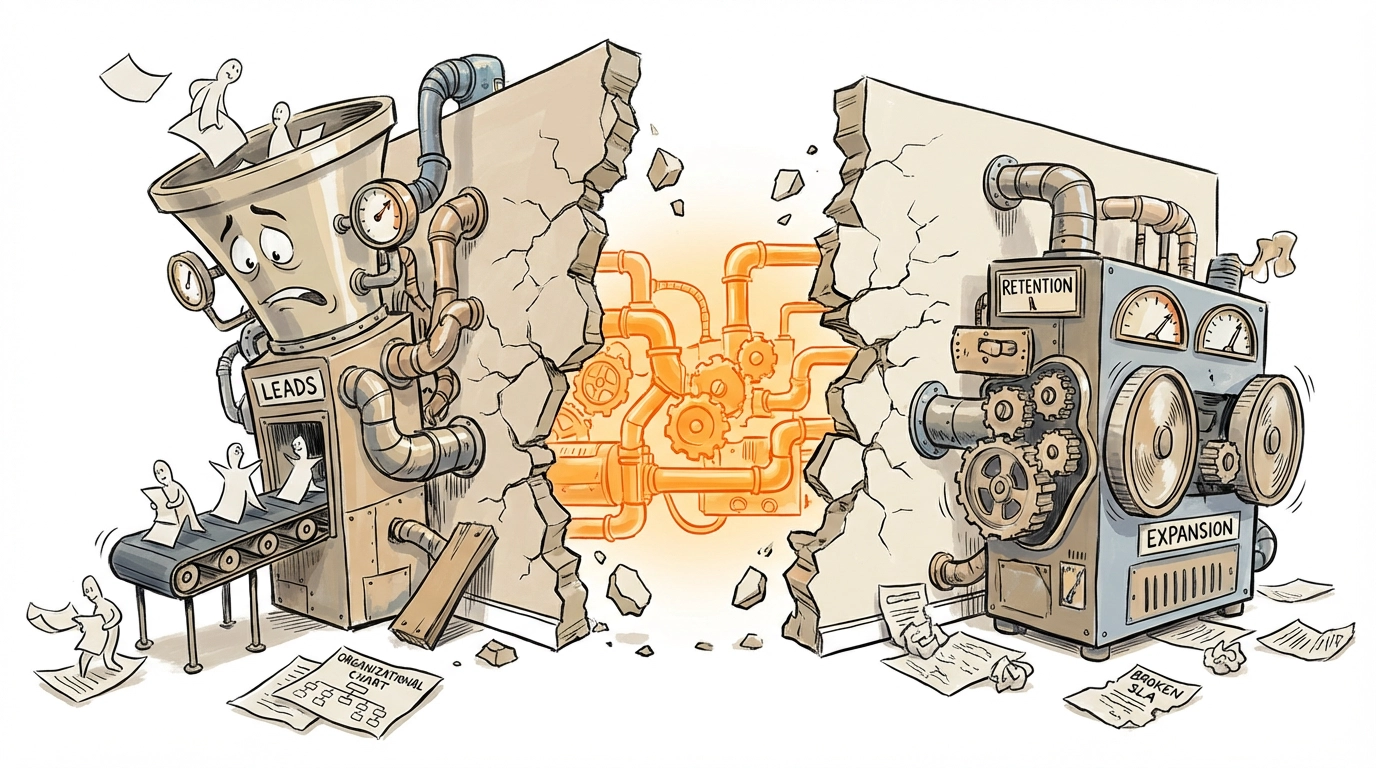
AI is collapsing the walls between marketing, sales, and customer success, because those walls exist to manage an information gap that AI is closing. What replaces the departmental model is a converged GTM org: two motions, acquisition and retention-expansion, on one shared data layer, with RevOps writing the rules that govern both.
Here’s the meeting that convinced me.
I sat in a pipeline review last year where the VP of Marketing, the VP of Sales, and the Head of CS were all presenting their numbers from the same quarter, about the same customers, and telling three different stories. Marketing showed a record number of MQLs. Sales showed pipeline was down. CS showed expansion revenue stalling. The CRO asked the RevOps lead to reconcile. She pulled up a fourth dashboard.
Four dashboards. One quarter. Zero agreement on what happened.
I’ve watched versions of this meeting at half a dozen companies over the past three years. The numbers change; the argument doesn’t. And the proposed fix is always the same: better alignment, tighter SLAs, shared KPIs, more RevOps headcount to patch the walls between teams.
Nobody asks whether the walls should be there in the first place.
Why Do Marketing, Sales, and CS Exist as Separate Teams?
In the early 1800s, electricity and magnetism were treated as separate forces. Different labs studied them. Different instruments measured them. Scientists built entire careers on one side of the wall or the other. Then James Clerk Maxwell showed they were expressions of the same underlying field. Not two forces that worked well together. One force, manifesting differently depending on the frame of reference.
The insight wasn’t that electricity and magnetism should collaborate more effectively. It was that the wall between them was wrong. And tearing it down didn’t just simplify the science: it predicted entirely new phenomena, from electromagnetic waves to radio to everything modern communications is built on.
I think we’re approaching a similar moment in how companies organize their go-to-market.
For most of the history of B2B software, we’ve built walls that split the revenue field into separate forces. Marketing generates demand. Sales converts it. Customer success retains it. Three teams, three leaders, three dashboards, three budgets, connected by a CRM that mostly functions as a shared spreadsheet with better branding. Each team measures the field through its own wall, with its own instruments, and each instrument tells a different story about the same underlying reality.
These walls made sense when information was expensive. Marketing knew the market but not the buyer. Sales knew the buyer but not the market. CS knew the product experience but not the purchase context. There was a real information asymmetry between functions, and we built org charts around it. The walls existed because no single team could see the whole field.
AI is collapsing that information asymmetry. And when you remove the force that built the walls, the walls become dead weight.
Why Are GTM Functions Converging Now?
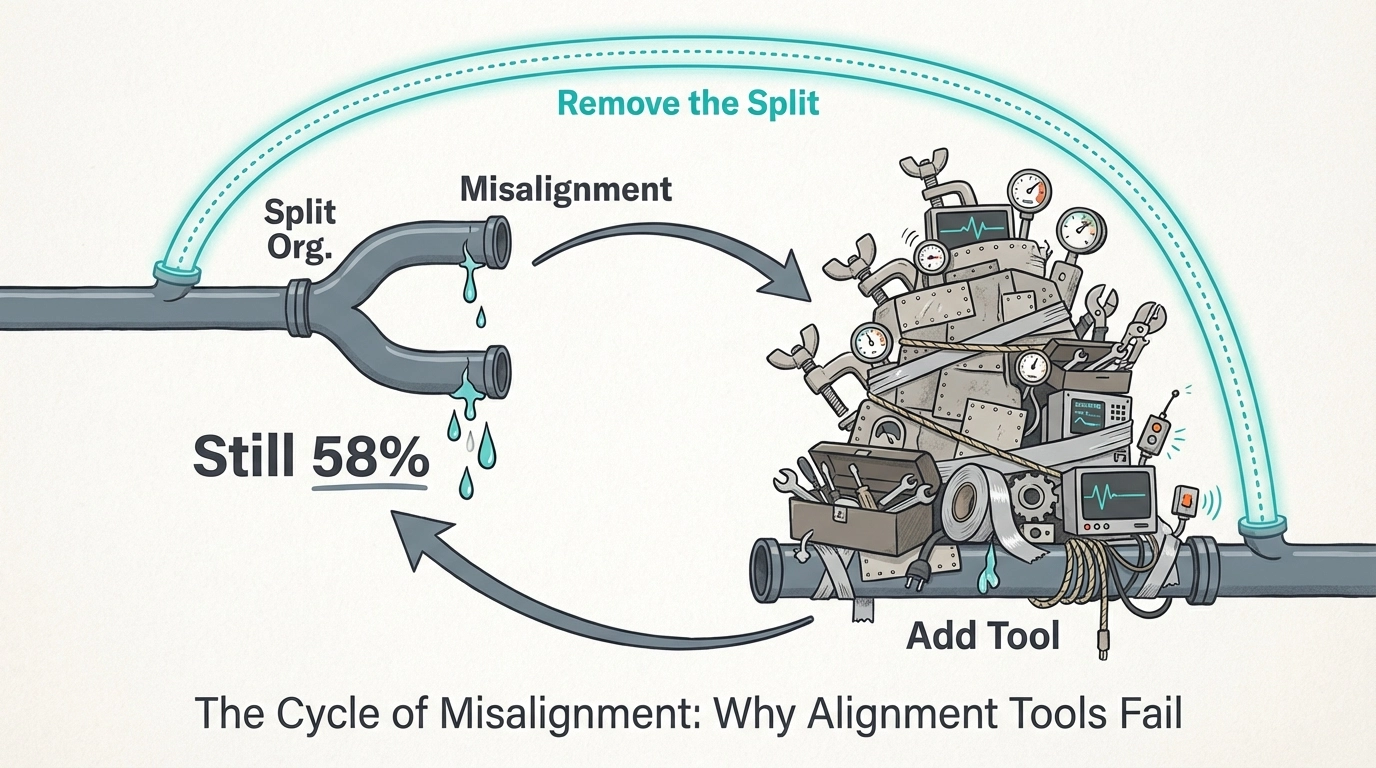
The split is already failing, and the tools built to manage it treat symptoms, not the underlying physics.
Forrester’s 2025 State of RevOps survey found that 58% of B2B companies cite process misalignment as their primary barrier to growth. That number hasn’t moved much in years despite heavy spending on alignment tools and RevOps hires. In physics terms, we keep adding more sophisticated instruments to measure two separate forces, when the actual problem is that we’re measuring one force with two instruments and wondering why the readings don’t match.
In the companies I’ve watched get closest to unification, the growth comes not from better handoff protocols but from treating the revenue system as a single field: shared data, shared goals, shared visibility. The closer they get, the faster they grow. That’s the physics working.
Meanwhile, the handoff that defines the split is becoming a fiction. Research from 6sense shows 61% of B2B buyer research happens before any vendor contact. Gartner’s data suggests up to 80% of the decision-making process is complete before direct engagement. The buyer doesn’t experience a handoff from marketing to sales. They experience a single gravitational field — your brand mass, your content, your community, your product — and they move through it on their own terms. The handoff is our organizational artifact, not the buyer’s experience.
And AI accelerates this in a way that alignment tools never could: not by connecting the separate functions, but by making the separation irrelevant. When intent signals, content engagement, conversation history, product usage, and support patterns all live in one data layer, the organizational boundaries between “marketing data” and “sales data” and “CS data” stop reflecting anything real. The walls remain, but the information has already moved past them. That’s the structural shift: not better tools bridging separate teams, but a unified information layer that renders the separation meaningless. Once agents share context, the software stops respecting departmental boundaries before the org chart does; From Chatbot to Agent Fleet traces that tooling shift.
What Replaces the Marketing/Sales Handoff?
If the old model split the field along a transaction sequence (before the hand-raise vs. after), field unification reorganizes it along customer-state. Two motions, one field. Same force, different directions.
Acquisition is everything involved in increasing the field’s pull on objects that haven’t yet entered your orbit. Reducing friction in discovery, evaluation, and adoption. This isn’t “marketing does awareness and sales does closing.” It’s one continuous gravitational motion from first signal to signed contract. The governing question: does this activity increase our pull on prospects, or just create noise?
Retention and Expansion is everything involved in maintaining and increasing the orbital velocity of objects already captured. Making the experience of being a customer so valuable that the orbit stabilizes and expands. This isn’t just “customer success.” It’s product experience, support, community, education, and the feedback loop that turns customer behavior into field intelligence. The governing question: does this activity keep customers in stable, expanding orbits?
In a unified field, these aren’t separate functions. They’re the same force expressed in different directions — pull-in for acquisition, hold-and-accelerate for retention. And the data that governs both flows through the same field, not across a handoff.
Marketing feels this first: the marketing org chart is being rewritten around orchestration rather than channels, and the acquisition motion is where that rewrite lands.
What Actually Changes When the Walls Come Down?
Side by side, here’s what the shift changes:
| Walled GTM org | Converged GTM org | |
|---|---|---|
| Structure | Separate Marketing, Sales, and CS departments, each with its own leader and budget | Two motions (acquisition, retention-expansion) staffed by cross-lifecycle teams |
| Metrics | MQLs, pipeline, NRR measured separately; three dashboards that disagree | Customer-state metrics on one continuous view, first visit to year-three expansion |
| Tooling | Function-specific stacks stitched together by CRM handoffs and alignment tools | One data layer; AI agents act on field events regardless of account ownership |
| Failure mode | Context evaporates at every handoff; each team optimizes its silo | Governance gaps; automation optimizing one motion at the expense of the other |
Note the last row: convergence swaps failure modes rather than removing them. Information loss gives way to ungoverned automation, which is why governance matters as much as the data layer.
What Does AI-Native Retention Look Like?
Here’s where the old split causes the most damage, and where the physics makes the strongest case for unification.
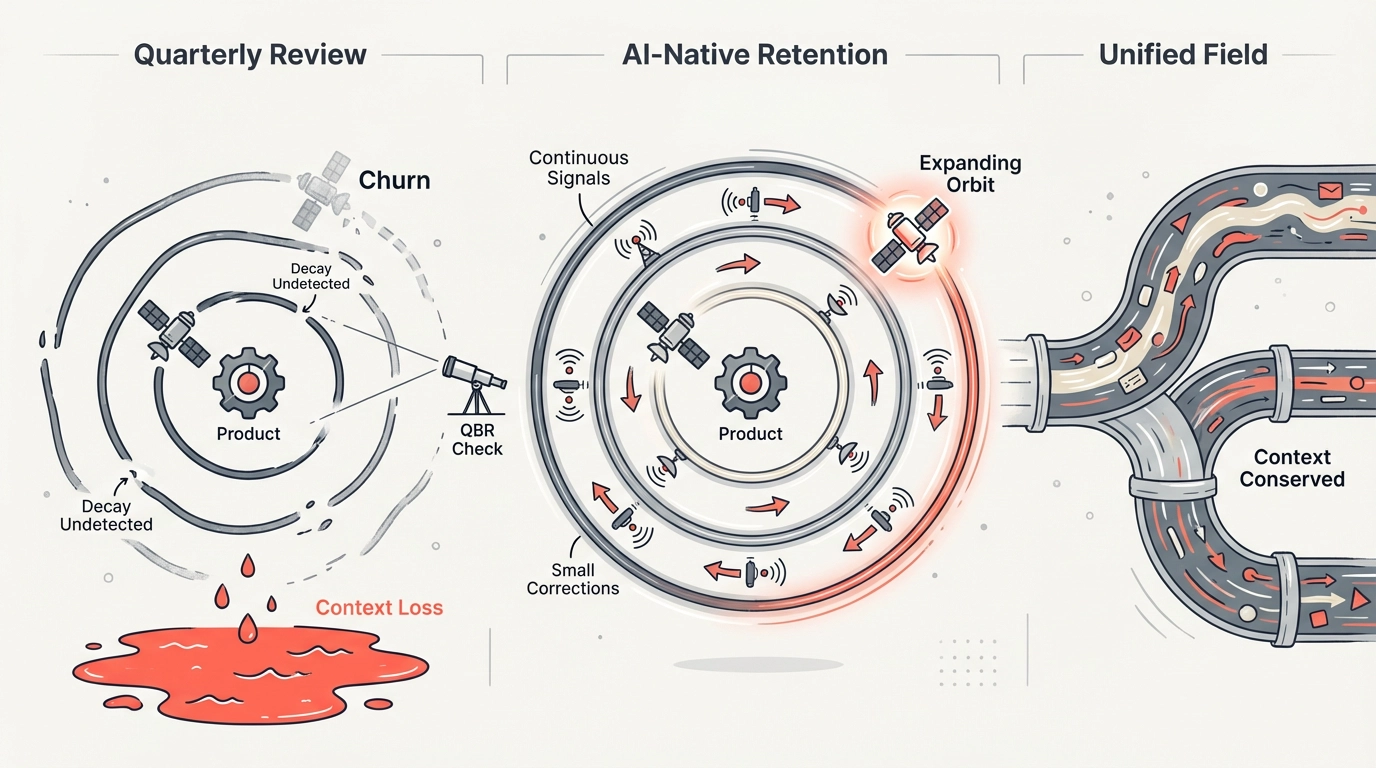
In most B2B SaaS companies, the moment a deal closes, the field loses most of its accumulated information. The buyer’s pain points, the conversations that moved the deal forward, the competitive alternatives they evaluated, the internal politics that shaped the decision — all of it lives in a sales rep’s head, maybe partially in CRM notes that read like haiku written under duress. That’s my estimate based on twenty years of watching this pattern, not a sourced number. But if you’ve ever sat through an onboarding call where the customer had to re-explain why they bought, you know the loss is real.
In physics, a system that loses information at a boundary is a system leaking energy. Every time context evaporates at the close, the customer’s orbit starts with less momentum than it should have. Customer success begins from near-zero, schedules an onboarding call, asks questions the buyer already answered three months ago. The customer feels the energy loss, and that’s where early churn begins. Not because the product fails. Because the field forgot what it already knew.
In a unified field, information is conserved. Context doesn’t evaporate at the close; it carries through. The retention side of the field picks up with the full depth of the relationship already loaded, the same way an electromagnetic wave doesn’t lose its properties when it transitions from one medium to another. That’s a structural inevitability once the data layer unifies.
And unification goes deeper than preventing information loss. When the field is one, retention reads the same signals acquisition does, just in a different direction. Product usage patterns, support ticket clusters, community engagement shifts — these are orbital signals. They’ve always existed. The difference is that a unified field reads them continuously, not once a quarter at a QBR. Traditional CS checks a satellite’s trajectory every ninety days and hopes it hasn’t already started falling. In a unified field, small corrections applied early are exponentially cheaper than rescue maneuvers applied late. That’s the literal mathematics of orbital mechanics, and it maps precisely to the economics of churn prevention vs. churn recovery.
The compounding effect flows both directions. Retention generates the most valuable data acquisition can have: which promises hold up after the sale, which use cases expand, which segments lose orbit. In the old model, this intelligence trickles back through quarterly reviews. In a unified field, it’s continuous. Acquisition pull strengthens because retention data shows what actually creates stable orbits — not what sounded good in a pitch deck.
What Happens to RevOps in a Converged GTM Org?
Maxwell didn’t just prove the field was unified. He wrote the equations that described how it behaved. Four equations that governed everything — how electric fields create magnetic fields, how magnetic fields create electric fields, and how they propagate together through space.
RevOps has the same opportunity, and the same transformation ahead.
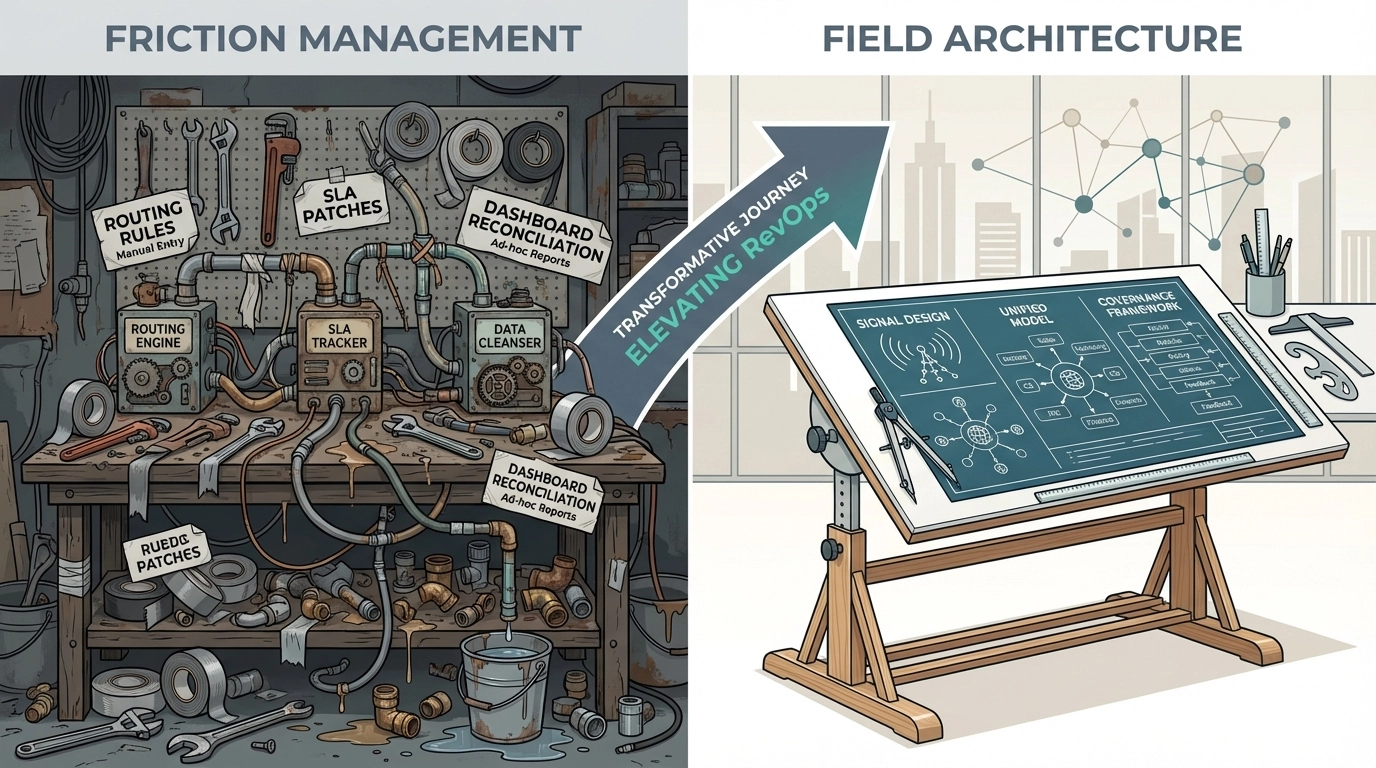
Today, RevOps mostly manages the seams between separate forces. Data hygiene. Dashboard reconciliation. SLA enforcement between teams. Routing rules. Territory management. Important work, but it’s friction management, made necessary by the decision to split the field in the first place. Gartner predicts that by 2028, 75% of these tasks will be executed by AI agents. That should concern RevOps leaders who define their value by the plumbing.
In a unified field model, RevOps stops managing seams and starts writing the equations that govern how the field operates.
Instead of building routing rules that determine which team gets a signal, RevOps designs the field architecture: the signal logic that determines what action the system takes regardless of which team nominally owns the account. A buying signal detected in a customer account isn’t a “CS upsell lead” or a “Sales expansion opportunity.” It’s a field event that flows to whatever combination of AI and human resources is best positioned to act.
Instead of reconciling three dashboards into a revenue forecast, RevOps maintains the unified data model, the field equations that make a single view of the customer the default state. Every interaction, from first anonymous visit to year-three expansion, lives in one continuous context layer. The job isn’t merging fragmented measurements after the fact. It’s designing the instrument so the field is measured as one from the start.
Instead of enforcing process compliance across teams with different incentives, RevOps designs the governance framework that keeps the field operating within strategic guardrails. Which field events trigger automated action vs. human review? What’s the escalation logic when an AI agent encounters a situation outside its training? How do you prevent the system from optimizing one field direction at the expense of the other? These are the field equations for revenue. The people who can write them will have more strategic influence than most of the VPs they currently support.
One level up, the leader of this org looks less like a functional VP and more like a chief marketing orchestrator: leverage from designing the system, not owning a department.
What Should Founders and GTM Leaders Do Now?
If you’re a founder or board member, I’m not telling you to tear the walls down overnight. Organizational structures have inertia, one of the most reliable laws in Market Physics. But start watching for evidence that the information has already unified even though your org chart hasn’t: your best deals don’t follow the funnel you designed. Your buyer’s journey doesn’t respect the handoff you built. Your retention side is re-discovering information your acquisition side already generated. When the information flows as one and the org chart still says three, the org chart is the lagging indicator.
If you’re a GTM leader or RevOps operator, start building toward unification within the current structure. Push for a unified data model that conserves information across the acquisition-retention boundary. Instrument that boundary so you can measure the energy loss. Design new initiatives to operate across the full customer lifecycle rather than within a single function, and use the results as evidence for why the walls are artificial. And if you’re in RevOps specifically: start learning to write field equations. The plumbing is getting automated. The architecture is just beginning.
Maxwell didn’t tell electricians and magneticians to collaborate better. He tore down the wall between them and showed they were studying the same thing.
AI is about to do the same to your GTM org. Let it.
Frequently Asked Questions
How is AI changing go-to-market teams?
It removes the information asymmetry the departmental model was built on. When intent signals, engagement, product usage, and support patterns live in one data layer, no function holds private knowledge the others lack. Work reorganizes around customer state instead of departmental ownership, and humans concentrate on the judgment work: positioning, governance, and relationships.
Will AI merge marketing and sales roles?
The functions converge before the titles do. Buyers complete most of their research before vendor contact (61% per 6sense, up to 80% per Gartner), so the handoff the two roles were built around is dissolving. Expect role boundaries defined by motion rather than funnel stage, with craft specialists working across the full lifecycle.
Does a converged GTM org still need RevOps?
More than ever, but for different work. The reconciliation and routing tasks that fill RevOps calendars are what AI automates first; Gartner puts that at 75% of the work by 2028. What remains is architecture: the unified data model, the signal logic that routes field events, and the governance rules for when automation acts versus when a human reviews.