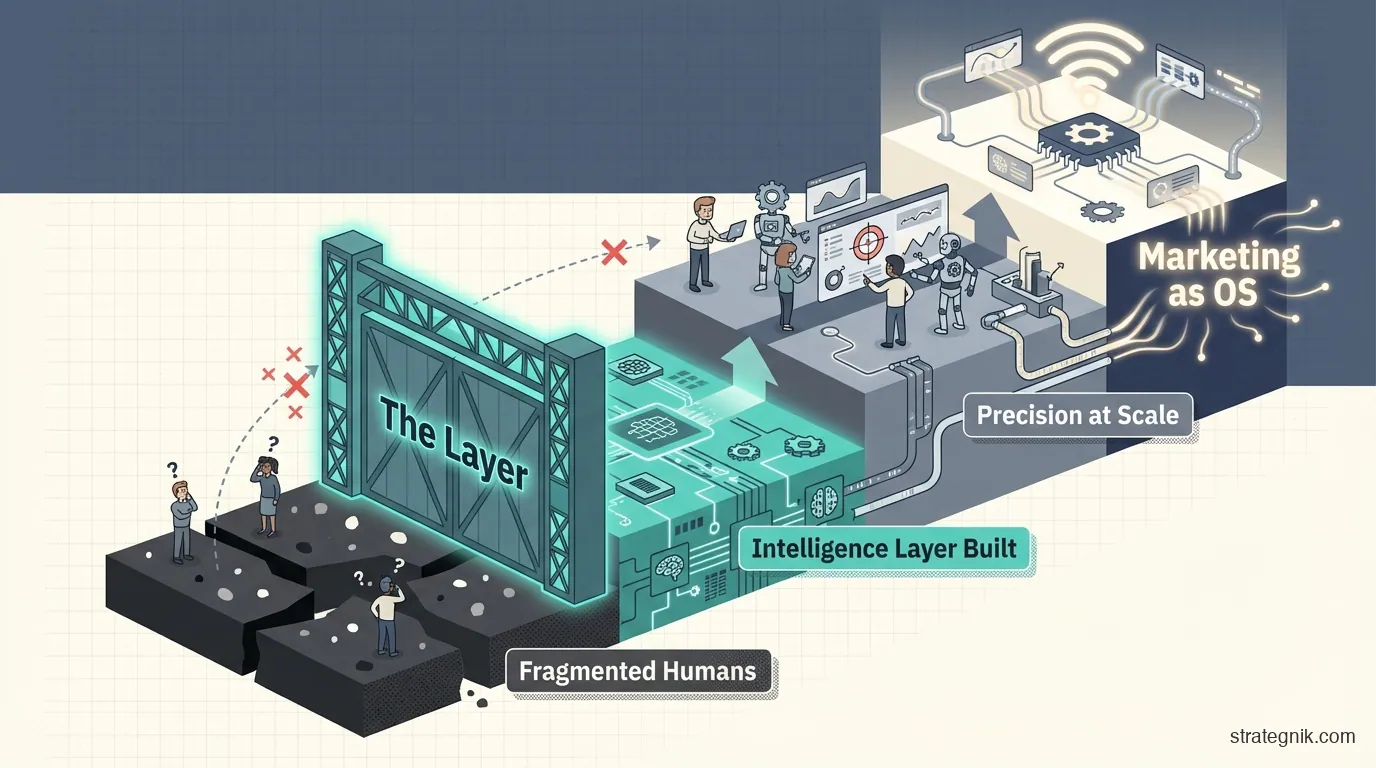
Marketing teams get from a single chatbot to a fleet of governed AI agents in five stages, and the jump succeeds or fails on one prerequisite: a shared, machine-readable operating context that every agent works from. Teams that build that context layer first compound with each stage; teams that skip it scale confusion faster.
The question I hear most from CEOs isn’t “Should we use AI in marketing?” That argument is over. The question is: “My team has AI tools and nothing feels different. What are we doing wrong?”
The answer, almost every time, is that they skipped a stage. They went from fragmented human teams directly to AI prompting without building the operating context (what context engineering actually means) that makes AI useful. It’s the equivalent of hiring 15 interns, giving them no onboarding, no brand knowledge, no understanding of the customer, and expecting them to run your go-to-market. Speed without context is just faster confusion.
There are five stages of AI marketing maturity. Most companies are stuck at stage one. The gate between stage one and everything after is the Context Layer. Here’s what each stage looks like, what becomes possible at each one, and how the transition actually works.
What Is an AI Agent Fleet?
An AI agent fleet is a set of autonomous AI agents that execute marketing work (content production, SEO maintenance, nurture sequences, competitive response) from a single shared operating context, under a governance model that defines what each agent may do without human approval. What separates a fleet from a pile of AI tools: the agents act rather than wait to be prompted, and they draw on the same encoded context instead of whatever a person pasted into the chat window.
Most teams that say they run agents are actually running disconnected chat sessions, a pattern I’ve broken down in your AI is still a chatbot. A chatbot answers when asked. An agent initiates within its guardrails. A fleet is many agents initiating from one context without contradicting each other. That coherence is a property of the context, not the agents.
The Five Stages at a Glance
The shape of the whole progression, before the depth:
| Stage | Capability | What breaks | Prerequisite to advance |
|---|---|---|---|
| 1. Fragmented humans | Siloed teams plus ad-hoc AI prompting | Brand consistency; every prompt starts from zero | Commit to building shared context before buying more tools |
| 2. Context Layer built | One machine-readable source of truth for brand, ICP, competitive framing, measurement | Nothing yet; the layer is inert until connected | Wire AI tools and first agents into the layer |
| 3. Humans + AI from shared context | Consistent output at scale; team prompts from one context | Throughput ceiling, because humans still initiate everything | Prove agents can run routine work inside guardrails |
| 4. Agents run routine work | Content, SEO updates, and nurture run autonomously | Judgment boundaries; escalation rules get stress-tested | Governance zones mature from approve-first to autonomy |
| 5. Proactive agents | Signal-driven deployment; humans govern strategy | Staleness, if the feedback loop stops updating the context | Ongoing signal review keeps the layer current |
Stage 1: Fragmented Humans
Who does the work: All humans, all silos. Strategy is briefed to five-plus teams independently. Handoffs dilute everything.
What’s possible: Inconsistent market presence. The buyer encounters five different companies. Brand dilutes. Pipeline slows. This is where most B2B marketing teams live today, not because the people are bad but because the architecture forces degradation at every handoff.
What AI does at this stage: Makes it worse. AI amplifies output, not quality. More content produced faster from a fragmented system means more fragmented content at higher velocity. Every agent prompt starts from zero: no brand memory, no ICP knowledge, no competitive framing.
The physics: Maximum friction. Every handoff between teams introduces resistance. Every piece of content that contradicts the last one erodes brand mass. The system is burning energy to maintain itself rather than building momentum. Adding AI at this stage is like adding a bigger engine to a car with the parking brake on.
The signal you’re here: Your team is using AI tools but the output still requires heavy human editing. Your brand voice sounds different in every channel. Your CRM data wouldn’t survive a trust audit. The CEO can’t tell whether the AI investment is producing results because there’s no measurement framework connected to revenue.
Stage 2: Context Layer Built
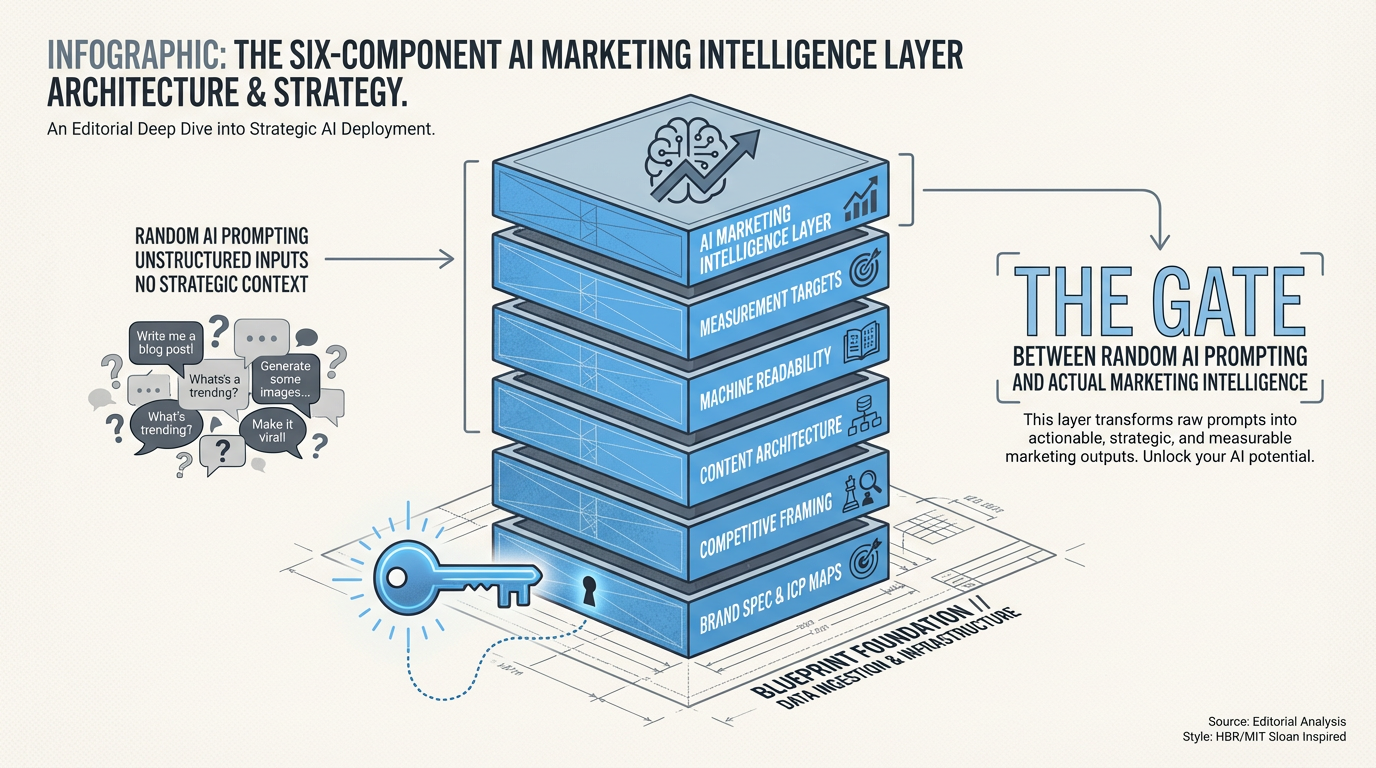
Who does the work: The Context Layer is installed. All six components — brand spec, ICP maps, competitive framing, content architecture, machine readability and distribution schema, and measurement targets — are encoded in machine-readable format.
What’s possible: Shared operating context. All teams pull from one source. Messaging becomes consistent. Brand becomes coherent. AI tools can now be wired into the Context Layer and produce output that actually sounds like your company, targets the right audience, and reinforces your market position. And every piece of content ships with structured data and entity definitions that make it citable by LLMs from day one.
What this engagement looks like: A 30 to 90 day sprint. Diagnostic first: score each of the six components, quantify the execution tax (hours spent on manual work, cost per output, signal-to-response latency), and map the gaps. Then build: encode the brand spec, the ICP hierarchy, the competitive framing, the content architecture, the machine readability schema, and the measurement framework. Deliver the Context Layer, train the team, hand off.
The physics: This is where friction drops dramatically. A shared operating context eliminates the handoff degradation that was eating every piece of strategy before it reached the market. The car’s parking brake comes off. Now when you add engine power, the vehicle actually moves.
The signal you’re ready: Your CEO is asking “what does AI-native marketing actually look like?” Your CMO knows something needs to change but can’t articulate the architecture. You’re about to make a marketing hire and wondering whether the money would be better spent on infrastructure.
Stages 3–4: Humans + AI + Agents
Who does the work: Teams prompt AI from the shared context. Agents begin running content production, SEO updates, and nurture sequences autonomously from the layer. Humans steer strategy, not output.
What’s possible: Precision at scale. Content scales because agents generate from a complete context — brand voice, ICP targeting, competitive positioning, keyword strategy — without someone rebuilding that context in every prompt. Campaigns launch faster because signals trigger deployment, not calendar planning. Personalization becomes realistic because the field holds the per-segment and per-account context that personalization requires. A small team competes with organizations ten times their size.
What changes in the org: This is where role definitions shift. Campaign managers become system designers. Content producers become content architects overseeing an agent fleet. Channel owners become experience governors. The team gets smaller, but the output multiplies. Not because people were replaced, but because the work they were doing manually is now handled by agents operating from shared context.
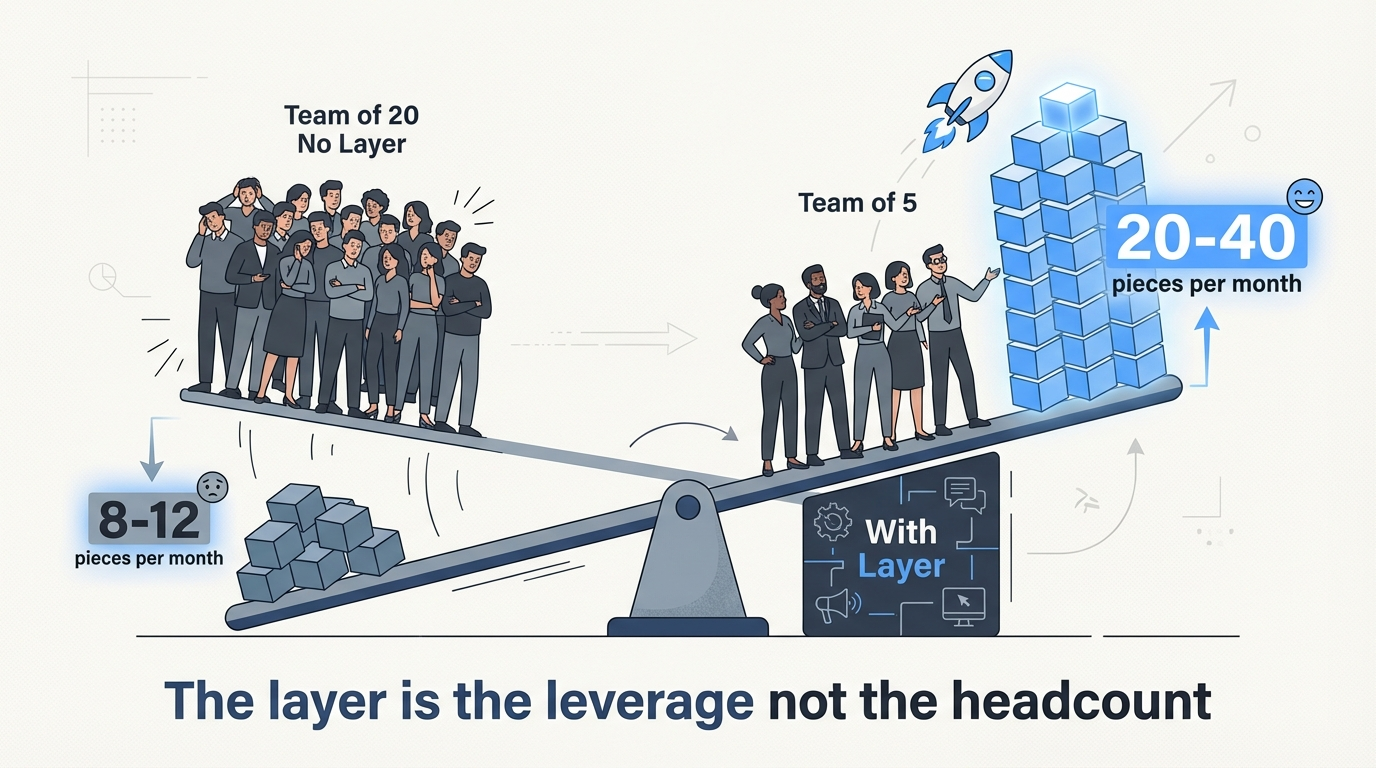
The scale economics: A team of 20 without the Context Layer produces 8-12 pieces of content per month with a 3-4 week campaign launch cycle. A team of 5 with the Context Layer produces 20-40 pieces per month with a 3-5 day launch cycle. Competitive response time drops from 2-4 weeks to same-day. Brand consistency shifts from variable — depending on who wrote it and when — to structural, enforced at creation. The Context Layer typically reaches ROI within 60-90 days of deployment. SaaStr research documents AI-native B2B companies running eight-figure businesses with 3 human employees and 20+ AI agents. The Context Layer is the operating context that makes that ratio possible.
The governance model: When agents run content production and campaign execution autonomously, the organization needs clear boundaries. The field defines three zones: full autonomy (agent acts, reports after — bid adjustments, schema updates, internal analysis), propose and approve (agent drafts, human approves — new content, campaign launches, competitive response), and human only (agent does not act — positioning changes, pricing decisions, public statements). These zones evolve as the organization matures. At stage 3, most actions are propose-and-approve. By stage 4, many move to full autonomy as confidence in the field’s constraints grows.
The physics: Momentum starts compounding. Every piece of content produced from the field reinforces brand coherence. Every signal-driven campaign generates data that feeds back into the field. Every month the system runs, it gets sharper. This is the stage where the feedback loop kicks in: the field isn’t static, it compounds. And like all compounding systems, the advantage accelerates over time.
What this engagement looks like: An ongoing advisor retainer. Monthly signal review: What ranked? What converted? What messaging missed the mark? What shifted in the competitive landscape? The field updates. New context pushes to all connected agents and tools. The cycle repeats. The field doesn’t go stale because the retainer is the update cycle.
Stage 5: Proactive Agents
Who does the work: Agents detect signals and deploy autonomously. Humans govern strategy, not output.
What’s possible: Marketing as infrastructure. The system runs, compounds, and scales with minimal headcount. A product usage signal fires, and the agent triggers a nurture sequence tailored to that user’s segment, in the brand’s voice, referencing the competitive alternative that segment typically evaluates. No human initiated it. No human reviewed it. The guardrails are in the field. The governance framework defines what’s autonomous, what requires human approval, and what escalates.
The physics: This is escape velocity. The system has enough momentum, enough mass, and low enough friction that it sustains and accelerates without proportional human input. Very few companies are here today. But the ones that get here first will have a structural advantage that’s extremely difficult to replicate, because the field compounds, and a 12-month head start in a compounding system is nearly insurmountable.
What real-time response looks like: Tuesday morning, a competitor launches a feature that challenges your primary differentiation. Without the field, the response takes 2-4 weeks: someone notices, a Slack thread starts, the CMO reviews, content rewrites, demand gen adjusts messaging, web updates landing pages. By the time the response reaches the market, the competitor’s narrative has set. With the field, the CMO updates the competitive framing input in one place. Changes propagate: website comparison page updates, ad copy variants regenerate, email nurture adjusts messaging, agent prompts reflect the new framing. By end of day, the market-facing response is live across all channels. Change it once, and it changes everywhere.
Who owns this stage: The internal team. Strategnik may advise on governance, but the system is self-sustaining. That’s the point.
What Makes an Agent Fleet Coherent?
Governed context. That is nearly the whole answer.
Each agent in a fleet touches a different surface. One drafts content. One maintains search presence, the pattern I’ve detailed in AI agents for SEO. One runs nurture. If each carries its own private version of the brand, the ICP, and the positioning, they optimize locally and drift apart, and the buyer meets a company that disagrees with itself at machine speed. That is stage 1 fragmentation rebuilt in software.
Shared context fixes the disagreement. Governance makes it durable: the layer has an owner, changes are deliberate, and updates propagate to every connected agent at once. Without governance you get a shared document that slowly rots; with it you get an operating context the fleet can be trusted against. The full architecture, including which agents to deploy first, is laid out in AI agents for marketing.
Why Can’t You Skip Stage 2?
This is the most important point in the entire maturity model: you cannot reach stage 3 or beyond without stage 2. The field is the gate.
Companies try to skip it constantly. They buy an AI writing tool and point it at their website. They wire up an agent to their CRM without encoding what a good lead looks like. They deploy content automation without a brand spec. The result is always the same: fast output, wrong direction. The agent is productive and confidently wrong, at scale.
Most companies experimenting with AI agents never manage to scale them, and that gap is almost entirely a stage 2 problem. The technology isn’t the bottleneck. The context is. The companies that can’t scale their AI experiments are the ones that never built the operating context those experiments need to succeed.
When Should a Marketing Team Move Beyond One Chatbot?
Later than most vendors imply, earlier than most skeptics assume. If your team’s AI usage today is individual sessions in a chat interface with results pasted into docs, the pattern most teams fall into with ChatGPT for marketing, you are at stage 1, and the next move is not an agent. It’s the context layer. Buying orchestration software before encoding brand, ICP, and competitive context just automates the inconsistency you already have.
The readiness test I use: could a new hire produce on-brand, on-ICP work in their first week using only your documented context, with no shoulder-tapping? If a human can’t, an agent can’t either. Once the answer is yes, moving beyond one chatbot is low-risk, because the thing that makes agents dangerous, confident output with no grounding, has been removed.
How Long Does the Transition Actually Take?
Here’s what surprises most CEOs: the Context Layer sprint is 30 to 90 days, not 12 months. It’s not a digital transformation initiative. It’s not an enterprise software deployment. It’s a focused build that takes the brand knowledge, market intelligence, competitive positioning, and measurement framework that already exist in your organization — scattered across people’s heads, old decks, CRM fields, and Slack threads — and encodes it into a machine-readable operating context.
The inputs already exist. They’re just not structured for agents to use. The sprint structures them.
After that, the progression from stage 2 to stage 3 happens naturally as teams start prompting from the shared context and seeing the difference. The progression from stage 3 to stage 4 happens as agents prove they can handle routine work within the guardrails. And stage 5 is the horizon: the thing you build toward, not the thing you buy.
Frequently Asked Questions
What is the difference between a chatbot and an AI agent?
A chatbot responds when a human prompts it and holds no knowledge of your business beyond the conversation. An agent acts on its own within defined boundaries: it detects a signal, executes a task, and reports back. The difference is initiative plus context. If a human has to start every task and paste in the background every time, you have a chatbot with a fancier name.
How many AI agents does a marketing team need?
Fewer than the fleet framing suggests. Start with routine, high-volume work that has clear success criteria: content drafts from the encoded brand spec, SEO maintenance, nurture sequencing. That is typically two or three agents. Add more only after agents have proven they escalate correctly and their output survives review. The count matters far less than whether every agent reads from the same context layer.
Can a small marketing team run an AI agent fleet?
Yes, and small teams are structurally better positioned to. They carry less organizational friction and fewer silos contradicting each other. The stage 3 and 4 economics above describe a team of five outproducing a team of twenty, and the mechanism is the Context Layer, not headcount. The real constraint for a small team is discipline: someone still has to own the context and keep it current.
Do AI agents replace marketers?
They replace tasks, and in doing so they change roles. In this maturity model, campaign managers become system designers and content producers become architects overseeing agent output. Judgment work, meaning positioning, pricing, and strategy, stays human at every stage, including stage 5. Teams do get smaller as agents absorb routine execution; the people who remain operate the system rather than perform the tasks.
Where Do You Stand?
Your marketing function will operate this way eventually. The open question is whether you build the foundation now or scramble to catch up later. The diagnostic tells you where you stand.