The best AI SEO tools in 2026 fall into four working categories: content optimization and drafting, keyword research and clustering, technical SEO assists, and the emerging class of AI agents that execute SEO tasks end to end. No single tool covers all four, and the vendors claiming otherwise are selling a content generator with extra dashboards.
There is also a boundary problem worth naming up front. If your actual goal is showing up in ChatGPT and Perplexity answers, that is GEO tooling, a different category with different buyers, covered separately in the best GEO and AEO tools. This post is about AI applied to traditional SEO: ranking pages in search results that still drive most B2B pipeline.
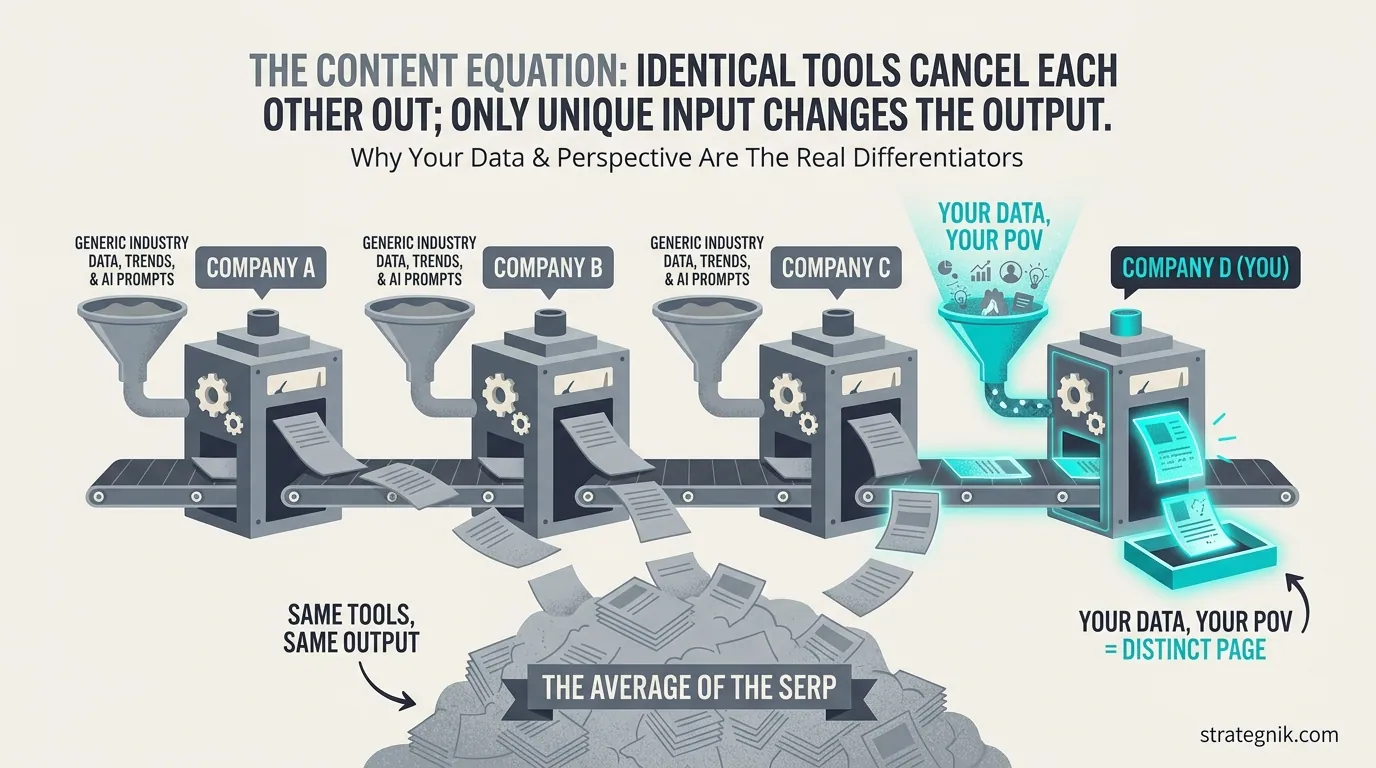
One idea threads everything below. AI SEO tools compress execution time, and that compression is real. But every one of them optimizes against the same models of the same SERPs. When the whole market runs the same optimization math, tool-generated output converges on sameness. Your differentiation has to come from positioning, proprietary data, and an actual point of view. No tool supplies those.
AI Content Optimization and Drafting Tools
This is the biggest and most crowded category, and the one where honest expectations matter most.
Surfer scores content against the pages currently ranking for a target term and guides structure, terms, and coverage. Clearscope does similar work with an emphasis on topical completeness and readability. Frase combines SERP-based briefs with drafting assistance. Jasper sits closer to the pure generation end: a writing platform with SEO workflows layered on, aimed at marketing teams producing at volume.
Here is the honest take. These tools optimize for a correlation model of what ranks. They look at pages that currently perform and infer the shared characteristics: terms used, questions answered, headings covered. That is genuinely useful for coverage. It catches the gaps a subject-matter expert leaves because the answer feels obvious to them.
It is dangerous as autopilot. A correlation model cannot tell you whether a page deserves to exist, whether your take differs from the ten pages it was scored against, or whether the resulting draft says anything a buyer would remember. Teams that let the score drive the writing produce content that reads like the average of the current SERP. The average of the SERP does not win the SERP, and it definitely does not win a buyer.
Use these tools to check coverage on drafts written by someone with an opinion. Do not use them to generate the opinion.
AI Keyword Research and Clustering Tools
Keyword research is where AI features have quietly become table stakes inside the established suites.
Semrush and Ahrefs have both folded AI into their core research workflows: intent classification, topic grouping, and assistance layered onto keyword databases that were already the reason to pay for them. If your team lives in one of these suites, the AI features are an upgrade to workflows you already run, not a new purchase decision.
Keyword Insights is the notable specialist. Its job is clustering: taking a large keyword export and grouping terms by whether they can be served by the same page, based on SERP overlap rather than string similarity. That distinction matters. Two keywords that look related can demand separate pages, and two that look unrelated can be the same intent. Clustering by live SERP behavior is the right method, and doing it manually at scale is miserable.
The limit of the category is that keyword tools describe demand that already exists and is already visible to every competitor running the same export. They will not find the problem your ICP describes in language no keyword database has indexed yet. That comes from sales calls, win-loss interviews, and support tickets. The best keyword strategy I have seen in B2B SaaS starts with what buyers actually say and uses the tools to size and validate it, not the reverse.
Can AI Actually Do Technical SEO?
Partially, and the partial version is worth having.
Screaming Frog remains the crawler of record, and its export-heavy workflow pairs unusually well with LLMs. Crawl exports fed into an LLM workflow can triage issues, draft redirect maps, and turn a wall of status codes into a prioritized fix list in a fraction of the old time. Screaming Frog has also added its own AI-adjacent features for working with page content at crawl time. Sitebulb approaches the same territory with built-in prioritization and explanations, which makes it friendlier for teams without a dedicated technical SEO.
The compression here is real and mostly safe, because technical SEO has right answers. A broken canonical is broken. The risk profile is different from content: an LLM misjudging issue priority wastes time, but it does not publish sameness to your domain.
What AI assists still cannot do is decide architecture. Whether your site should have twelve service pages or four, whether a content hub belongs at the subdomain or the subfolder, how LLM SEO considerations should shape your markup and structure so machines parse your business correctly. Those are judgment calls with tradeoffs, and the crawler just reports what it finds.
What About AI Agents That Do SEO End to End?
This is the emerging category, and the one changing fastest. Instead of a tool that assists a human task, agents chain the tasks: research a topic, draft the page, build internal links, monitor the result, propose the next move.
The capability is arriving faster than most teams’ judgment about where to apply it. Agents are legitimately good at bounded, verifiable work: crawl triage, internal linking passes, metadata cleanup, refresh candidates. They are a liability when handed open-ended editorial authority, for exactly the convergence reason above, now at higher volume and lower supervision.
This category deserves its own treatment, and it gets one in AI agents for SEO, published alongside this post. The short version: agents amplify whatever system they are dropped into. A coherent strategy gets executed faster. An incoherent one produces mediocrity at scale.
If the Goal Is AI Visibility, You Are in the Wrong Aisle
A growing share of people searching for AI SEO tools actually want something else: visibility inside AI-generated answers. Citation monitoring in ChatGPT and Perplexity, entity and schema infrastructure, AI Overview tracking.
That is GEO and AEO tooling. Different tools, different vendors, different work. The categories above will not tell you whether ChatGPT cites you, and a citation-monitoring dashboard will not fix a page that cannot rank. If AI-answer visibility is the goal, start with the GEO and AEO tools roundup instead. Most B2B teams eventually need both, but buying one while needing the other is the most common tooling mistake I see right now.
How to Choose, By Team Situation
Solo marketer or small team producing content in-house. One content optimization tool plus the AI features inside a suite you already pay for. Skip agents until your strategy is stable enough to be worth accelerating.
Content team of three or more shipping weekly. Add clustering. At this volume, cannibalization and page-mapping mistakes cost more than the tool does, and SERP-based clustering prevents both.
Team with real technical debt. Crawler plus LLM triage before anything else. Fixing crawl and indexation problems usually outperforms another optimized post, and it is the cheapest win in this entire post.
Team already ranking, worried about AI search. Your bottleneck is not in this article. Go to the GEO roundup.
Team with budget and no strategy. Do not buy anything yet. Every tool here assumes someone has already decided what you should rank for and why a buyer should pick you. Tools execute decisions. They do not make them.
The Part No Tool Sells
Run the thought experiment: you and your three closest competitors all buy the same optimizer, the same clustering tool, the same agent framework. Everyone’s execution speeds up. Nobody’s position improves, because you are all optimizing against the same models of the same results with the same inputs. The tools cancel out.
What does not cancel out is the input only you have. Your positioning, your customer data, the argument your founder can make that competitors cannot. Tool-assisted content built on a distinct point of view compounds. Tool-generated content built on SERP averages fills a sitemap.
That is the difference between buying tools and having someone architect the system the tools plug into: what to rank for, what to say that nobody else can, and how content, structure, and authority reinforce each other. If the stack keeps growing while results stay flat, the gap is architecture, and that is the case for working with an AI SEO agency that builds the system rather than reselling the dashboards.
Frequently Asked Questions
What is the best AI tool for SEO? There is no single best AI SEO tool because the category spans four jobs. Surfer and Clearscope lead content optimization, Keyword Insights leads clustering, Screaming Frog with LLM workflows leads technical triage, and agents are too new to have a durable leader.
Do AI SEO tools actually work? Yes, for compressing execution: briefs, clustering, and crawl triage all get meaningfully faster. They do not work as a substitute for strategy, because every buyer of the same tool gets the same recommendations.
Will AI-generated content rank? It can, when it carries real expertise and a distinct angle. Pure tool output tends to converge on what already ranks, which makes it easy to publish and hard to prefer.