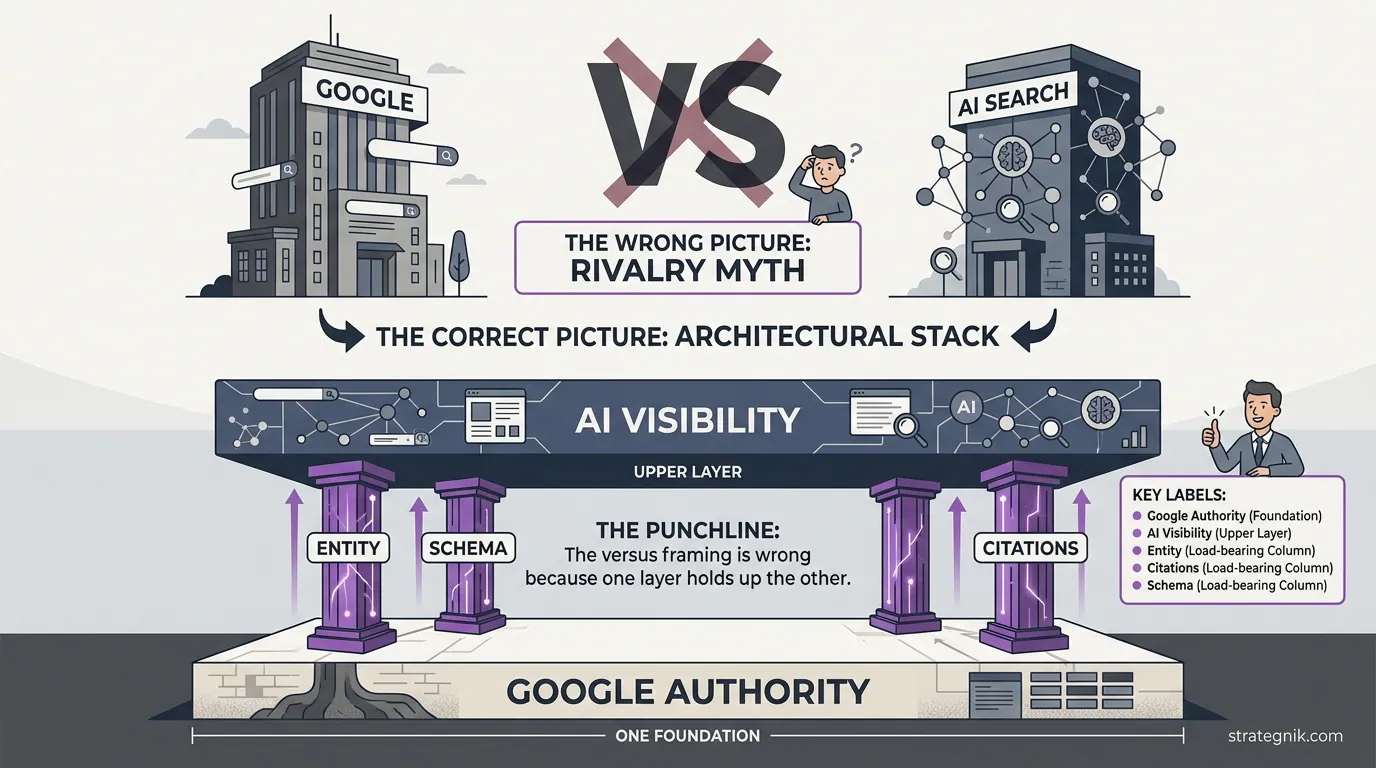
You don’t choose between ChatGPT and Google. Your Google authority is one of the primary inputs to your AI visibility, because retrieval-augmented engines pull heavily from sources that already rank, which means the real decision is how to layer the two, not which one to abandon.
That framing matters because most B2B marketing leaders are being pitched a channel switch right now. Some agency is telling them SEO is dead and AEO is the future, and some SEO shop is telling them ChatGPT is a fad. Both pitches are wrong, and both are wrong in ways that will cost you pipeline.
How Does ChatGPT Search Work Differently From Google?
The mechanical differences are bigger than most marketers realize. Google is a ranking system: it crawls pages, scores them, and hands the user a list to evaluate. ChatGPT is a synthesis system: it retrieves sources (via Bing’s index, when it searches the live web), reads them, and composes a single answer with a handful of citations.
| ChatGPT | ||
|---|---|---|
| Output | Ranked list of pages | One synthesized answer |
| Visibility model | Positions 1–10, page two exists | Cited or invisible |
| Query shape | Keyword strings (“freight audit software”) | Full questions (“which freight audit platform handles LTL?”) |
| Live index | Google’s own crawl | Bing’s index, plus model training data |
| What wins | Rankings, backlinks, on-page optimization | Entity recognition, citation consensus, retrievable structure |
| Failure mode | You rank on page three | You don’t exist in the answer |
Two of these rows deserve emphasis. First, “cited or invisible” is a genuinely different game than ranking. In Google, position seven still gets some clicks. In ChatGPT, there is no position seven. The answer names three vendors or it doesn’t name you.
Second, query shape has already changed. I can see it in my own Search Console data: the queries reaching this site are increasingly full sentences, things like “we rank well on google but are invisible in chatgpt, why.” People have learned to talk to search like they talk to a colleague, and that habit is bleeding backward into Google itself. If you’re curious what the machines currently say about you, run a structured check on what ChatGPT says about your brand before you plan anything.
How Is Buyer Behavior Different in ChatGPT?
The behavioral shift matters more than the mechanical one. Google search behavior is iterative: a buyer researching a category runs a query, scans results, refines, runs another. Over a few weeks that might be fifteen searches across vendors, comparisons, pricing, and reviews.
In ChatGPT, that same research collapses. The buyer asks for the landscape, asks for a comparison against their specific constraints, asks for the shortlist. Three turns. I call this research compression, and to be clear, that’s my framing and my field observation, not a published statistic. But the direction is unmistakable when you watch buyers work.
The zero-click era softened us up for this. SparkToro’s research found that for every 1,000 US Google searches, only 374 clicks reach the open web. Google already trained buyers to take the answer and move on. ChatGPT just finishes the job. And Gartner projects traditional search engine volume will drop 25% by 2026 as buyers shift research to AI assistants.
For a B2B marketer, compression has a brutal implication. Fifteen searches gave you fifteen chances to intercept the buyer: a comparison page here, a retargeting pixel there, a gated asset somewhere in the middle. Three turns give you three chances, and you’re not present for any of them unless the model cites you.
Which Channel Owns Which Stage of the Funnel?
AI engines are eating the top of the funnel first. Early-stage category research, “what kinds of tools solve this problem,” “what should I look for in a vendor,” “who are the main players,” is exactly the kind of open-ended synthesis question ChatGPT is good at and Google’s ten blue links are clumsy at.
That’s where shortlists form. By the time a buyer types a vendor name into Google, the consideration set is mostly locked. If the AI answer that shaped the shortlist didn’t include you, you never see the demand. No impression, no click, no signal in your analytics. The deal you lost never shows up as a lost deal.
Google still owns the later stages, for now. Branded searches, pricing lookups, documentation, “vendor X vs vendor Y” comparisons where the buyer already knows the names: those still route through traditional search, and they still convert. Which is exactly why abandoning SEO to chase AI visibility is as wrong as ignoring AI entirely.
The uncomfortable case is the company that ranks well and gets ignored anyway. The correlation between Google rankings and AI citations is real but weak, and I’ve written about why you can rank on Google and still be invisible in ChatGPT, because the causes are specific and fixable.
What Stays the Same Across Both Channels?
Less changes than the panic suggests. Both systems are trying to solve the same problem: surface the most trustworthy answer to a human question. So the durable assets are identical.
Real expertise still wins. Original research, named frameworks, and opinions specific enough to be wrong are what earn backlinks in Google and citations in ChatGPT. Authority still compounds: a brand that other credible sources reference gets rewarded by both the link graph and the citation graph. And quality still filters: thin, generic content performs badly in Google and gets skipped entirely by retrieval systems.
In Coherence Model terms, both channels are measuring the same Gravity, the pull your brand exerts without pushing. They just measure it with different instruments. Building mass serves both. Gaming either one serves neither for long.
Should You Optimize for ChatGPT or Google First?
Depends entirely on where you’re starting. Two situations cover most B2B companies I audit.
Strong SEO, no AI presence. You rank for your category terms but ChatGPT never names you. Don’t touch your content strategy first. Your problem is the entity and citation layer: missing Organization schema, inconsistent brand descriptions across LinkedIn, G2, and your own site, no presence in the comparison articles and community threads where models learn who belongs in an answer. This is retrofit work on top of an asset you already own, and it’s the highest-ROI move available to you. The mechanics are laid out on my LLM SEO services page.
Weak in both. Don’t build two programs. Build one foundation that serves both: answer-first content that leads with the conclusion, systematic schema markup, consistent entity signals everywhere your company appears, and one or two genuinely citable assets. Everything on that list improves Google rankings and AI retrievability simultaneously. Running separate “SEO content” and “AEO content” workstreams is how you end up mediocre at both.
What I’d push back on hardest is the budget-line framing, where ChatGPT becomes a new channel with its own agency and its own dashboard, bolted on next to paid search. The layered view is more accurate and cheaper: Google authority feeds AI visibility, entity work feeds both, and the fundamentals underneath haven’t moved. Treat answer engine optimization as an upgrade to your existing search program, not a parallel one.
Frequently Asked Questions
Is ChatGPT replacing Google for B2B buyers? Not replacing, redistributing. Early-stage category research and shortlist formation are moving to AI engines, while branded search, pricing lookups, and late-stage comparisons still run through Google. Gartner projects a 25% decline in traditional search volume, which is a major shift, not an extinction event. Plan for both channels with one foundation.
Should I stop investing in SEO to focus on AI visibility? No. Retrieval-augmented engines pull disproportionately from sources that already rank well, so dismantling your SEO program would undercut the AI visibility you’re trying to build. The right move is additive: keep the SEO baseline and layer entity, schema, and citation work on top of it.
How do I know if ChatGPT is already costing me pipeline? You mostly can’t see it in analytics, which is the problem. Buyers who never saw you in an AI answer never visit your site. The proxy test is direct: ask ChatGPT the questions your buyers ask, across multiple sessions and phrasings, and see whether you’re named. If competitors appear and you don’t, the shortlists forming right now don’t include you.
Does content that ranks in Google automatically get cited by ChatGPT? No. Ranking helps retrieval, but citation requires more: recognizable entity identity, answer-first structure the model can extract, and corroborating mentions across the sources where AI systems build consensus. Plenty of page-one content is never cited because it buries its answers or belongs to a brand the model can’t confidently identify.