AEO tracking tools measure how often AI assistants mention, cite, and describe your brand when buyers ask questions you care about. They work by running a fixed panel of prompts against ChatGPT, Perplexity, Gemini, and Google AI Overviews on a schedule, then comparing the answers over time.
That is the entire category. If you want a tool-by-tool review of the broader landscape, including schema, content optimization, and AI Overview rank tracking, read the full GEO and AEO tools roundup. This post covers the measurement layer specifically: what tracking captures, how it works mechanically, which metrics deserve a B2B marketing leader’s attention, and when paying for monitoring is premature.
The short version of the point of view: tracking tools measure progress. They do not create it.
What Does AI Visibility Tracking Actually Measure?
Four things, and it helps to keep them separate because vendors bundle them differently.
Share of voice in AI answers. For a defined set of prompts, how often does your brand appear in the response? If a buyer asks an assistant for freight audit software and you show up in six of ten runs while a competitor shows up in nine, that gap is your share-of-voice problem stated plainly.
Citation tracking. Which URLs get cited when your brand appears, and whose pages are they? Sometimes the answer cites your own site. More often it cites third-party pages: review sites, industry publications, community threads. Knowing which sources power your mentions tells you which sources to protect and which to cultivate.
Sentiment and accuracy. How does the model describe you? An assistant can mention you and still misstate your category, your pricing model, or who you serve. A mention that positions you wrong can cost you the shortlist as surely as absence does.
Competitor benchmarking. The same prompt panel, run for your competitors. This turns raw mention counts into relative position, which is the only frame that matters in a competitive evaluation.
How Do AEO Tracking Tools Work Under the Hood?
Every tool in this category runs the same basic loop. Define a prompt set, query the answer engines on a schedule, parse the responses for brand mentions and citations, and diff the results against previous runs.
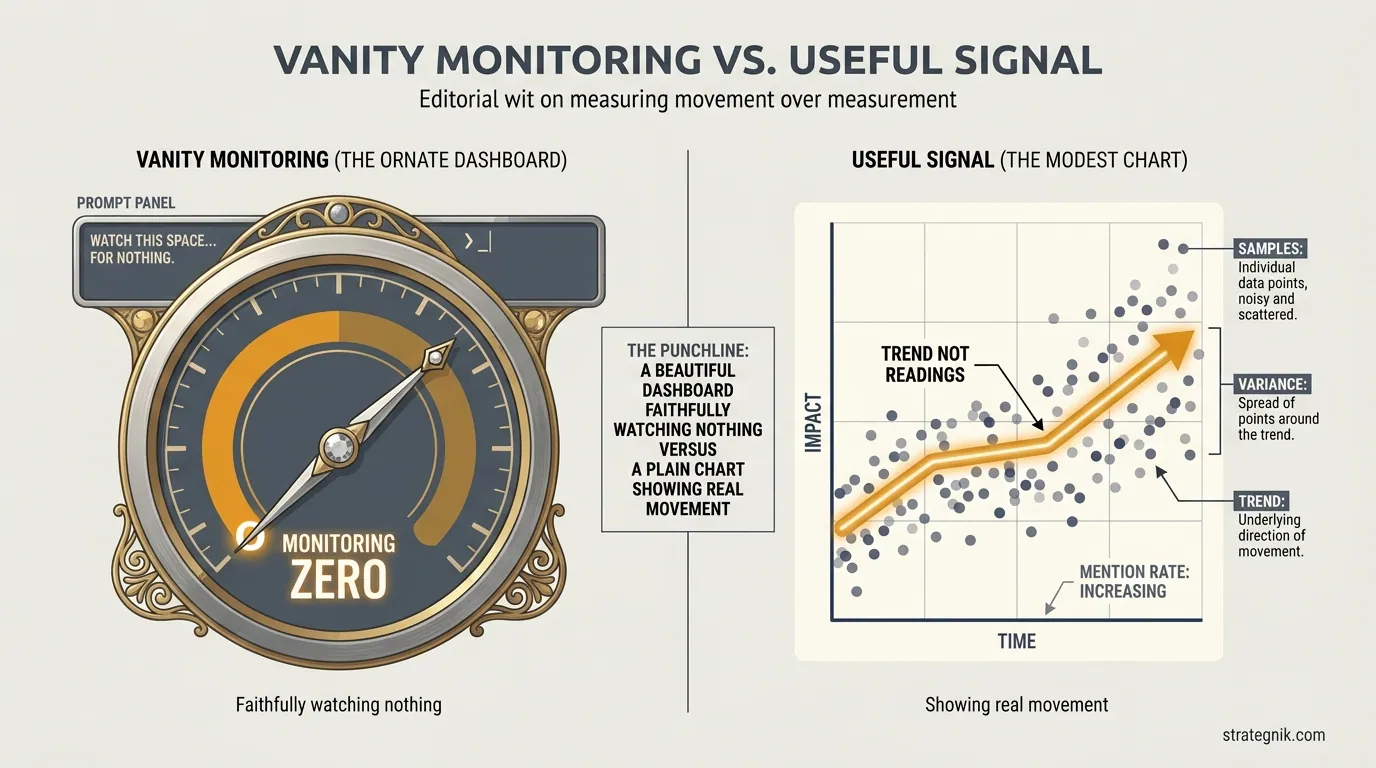
Understanding that mechanism changes how you should read the output. AI answers are generated fresh each time, so the same prompt can produce different responses hour to hour. What a tracking dashboard shows you is a probabilistic sample, not a ranking.
There is no “position 3” in ChatGPT. There is only a mention rate across repeated runs. Expect variance between readings, and treat any single data point with suspicion. The signal lives in trends: mention rate climbing over six weeks, a competitor’s citation source dropping out, your description shifting after a site update.
Teams that miss this end up chasing noise. One bad weekly reading triggers a fire drill, and one good one gets screenshotted for the board. Both are the wrong response to a sampled measurement.
The other implication: the prompt panel is the product. A tool tracking fifty generic category prompts will produce clean charts about questions your buyers never ask. Before evaluating any vendor, write the fifteen prompts your actual evaluators would type into an assistant, because those are the only prompts whose answers you should pay to watch.
Which Metrics Matter for a B2B Team?
Most dashboards will show you more numbers than you need. Three matter.
Mention rate on buyer-intent prompts. Not “what is [category]” prompts. Prompts a real evaluator would ask: best tools for a use case, alternatives to an incumbent, comparisons between named vendors. Visibility on definitional prompts is nice. Visibility on shortlist prompts is pipeline.
Presence in shortlist answers. When an assistant produces a “top options” style response for your category, are you in it? These answers function like an analyst shortlist that regenerates on every query. Being consistently absent from them means the model does not consider you a default option, whatever your actual market position.
Cited-source overlap with competitors. Look at which sources power competitor mentions on prompts where you are absent. If three review sites and one industry publication keep feeding their visibility and you appear on none of them, that list of sources is your earn-list. This is the single most actionable output a tracking tool produces, because it converts a visibility gap into a concrete outreach and content plan.
Which Tools Do the Tracking?
Category-level guidance here, since the roundup linked above covers the landscape in more depth.
Profound sits at the enterprise tier: citation monitoring across generative answer surfaces, built for brands with the demand footprint to justify it.
Otterly.AI and Peec AI are mid-market AI visibility trackers, built around prompt-based monitoring of where your brand and competitors appear in AI answers.
Semrush has added AI visibility features to its broader suite, which is the shortest path for teams already living in its dashboards.
Pick based on where your reporting already happens and how much prompt-panel customization you need. The underlying tracking mechanics are broadly similar across the tier.
Should You Buy a Tracking Tool Before You Have Visibility?
Usually not, and this is where most teams get the sequence backwards.
Run a free audit first. You can do it manually in an afternoon: write ten buyer-intent prompts, run each several times across two or three assistants, and record mentions, citations, and descriptions. The full method is in how to check what ChatGPT says about your brand. Or use Strategnik’s free AI Visibility Grader, which runs the structured version for you.
The audit tells you which situation you are in. If your mention rate is meaningfully above zero, monitoring makes sense. You have a baseline worth defending and trends worth watching. If your mention rate is zero, a dashboard will faithfully report zero every week while charging you for the privilege.
Zero-visibility companies do not have a measurement problem. They have an answer engine optimization problem: thin entity signals, no credible third-party citations, content that never answers the questions buyers actually ask assistants. That work has to happen first. Then tracking earns its keep by telling you whether the work is landing.
Sequence it this way: audit free, fix the visibility gaps, buy monitoring when there is movement worth measuring.
Frequently Asked Questions
How do I track AI search visibility for free? Build a fixed prompt panel of ten to fifteen buyer-intent questions, run each prompt several times across ChatGPT, Perplexity, and Gemini, and log mentions, cited URLs, and how you are described. Repeat monthly with the same panel so results stay comparable. The consistency of the panel matters more than its size.
What is a good AI mention rate? There is no universal benchmark, and anyone quoting one is guessing. The useful comparisons are relative: your rate versus named competitors on the same prompts, and your rate this month versus last. Direction and gaps beat absolute numbers.
Why do my AI visibility numbers change between runs? Because answers are generated fresh each time rather than retrieved from a fixed index. Tracking tools sample a moving target. Variance between individual runs is normal, and only sustained movement across multiple readings should change your decisions.