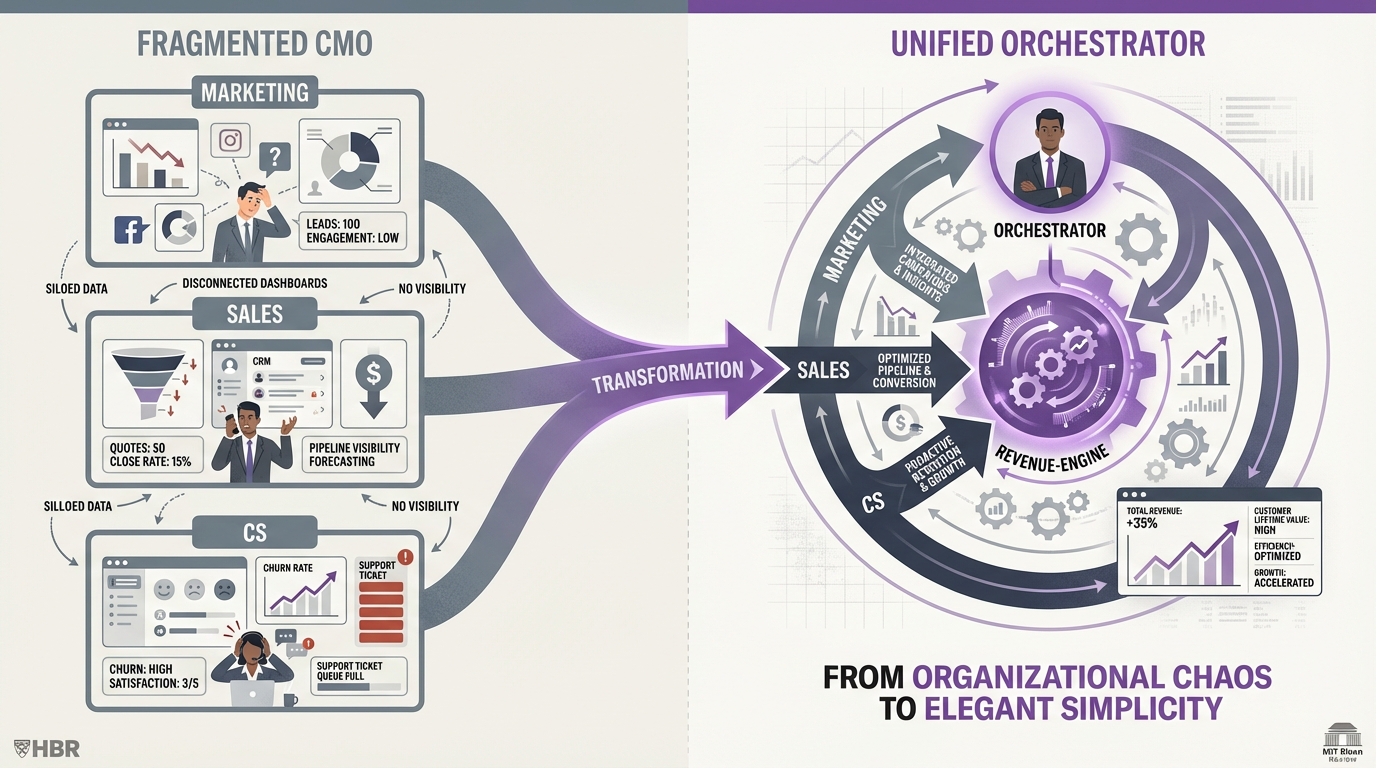
The CMO title is vanishing from org charts. But the mandate it represents — orchestrating how a company creates and captures value — has never been more critical. The leaders who see this aren’t hiding. They’re rewriting the job.
Forrester says B2B CMO representation has dropped from 48% to 42%. Spencer Stuart says average tenure has ticked up to 4.3 years. Gartner says budgets are flat at 7.7% of revenue while the scope keeps expanding. McKinsey says 70% of CEOs judge marketing on revenue growth, but only 35% of CMOs even track it as a primary metric.
Read those four data points together and a picture forms. It’s not a picture of a role dying. It’s a picture of a role that has outgrown its container.
The traditional CMO — the one who owns brand, demand gen, maybe product marketing, and reports up through a structure designed in the pre-internet era — that person is increasingly irrelevant. Not because the work doesn’t matter. Because the work has expanded so far beyond “marketing” that the title itself has become a constraint.
What’s replacing it is something more interesting: a leader who orchestrates the entire go-to-market motion. Across functions. Across humans and machines. Across the full customer lifecycle.
I’ve started calling this the Chief Marketing Orchestrator. Not because the title matters (it doesn’t) but because the shift in orientation does.
The Container Broke
Here’s what happened. The buyer’s journey collapsed. Not “evolved.” Collapsed.
The old model (marketing generates an MQL, hands it to sales, sales closes, CS retains) assumed that each stage was separable. That a lead could be manufactured in one department, processed in another, and maintained in a third, like stations on an assembly line.
That model worked when information was expensive and asymmetric. Marketing knew the market. Sales knew the buyer. CS knew the product experience. The walls between them existed because no single function could see the whole field.
AI is closing that information gap. Intent data, conversational intelligence, product usage signals, customer health scores: all of it is increasingly available to everyone, in real time, through unified data layers. When the reason for the walls disappears, the walls become drag. I’ve written about this before and the thesis keeps getting stronger.
But here’s what I didn’t fully explore in that piece: if you tear down the walls, someone has to orchestrate what replaces them. The unified field doesn’t manage itself.
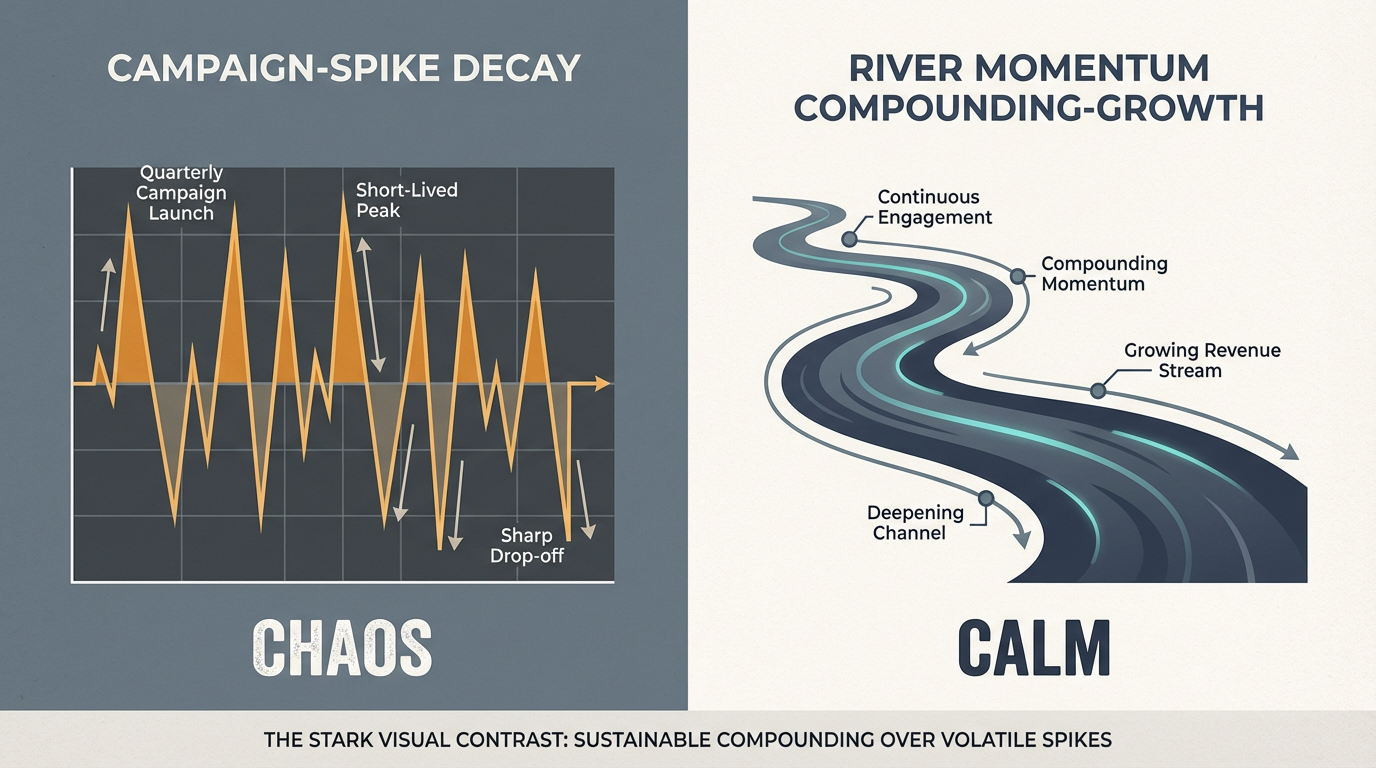
From Campaign Spikes to Rivers of Impact
The traditional marketing operating model is built around campaigns. Launch a campaign. Measure the spike. Report results. Rinse, repeat.
The problem with campaigns is that they produce spikes: episodic surges in traffic, leads, or pipeline that create feast-or-famine cycles for the entire revenue team. The sales team staffs for the spike, then starves between them. The CFO can’t forecast because the pipeline signal is noisy. Marketing gets addicted to the next launch because last quarter’s campaign already decayed.
The Chief Marketing Orchestrator replaces campaign spikes with something more like rivers: continuous, compounding flows of pipeline and revenue that are predictable, measurable, and sustainable.
This is an operating model shift.
It looks like:
Intent data that triggers action automatically. When an account shows buying signals (visiting pricing pages, engaging with competitive content, researching your category), AI-powered orchestration tools trigger personalized outreach without waiting for a marketing-to-sales handoff. The river flows because the system is always reading the signal.
Continuous feedback loops from the field. Win/loss data and conversational intelligence feed back into messaging, positioning, and battlecards in near-real time. Not quarterly reviews. Continuous adjustment. The river self-corrects because it’s instrumented end to end.
Lifecycle orchestration, not funnel management. The motion extends past acquisition into activation, expansion, and renewal. Marketing doesn’t “hand off” and walk away. The orchestrator owns the customer’s entire relationship with the company’s value proposition, from first touch through renewal and expansion.
This is the Coherence Model concept of momentum applied at the systems level. Momentum compounds. Campaigns dissipate. I’ve written about how friction compounds in buyer journeys, and campaigns are friction machines, generating heat and then losing it. Rivers build channels that deepen over time.
The Controversial Part: Should Sales Report to This Person?
I can already hear the objections. Let me steelman them first.
The case against is real. Ben Horowitz and Ali Ghodsi at a16z have made the point clearly: if sales reports to marketing, “typically you have no revenue.” Sales requires a specific psychological resilience (managing quotas, overcoming daily rejection, complex deal negotiation) that traditional marketers often lack the background to coach effectively. There is a cultural friction between the two disciplines that is genuine, not imagined.
I respect those arguments. And yet.
The case for is getting stronger. Here’s why.
The Chief Marketing Orchestrator I’m describing isn’t a traditional marketer who’s been given a bigger title. This is someone who has already crossed the functional boundary, who speaks CAC and LTV and EBITDA, not just brand awareness. Who has spent time in the field, sat in pipeline reviews, traveled with reps, and internalized the pressure of a number.
When this leader exists — and they increasingly do — the argument for sales reporting into them comes down to physics, not politics.
Marketing now owns the majority of the buyer’s journey through digital education, intent data, and content. The person who understands how demand is created, how markets are shaped, and how positioning translates into pipeline velocity is better positioned to direct the commercial motion than someone who inherited the CRO title from a VP of Sales background and defaults to “more activity, more reps, more dials.”
The real question isn’t whether sales should report to marketing. It’s whether the person orchestrating GTM has the range to hold both. Shashi Kiran at Check Point Software calls this the “chief marketing orchestrator”: the executive who must speak the language of finance while orchestrating the full revenue motion. Paul Sullivan, a fractional Chief GTM Officer, describes it as building an “operating system” rather than managing departments.
When the orchestrator has the range, the structure works. When they don’t, it’s a disaster. The variable isn’t the org chart. It’s the leader.
What the Orchestrator Actually Orchestrates
The Chief Marketing Orchestrator is responsible for:
Product-market fit validation. Not just messaging and positioning, but the continuous feedback loop between what the market wants, what the product delivers, and where the gaps are. This person sits at the intersection of customer signal and company response.
Human-machine team design.
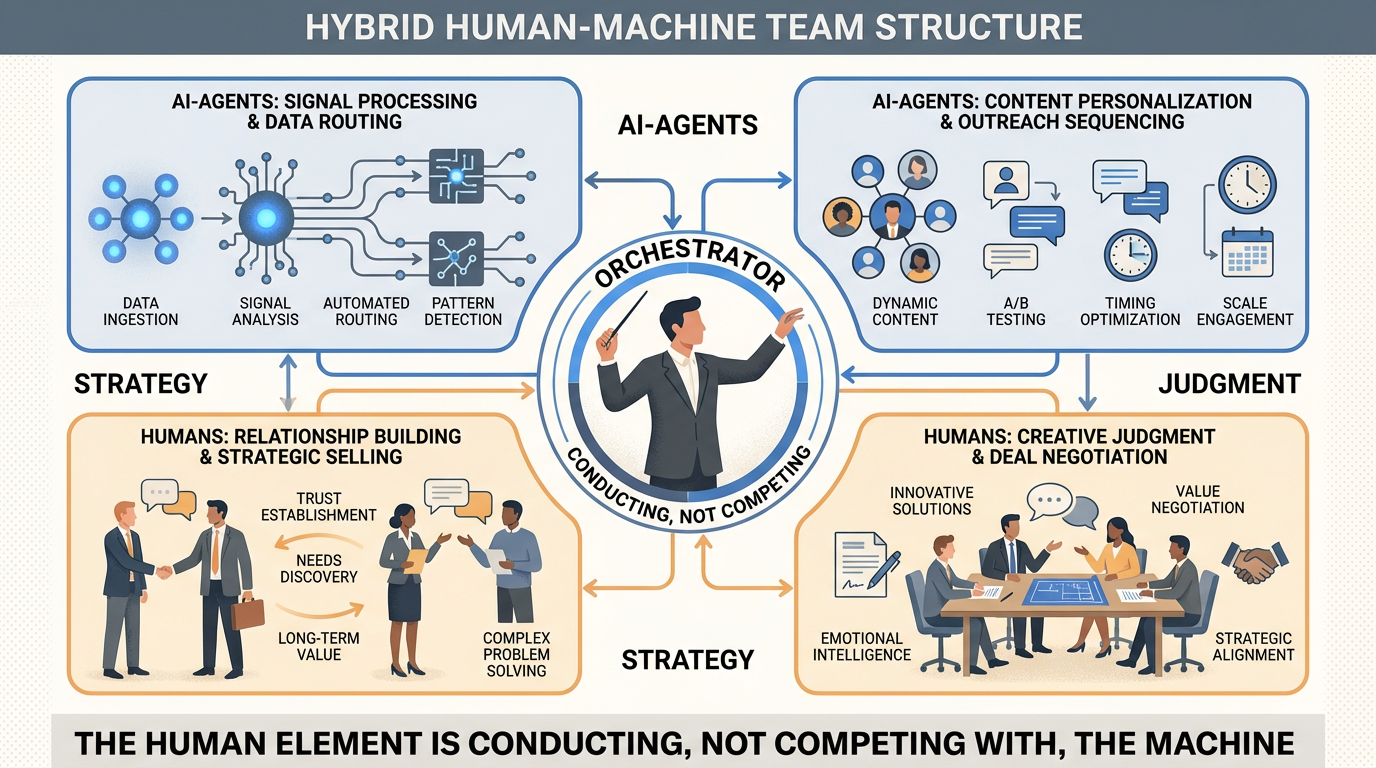
McKinsey estimates that agentic AI will drive over 60% of the increased value from AI in marketing and sales. The orchestrator doesn’t just manage headcount; they design hybrid teams where AI agents handle signal processing, content personalization, and outreach orchestration while humans handle relationship building, strategic selling, and creative judgment.
Cross-functional alignment through shared truth. Snowflake’s GTM engine, which powered a $100B IPO, was built on one principle: product, engineering, marketing, and sales all operate off “one shared truth.” No MQLs. No vanity metrics. Qualified meetings and new logos. Period. The orchestrator defines and enforces this shared measurement system.
Culture creation. This might be the hardest part. The orchestrator has to build a culture where sales and marketing don’t just coexist but actually function as one team. That means shared incentives, shared language, and a willingness to spend time in each other’s world. The leaders who do this well travel with reps, sit in on CS calls, and bring field insights back into strategy, not as a quarterly exercise but as a continuous practice.
The Change Management Nobody Wants to Talk About
Let’s be honest about what this shift requires.
It requires CEOs who actively endorse it. A McKinsey survey found that C-suite misalignment is rampant: executive teams have ballooned in size, fragmenting responsibilities across digital, product, and sales. The CMO who wants to become the Chief Marketing Orchestrator needs explicit CEO backing, not just an expanded title.
It requires a deep alliance with the CFO. The gaming industry CFO who told McKinsey, “I don’t want to hear about brand awareness if that’s not what we agreed upon” — that’s the bar. The orchestrator earns credibility by presenting marketing as a mathematically sound investment engine, not a cost center.
It requires breaking the “blame game” cycle. The traditional relationship between sales and marketing is famously toxic: sales complains about lead quality, marketing complains about follow-up. This only breaks when both functions are held accountable to identical revenue metrics, not department-specific vanity numbers.
And it requires leaders who are willing to be uncomfortable. Smart leaders aren’t hiding right now. They’re leaning into the hard questions about org design, AI integration, and the future of commercial teams, questions that don’t have clean answers and definitely don’t have consensus.
The Acceleration Is Here
Forrester’s framework is blunt: unless the CMO transitions from brand-builder to “generator of customer outcomes,” the role gets replaced by Chief Growth Officers and CROs. Gartner’s data shows budgets staying flat while expectations expand. Spencer Stuart shows that the leaders who successfully make this transition increasingly end up as CEOs: 10% of departing Fortune 500 CMOs now take that path.
The organizations getting this right (Snowflake, HubSpot, Gong) aren’t treating this as a title change. They’re redesigning how commercial teams work. They’re embedding AI into the orchestration layer, not bolting it onto legacy processes. They’re measuring marketing by revenue outcomes, not activity metrics. And they’re building the kind of continuous, compounding GTM motions that make quarterly campaign launches look like flickering lightbulbs next to a power grid.
The CMO isn’t dead. The CMO is being reforged into something harder and more consequential: a leader who orchestrates the entire mechanism by which a company creates and captures value.
The leaders who see this are already moving. The ones who don’t will keep fighting over MQL definitions in pipeline reviews while the world reorganizes around them.
Strategnik builds the Context Layer that makes this orchestration possible. See how we work.
Nick Talbert is the founder of Strategnik, where he helps B2B companies design and execute go-to-market strategies built for how markets actually work. Previously, he held senior marketing leadership roles at numerous B2B technology-forward companies. See full experience.