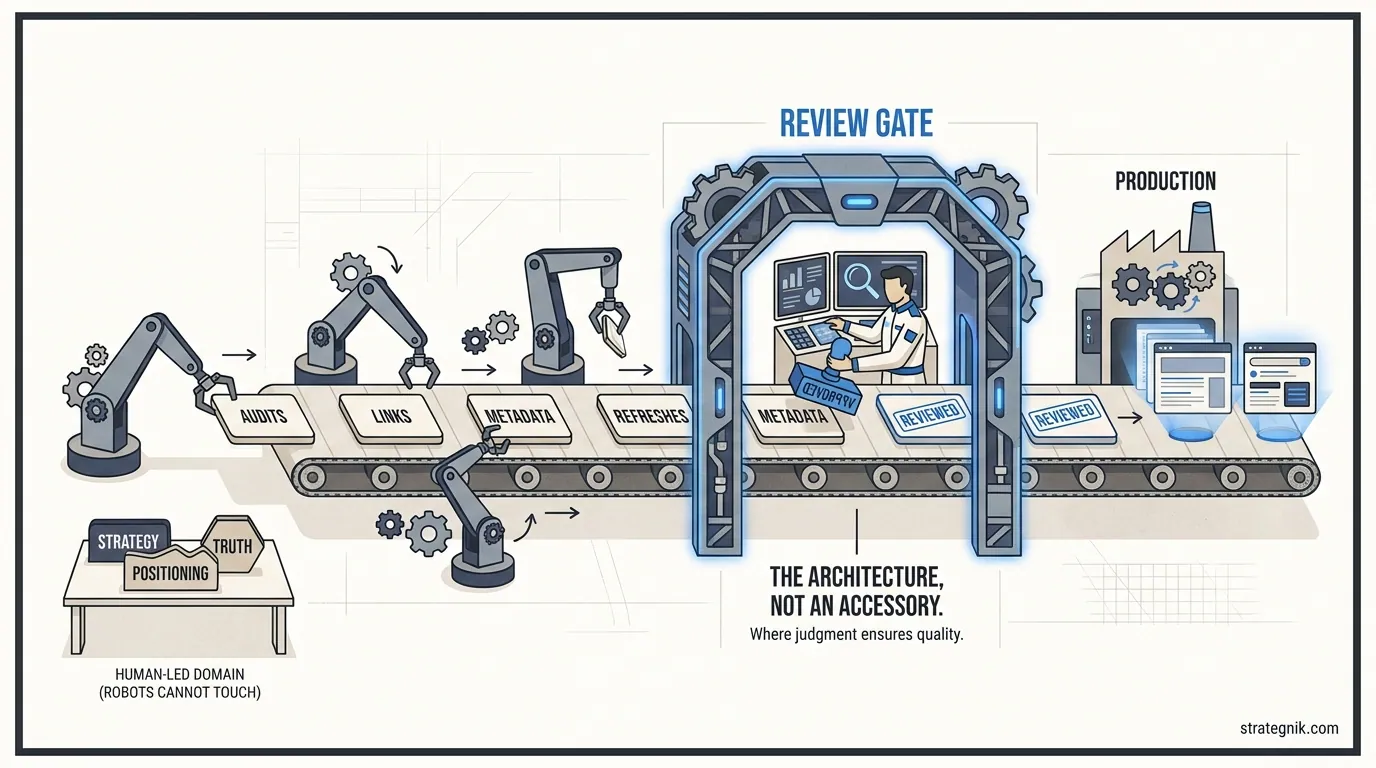
An AI SEO agent is software that plans and executes multi-step SEO work toward a goal: crawl the site, find the issues, draft the fixes, open a pull request. A tool assists with a task you drive; an agent runs the sequence itself and checks in with you at defined points.
That distinction matters more than any feature list, because the market is currently flooded with products calling themselves “SEO AI agents” that are really tools with a chat interface bolted on. Before you evaluate one, get clear on what you’re actually buying and what you’re actually delegating.
What Is an AI SEO Agent?
A tool waits for you. You run the crawl, read the report, decide what matters, make the change. The tool did one step; you did the workflow.
An agent owns the workflow. You give it a goal — “find and fix broken internal links across the blog” — and it plans the steps, executes them, and surfaces its work at checkpoints you define. On the technical side that looks like crawl → diagnose → draft fixes → open PRs for review. On the content side it looks like research → brief → draft → interlink → queue for human approval.
The checkpoints are the difference between an agent and a liability. Any vendor selling a fully autonomous loop with no review gate is selling you a way to ship mistakes at scale.
If you’re still at the tool stage, that’s fine and often correct. I’ve written separately about which AI SEO tools are actually worth using, and for plenty of teams a good tool plus a sharp operator beats a mediocre agent.
What Can AI Agents for SEO Actually Do?
The honest list is shorter than the marketing suggests, but the items on it are genuinely valuable.
Technical audits at scale. Crawling thousands of pages, cataloging redirect chains, orphaned pages, duplicate titles, and broken canonicals, then drafting the fixes instead of just listing the problems. This is the strongest current use case because the work is verifiable. A redirect either resolves or it doesn’t.
Internal-linking passes. Reading your corpus, identifying pages that should reference each other, and proposing the links with anchor text. Tedious for humans, mechanical for an agent, and easy to review in batch.
Metadata generation. Titles and descriptions for hundreds of pages against a template and character constraints. Review the batch, ship it.
Content refreshes against a brief. Give an agent a page, its current rankings, and a clear brief on what to update, and it can execute the refresh competently. The brief is doing the heavy lifting. The agent is doing the typing.
Programmatic page QA. Checking generated pages for thin content, missing schema, broken templates, and inconsistent formatting before they go live.
Monitoring-and-alerting loops. Watching rankings, crawl errors, and index coverage, then flagging anomalies with a diagnosis attached instead of a raw alert.
Notice the pattern. Every item is high-volume, mechanical, and checkable. The agent does work a diligent junior would do, faster, and a human confirms it before anything ships.
Where Do SEO AI Agents Fail?
They fail at judgment, and they fail quietly.
An agent cannot decide your positioning. It cannot tell you which keywords map to buyers versus tire-kickers, whether a comparison page should concede a competitor’s strength, or what your product is genuinely best at. Those calls require knowing what’s true about your business, and no crawl surfaces that.
Left unsupervised, agents optimize what they can measure and drift toward generic output. Word counts go up. Headers get keyword-stuffed into blandness. Every page starts sounding like the median page in your category, because the median is what the model learned. You end up with a site that scores well on an audit and says nothing.
The sharper risk is fabrication. An agent refreshing a product page will happily invent a statistic, a customer count, or a capability claim, and unlike a chatbot draft you’d read before sending, agent output is designed to ship. A hallucinated claim on a production page is a legal exposure and a sales problem, not a typo. This is why the review gate is the architecture, not a setting.
Why Does Context Matter More Than the Agent?
I made this argument about ChatGPT for marketing and it applies with more force here: generic inputs cannot produce differentiated output. An agent without your positioning, ICP, proof points, and approved claims doesn’t produce bad work. It produces fast generic work, which is worse, because volume makes it look like progress.
Prompting at least has a human in the loop each time, filling in missing context from memory. An agent runs the same thin context through fifty pages before you look up. Whatever the agent doesn’t know about your business gets averaged out of every page it touches.
So the prerequisite for agent-driven SEO isn’t a better agent. It’s encoded context: who you sell to, what you claim, what you can prove, how you talk, and what you never say. That’s the same foundation that makes AI agents for marketing work beyond SEO — one governed context that every agent executes against, instead of each tool improvising its own version of your company.
Get the context layer right and a mediocre agent produces usable work. Skip it and the best agent on the market produces polished sameness.
When Should You Use an AI SEO Agent?
Use one when the work is high-volume and mechanical, the output is verifiable, and a human review gate sits between the agent and production. Technical cleanup on a large site. Internal linking across a few hundred posts. Metadata at programmatic scale. Refreshes where you’ve already decided what good looks like and written it into a brief.
Don’t use one expecting it to build authority. Authority comes from original data, earned mentions, real expertise, and being cited by people who matter — none of which an agent can manufacture. And don’t use one to decide strategy. An agent asked “what should our SEO strategy be” will return a competent summary of everyone else’s.
A useful test before delegating any task: would you hand this to a smart junior contractor with zero institutional knowledge and a strict review process? If yes, an agent is probably cheaper and faster. If the task needs someone who knows the business, it needs you or someone who reports to you.
What Do AI Agents Change About SEO Itself?
The economics. When execution gets cheap, everyone’s technical debt gets fixed, everyone’s metadata gets optimized, and everyone’s internal linking gets tightened. Execution quality stops being a differentiator because it stops being scarce.
What stays scarce: original data nobody else has, a point of view a model can’t average into existence, and entity authority built over years of being the credible source on your subject. Those are the inputs agents can’t generate, which makes them the inputs worth investing in.
Conveniently, they’re also exactly what wins in AI search. The factors that get a brand recommended by ChatGPT — consistent entity signals, third-party corroboration, genuinely citable content — are differentiated-input problems, not execution problems. The agent handles the mechanical layer so you can fund the layer machines can’t do.
Buy the agent for the drudgery. Budget the savings for the substance.
Frequently Asked Questions
What’s the difference between an AI SEO tool and an AI SEO agent?
A tool assists with a single task you’re driving: a crawl, a keyword report, a draft. An agent plans and executes a multi-step workflow toward a goal, with human checkpoints. Most products marketed as agents today are tools with a conversational interface. Ask the vendor to show you the workflow it completes end to end, and where the review gates sit.
Can an AI SEO agent replace an SEO team?
No. It replaces the mechanical portion of the work: audits, linking passes, metadata, refresh execution. Strategy, positioning, and judgment about what’s true and provable about your business stay human. Teams that delegate judgment to agents ship confident, generic, occasionally fabricated pages faster than anyone catches them.
Are AI SEO agents safe to run on a production site?
Only with review gates. Agent output should land as drafts and pull requests a human approves, never direct-to-production changes. The failure mode isn’t a broken site. It’s a plausible-looking claim you never made, live on a page your buyers read.