ChatGPT is genuinely useful for marketing. It turns a messy brief into a first draft, pressure-tests a landing page, summarizes a customer call, and lets a small team ship more variants than it could by hand.
And almost every team is using it in the way that produces the least value.
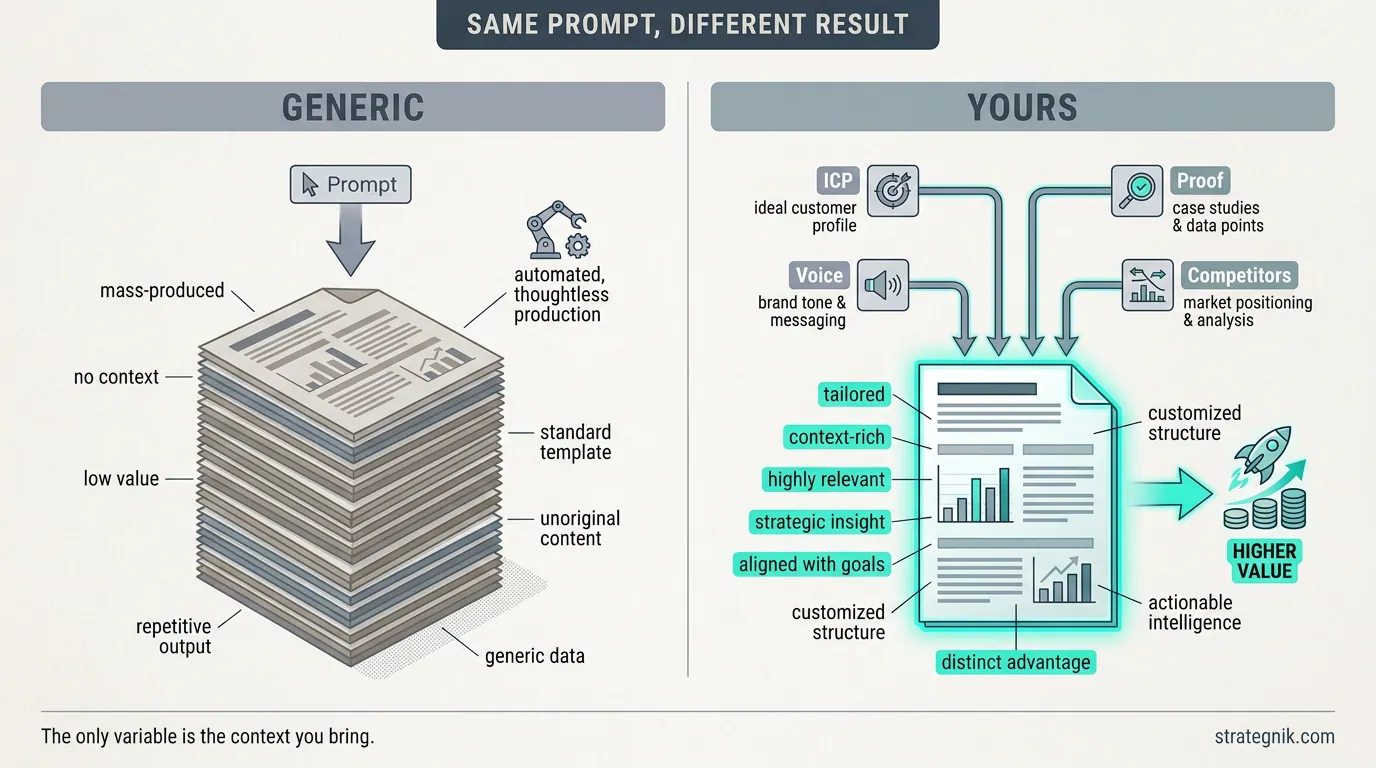
The difference is context. A model that doesn’t know your positioning, ICP, proof points, claims, competitors, and voice is a fast intern who doesn’t know your business. It produces plausible marketing. It sounds clean. It also sounds like everyone else running the same model on the same thin prompt.
What ChatGPT Is Actually Good At in Marketing
ChatGPT is good at production work — once the judgment has already happened.
First drafts and variants. Give it a real brief and one idea becomes ten headlines, three email angles, five ad versions, or a landing page draft worth editing.
Summarizing research and calls. Feed it customer interviews, sales notes, win-loss transcripts, or support themes and it pulls patterns faster than a person scanning the same pile by hand.
Repurposing across formats. A webinar becomes a recap, an enablement note, a social thread, a nurture email, and a product brief, when the source material is strong.
Critique. Ask it to red-team a page against a specific ICP, flag vague claims, or compare a draft against a positioning doc. That’s usually worth more than asking it to write from scratch.
Structured brainstorming. Not “give me campaign ideas.” That produces mush. But “given this audience, offer, constraint, and these claims, generate ten angles and score them on sales usefulness” gets you somewhere.
The pattern: ChatGPT works when it operates on something real. It fails when you ask it to invent the substance.
Where It Fails (And Why Your Output Sounds Like Everyone Else’s)
The generic-output problem isn’t mysterious. Most prompts are generic inputs asking for differentiated output. That math doesn’t work.
If the model doesn’t know your customers, it writes for a composite buyer. If it doesn’t know your claims, it defaults to broad category language. If it doesn’t know your competitive reality, it describes the market exactly the way your competitors do. If it doesn’t know what you’re allowed to say, it either overclaims or sands the message down until nothing sharp survives.
Your output sounds like everyone else’s because your input looks like everyone else’s.
The second failure is organizational. One person prompts ChatGPT with one version of the company. Another prompts it with a different one. Demand gen uses one ICP, content uses another, sales enablement has a third. Nobody’s being careless. They’re each filling in the missing context from memory.
That’s how team-of-one prompting becomes five versions of the company.
Then the session ends. The next prompt starts from zero. The next teammate starts from zero. The next tool starts from zero. ChatGPT remembers within a conversation, and some products retain preferences, but that’s not a governed operating context every teammate and agent shares.
The model isn’t the problem. The blank slate is.
ChatGPT Prompts for Marketing That Actually Work
The best marketing prompts aren’t magic words. They front-load the business context before asking for output.
“Here’s our ICP, positioning doc, and the claim we’re allowed to make: [paste]. Draft X.”
Gives the model a boundary before it writes a word.
“Here’s a customer call transcript and our ICP definition: [paste]. Extract the pains, objections, and exact language worth reusing.”
Turns ChatGPT into a summarizer of evidence, not an inventor of insight.
“Here’s our landing page and competitive framing: [paste]. Red-team it for vague claims and missing proof.”
Uses the model for critique, where it exposes weak spots fast.
“Here’s the source asset, our voice rules, and the target channel: [paste]. Repurpose it without adding new claims.”
Keeps format conversion from becoming message drift.
“Here’s our campaign brief and scoring criteria: [paste]. Generate ten angles, then rank them on fit, specificity, and sales usefulness.”
Makes brainstorming structured enough to be useful.
Every one of these does the same thing: it hands the model context instead of a blank page.
From Prompting to a System
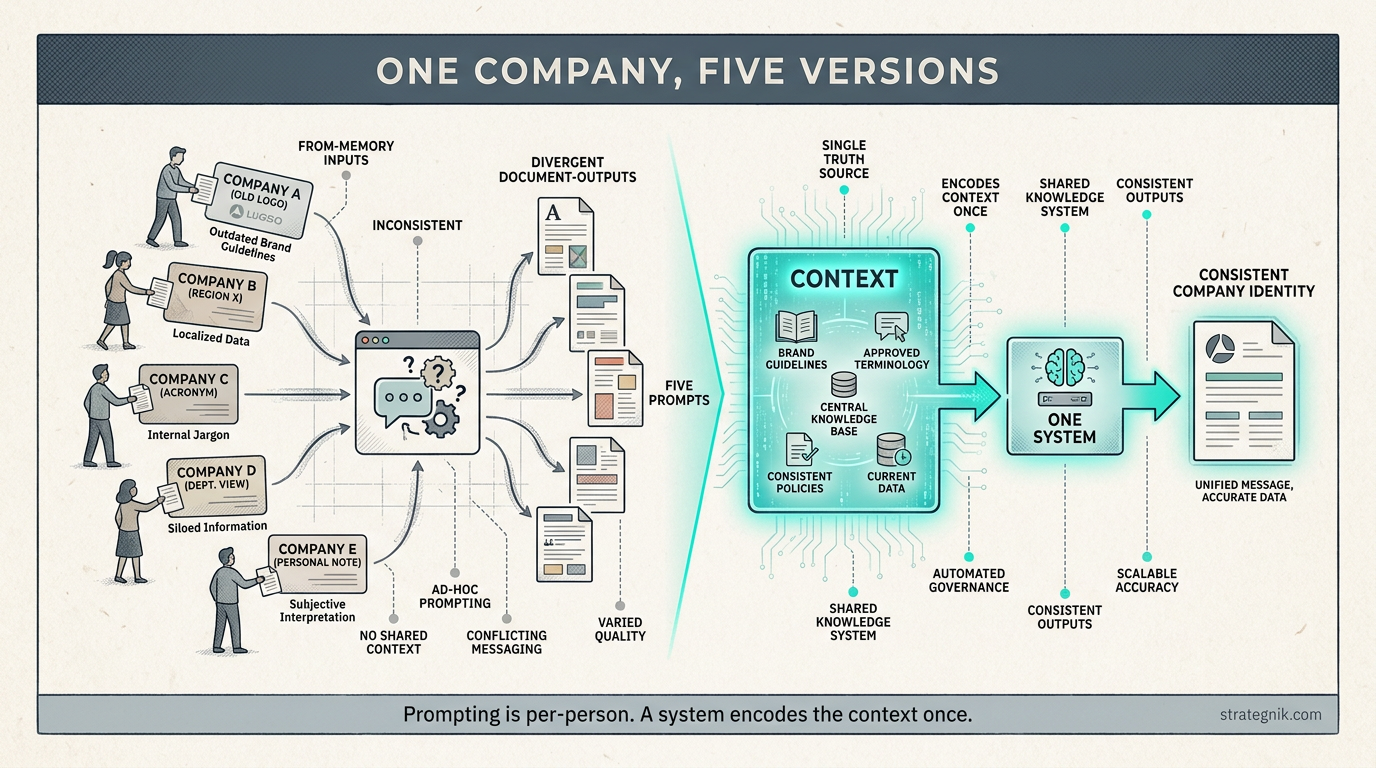
Prompting is per-person, per-session. That’s the ceiling.
A good marketer gets better output than a bad one because they know what context to include. But that knowledge stays trapped in the person. The next teammate doesn’t inherit it. The next session doesn’t inherit it. The next agent doesn’t inherit it.
A system encodes the context once.
That’s the role of the Context Layer: your go-to-market context (persona, competitor, vertical, buyer stage, topic, product, channel, goal, and creative) encoded in a form machines can actually use, instead of pasted in from memory one prompt at a time. It isn’t a prompt library, and it’s no longer a bespoke consulting deliverable: the engine that tags that context and resolves which piece applies is open source (ontogent-core).
Once that layer exists, ChatGPT for digital marketing stops being isolated prompts and becomes an operating model. Agents draft against the same voice. Campaigns generate from the same ICP hierarchy. Content gets checked against the same claims and proof. The system doesn’t depend on each person remembering which paragraph to paste.
That’s also where the work moves from chatbot to fleet. A chatbot waits for a person to ask. A governed agent executes against context, constraints, and tools. The next step isn’t a better prompt library. It’s AI agents for marketing operating from shared context, along the path from chatbot to agent fleet.
ChatGPT is a useful interface. It isn’t the system.
Frequently Asked Questions
Can ChatGPT replace a marketing team?
No. It replaces production drudgery, not judgment. Teams that treat it as a teammate with amnesia get burned — the model produces work faster than the organization can decide whether the work is right.
How do I use ChatGPT for digital marketing?
Start with context. Define the ICP, positioning, claims, proof points, competitors, and voice for the task. Paste the relevant source material instead of asking the model to invent from a topic. Then ask for a specific output, and a critique against your own criteria, before anything ships.
Is ChatGPT content bad for SEO?
Not because ChatGPT wrote it. Content is bad when it’s thin, generic, unsupported, or unhelpful. Google’s position is about usefulness and quality, not authorship. AI-assisted content works when it’s grounded in real expertise, clear claims, and a coherent content system. Generic AI content fails because it has none of those.
Before you scale AI output, audit the context it’s running on.