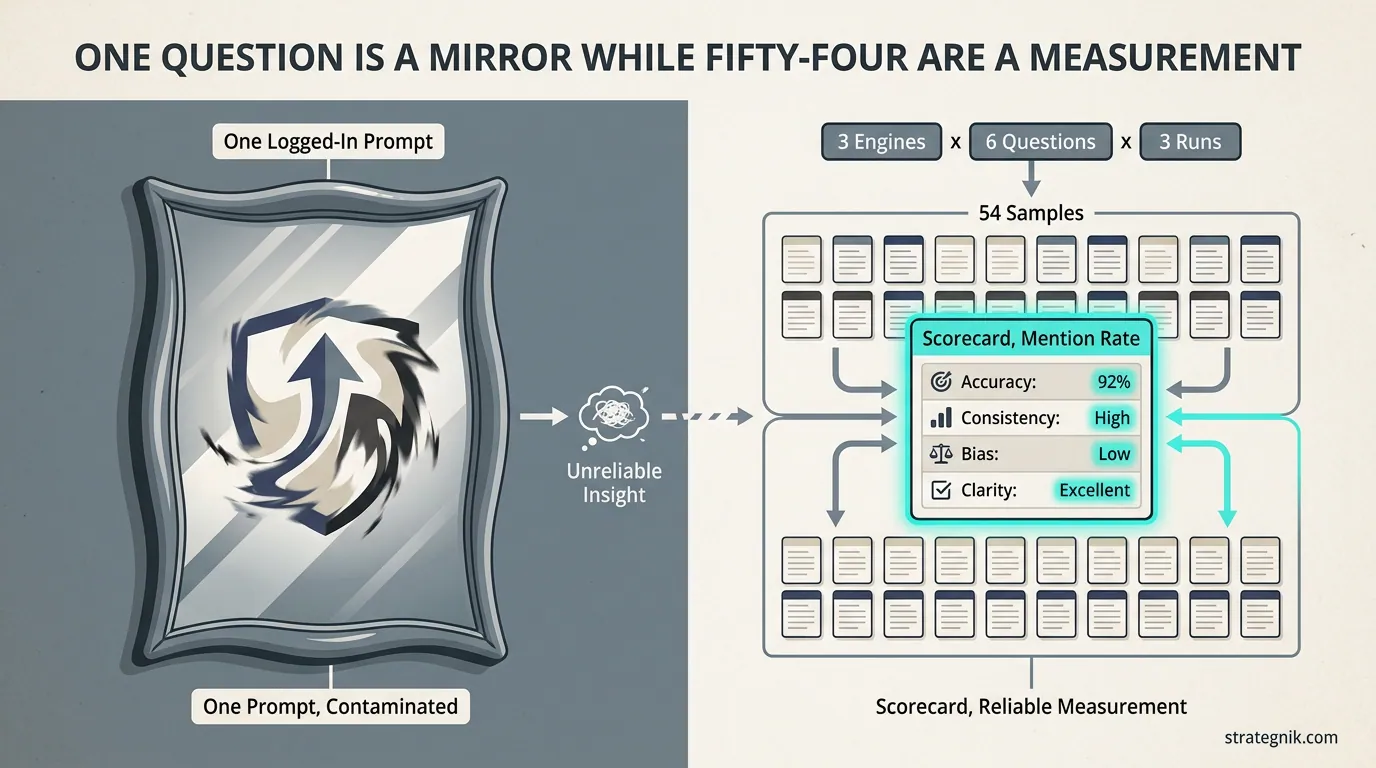
To check what ChatGPT says about your brand, open a temporary chat, ask the questions your buyers actually ask, run each one several times, and record whether you’re named, where you land, and who beats you. Most companies skip the method, ask one casual question from a logged-in account, and walk away with an answer that’s contaminated, unrepeatable, and wrong.
I run these audits for B2B SaaS companies, and the manual version takes about an hour. Here’s exactly how to do it, and then the shortcut that does it for you.
Why Can’t You Just Ask ChatGPT Yourself?
You can. But the way most people do it produces garbage data, for three reasons.
AI answers are non-deterministic. Ask ChatGPT “what are the best freight audit platforms” three times and you’ll get three different lists. Sometimes the same five names in different orders. Sometimes a name appears in run one and vanishes in run three. A single prompt is one sample from a distribution, and one sample tells you almost nothing. If you run a question once and see your brand, you might be at 30% inclusion and celebrating.
Your account contaminates the results. ChatGPT has memory. It knows you work at your company, it’s read your previous chats about your positioning, and it will happily name your brand because you keep bringing it up. That’s not visibility. That’s a mirror. The same applies to Gemini if you’re logged into a Google account soaked in your own brand searches.
Logged-in context skews retrieval. Even without explicit memory, personalization signals nudge what gets surfaced. Your buyer doesn’t have your history. Testing from your own context is like Googling your company name from your office network and concluding your SEO is great.
The fix is simple discipline. Use ChatGPT’s temporary chat mode (or a logged-out incognito window), run every question at least three times, and test in the phrasing a buyer would use, not the phrasing you wish they’d use. Nobody asks ChatGPT “tell me about [your tagline].” They ask “what’s the best X for Y.”
What Questions Should You Actually Test?
Test the questions that sit in a buying process, plus one question that tests whether the AI knows what you are at all. When I build a question set, it looks like this:
Five buyer questions:
- Category recommendation: “What are the best [your category] platforms?”
- Qualified recommendation: “What’s the best [your category] tool for [your ICP — e.g., mid-market shippers, B2B SaaS teams under 200 people]?”
- Problem-first: “How do I solve [the problem you exist to solve]? What tools help?”
- Competitor comparison: “How does [top competitor] compare to alternatives?”
- Shortlist request: “I’m evaluating [your category] vendors. Who should be on my shortlist?”
One entity question:
- “What is [your company name]?”
The entity question matters more than it looks. If ChatGPT can’t accurately describe what your company does, the recommendation questions are unwinnable. You can’t be recommended for a category the model doesn’t know you belong to.
Run this set across at least three engines: ChatGPT, Perplexity, and Gemini. They retrieve from different sources with different weights. Perplexity leans hard on live web citations. Gemini pulls from Google’s index and Knowledge Graph. ChatGPT blends training data with its own browsing. I regularly see companies visible in Perplexity and absent in ChatGPT, or vice versa, and the gap tells you which signals you’re missing. One engine is not a read on “AI visibility.” It’s a read on one engine.
Three engines, six questions, three runs each. That’s 54 data points instead of one.
What Should You Record for Each Answer?
Don’t just eyeball the responses. Score them. For every run, capture five things in a spreadsheet:
1. Mentioned at all? Yes or no. This is your inclusion rate, and it’s the headline number. Mentioned in 2 of 18 ChatGPT runs is a very different situation from 18 of 18.
2. Position in the list. First mention carries disproportionate weight. Buyers using AI for research rarely dig past the top two or three names, the same way they never clicked to page two of Google. Fifth on a list of seven is closer to invisible than it feels.
3. Described accurately? Read what the AI says about you. Right category? Right ICP? Current positioning, or the thing you pivoted away from two years ago? An inaccurate description in a recommendation is arguably worse than absence, because now the buyer is evaluating a version of you that doesn’t exist.
4. Which competitors appear? List every vendor named, every time. After 54 runs you’ll have a frequency table, and it’s usually humbling. The competitor set AI engines carry is often not the competitor set on your battlecards.
5. What sources are cited? Perplexity and Gemini cite openly; ChatGPT cites when browsing. Note every source: G2 category pages, “best X” roundups, Reddit threads, analyst lists, competitor comparison pages. This is your treasure map. These are the specific places AI engines learn your category, written down for you.
How Do You Interpret the Results?
The pattern of failure tells you which problem you have. Three patterns cover most audits I run.
Absent everywhere, including the entity question. You have an entity problem. The AI doesn’t know what you are, so it can’t recommend you for anything. This usually traces to missing Organization schema, no Knowledge Panel, and inconsistent descriptions of your company across your site, LinkedIn, and review platforms. The full diagnosis is in why your B2B SaaS is invisible in ChatGPT, and it’s fixable, but it’s foundation work, not a content tweak.
Present but described wrong. You have a signal-consistency problem. The engines know you exist but they’re triangulating from conflicting sources: an old About page, a stale Crunchbase entry, a G2 category you outgrew. The model runs something like a consensus algorithm on your identity, and the consensus is out of date. The work is consolidation. Make every surface say the same thing about what you are.
Competitors keep appearing, with citations. You have a citation-surface problem, and the good news is the audit just handed you the fix list. If ChatGPT recommends your competitor and cites a specific roundup, that roundup is where you need to be. If Perplexity keeps pulling from a G2 category page, your G2 presence is now a GTM priority. Go earn the exact sources your competitors are being cited from. This is the most actionable output of the whole exercise, and it’s the core of how to get recommended by ChatGPT, the companion playbook to this one.
In Coherence Model terms, this audit is a Gravity measurement: it tells you whether your brand actually pulls demand in the channel where buyers now do their research, or whether you’ve been assuming it does.
Is There a Faster Way to Run This Audit?
Yes. I built the manual method above into a free tool: the Strategnik AI Visibility Grader.
It runs the same methodology automatically. It asks buyer questions and an entity question across multiple AI engines, crawls your site to check the technical signals that drive retrieval, and scores you on four dimensions of AI visibility. You get the inclusion data, the competitive picture, and the diagnosis without spending an hour in incognito windows with a spreadsheet.
I’d still encourage you to run a few manual prompts yourself at least once. Watching ChatGPT recommend your competitor to your exact ICP, in real time, creates urgency that no report can. But for a repeatable baseline you can re-run quarterly, use the grader. It’s free, and it exists because I got tired of doing the spreadsheet version by hand.
Frequently Asked Questions
How do I check if ChatGPT recommends my brand? Open a temporary chat (so memory and personalization don’t contaminate results), ask 5 buyer-style questions plus “What is [your company]?”, run each question three times, and record whether you’re mentioned, your position, description accuracy, competitors named, and sources cited. Repeat in Perplexity and Gemini, since each engine retrieves from different sources. Or run the AI Visibility Grader, which automates this exact process.
Why is my brand invisible when people ask ChatGPT for recommendations in my industry? Usually because the AI doesn’t recognize your company as an entity in your category. If you’re absent across all engines and ChatGPT can’t answer “What is [your company]?”, the cause is structural: missing schema, inconsistent brand descriptions across platforms, and no presence in the sources AI engines cite, like review-site categories and roundup articles. Google rankings don’t transfer. A company can rank page one and never be named in an AI answer.
How often should I re-run an AI visibility audit? Quarterly is a sensible cadence, plus after any major positioning change. AI engines update their retrieval sources continuously, so visibility shifts faster than traditional search rankings. Track your inclusion rate over time rather than reacting to any single run.
For the full framework behind this methodology, see the Answer Engine Optimization strategy page.