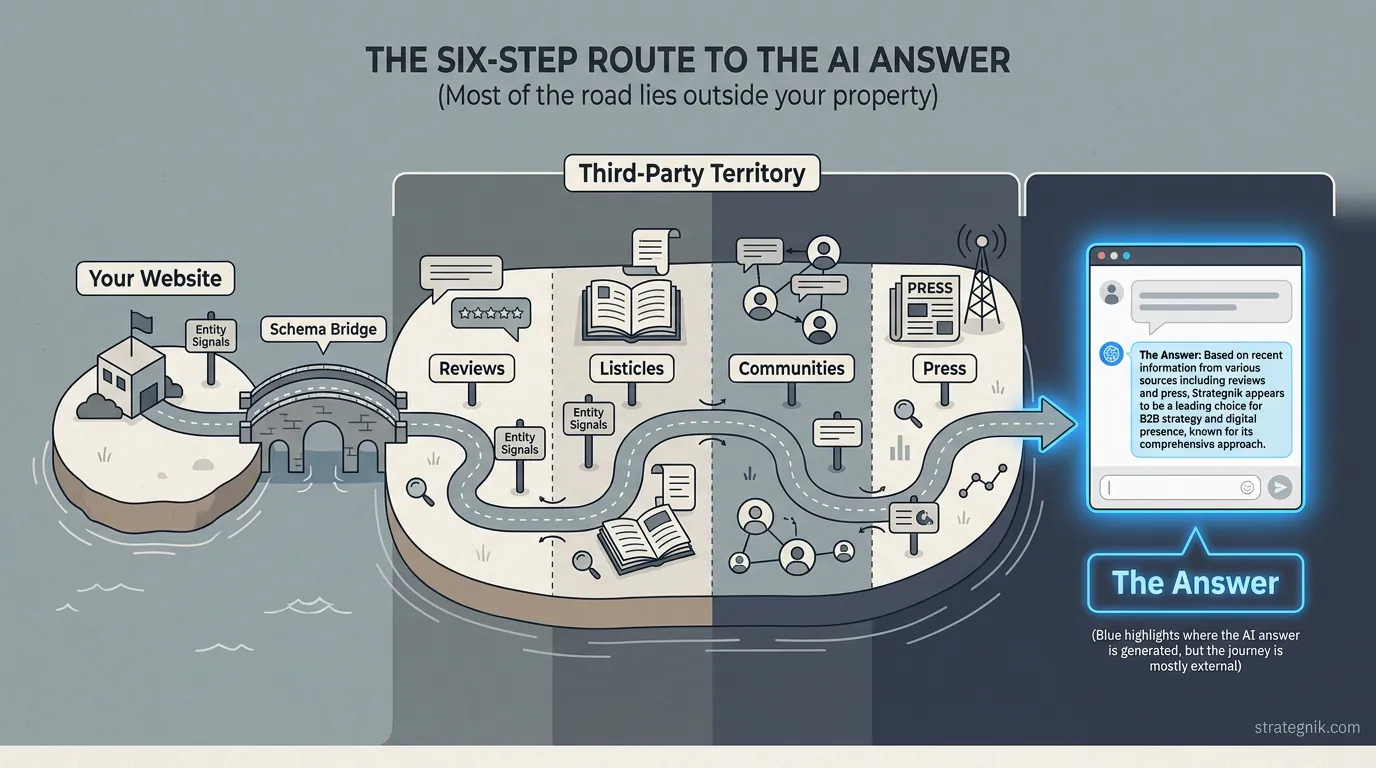
To get recommended by ChatGPT, you need to become a recognizable entity with consistent brand signals, machine-readable structure, and presence on the third-party sources AI systems actually cite. That work breaks into six steps, and the order matters: fix your entity identity first, then your content structure, then go earn citations off your own site.
If you want the full diagnosis of why you’re invisible in the first place, read why your B2B content doesn’t show up in ChatGPT. This post assumes you already know you have the problem. It’s the playbook for fixing it, sequenced so a marketing leader can hand it to a team on Monday.
One framing note before the steps. SparkToro’s research found 69% of Google searches already end without a click, and Gartner projects traditional search volume drops 25% by 2026. The buyers you’re losing aren’t going to a competitor’s website. They’re asking a chat window, and the chat window is answering.
Step 1: Run an Entity Consistency Audit
Before you write anything new, make every description of your company say the same thing everywhere. AI systems triangulate identity across your website, LinkedIn, G2, Crunchbase, app marketplaces, and press mentions. When those sources disagree about what you are, the model hedges, and hedging means you get left out of the answer.
I’ve audited dozens of B2B websites, and this is the most common failure I find. The homepage says “revenue intelligence platform,” LinkedIn says “AI-powered sales insights,” G2 has you filed under a category you abandoned two years ago, and the founder’s bio still describes the 2021 pivot. A human squints past that. A retrieval system reads it as four weak entities instead of one strong one.
The audit itself is a spreadsheet, not a project. List every property where your company is described. Record the exact category language, the one-sentence description, and the named competitors on each. Then rewrite all of them to a single canonical description: same category noun, same problem statement, same positioning language. This takes a week and costs nothing but attention.
Step 2: Ship Organization and FAQ Schema
Structured data is how you tell machines what your content means instead of hoping they infer it. Two schema types do most of the work for AI visibility: Organization schema on your homepage, and FAQ schema on any page that answers buyer questions.
Organization schema should carry your canonical name, logo, description (the same one from Step 1), founding date, and sameAs links to every profile you audited. That sameAs array is doing real work: it explicitly connects your scattered web presence into one entity, which is exactly the disambiguation problem AI systems struggle with.
FAQ schema goes on product pages, pricing pages, and posts built around questions. Write the question the way a buyer would actually type it, and make the answer complete in two or three sentences. Your developers can ship both schema types in a sprint. If your site runs on a modern framework, it’s an afternoon.
Step 3: Restructure Content to Answer First
Every important page should answer its core question in the first two sentences, because retrieval systems extract answers from the top of the content, not the bottom. The classic B2B blog post opens with 400 words of throat-clearing about how the landscape is changing, then gets to the point somewhere around the second H2. That structure was tolerable for SEO. For AI retrieval it’s fatal.
The fix is an editing pass, not a rewrite. Take your twenty highest-value pages. For each one, identify the question the page exists to answer, and move the direct answer into the opening. Convert H2s into actual questions where it reads naturally. Cut the wind-up paragraphs entirely.
Notice how this post opens. The first sentence is the answer. That’s not a stylistic preference, it’s the mechanism: when an AI system retrieves this page for someone asking how to get recommended by ChatGPT, the extractable answer is sitting right at the top.
Step 4: Earn Presence Where ChatGPT Actually Looks
Here’s the part most teams miss: the majority of AI-visibility work happens off your own website. When ChatGPT recommends vendors, it’s synthesizing from review sites, comparison listicles, Reddit threads, industry publications, and analyst roundups. I broke down the source landscape in detail in where ChatGPT gets its answers, and the short version is uncomfortable: your beautifully optimized product pages are a minority input.
So go earn presence in those sources deliberately. Claim and complete your G2 and Capterra profiles in the right category, and run a real review-generation program, because volume and recency both matter. Pitch your way into the “best X tools” roundups that already exist for your category; the authors update them, and they respond to well-argued inclusion requests. Show up in Reddit and community threads as a genuinely useful participant, not an astroturfer, because those threads get retrieved constantly.
This is slow, unglamorous work compared to publishing another blog post. It’s also the highest-leverage step in this playbook. In Coherence Model terms this is Mass work: every third-party mention adds weight that pulls AI recommendations toward you long after the effort is spent.
Step 5: Publish Data Worth Citing
AI systems cite sources that other sources cite, so the fastest way into the citation graph is publishing something nobody else has. Original benchmark data from your product, an annual survey of your buyer persona, a named framework that gives people language for a problem they couldn’t articulate. These are the assets that industry publications reference, and those references are what teach the model you’re an authority.
You don’t need a research department. A SaaS company sitting on usage data across a few hundred customers can produce a benchmark report that becomes the default citation for its category. One genuinely original data point beats fifty thought-leadership posts, because the data point gets repeated by other people, and repetition by others is the signal AI systems trust.
If you publish it, make it easy to cite. Clear methodology, quotable single-line findings, a stable URL. Give the stat a name if you can. Uncited research is just a PDF.
My Competitors Show Up in ChatGPT and We Don’t. How Do I Fix That?
Reverse-engineer where the AI is learning about your competitor, then go earn presence in those exact sources. When ChatGPT names your competitor, ask it why. Prompt it directly: “What sources informed that recommendation?” Use the browsing-enabled modes and check the citations. You’ll usually find the same handful of inputs: a G2 category they lead, two or three listicles that include them and not you, a comparison page they wrote, active Reddit threads where users mention them.
That output is your gap list, and it converts straight into a work plan. If they’re in five roundups you’re missing from, pitch those five authors. If their G2 category presence is stronger, that’s your review program’s target. If a Reddit thread from 2024 keeps surfacing, join the current conversations in that community. You’re not trying to out-content them. You’re closing a specific, enumerable presence gap.
I’d also test your own baseline before and after. The AI visibility grader is a free tool I built that grades exactly this: whether AI systems recognize your company, and how you compare on the signals that drive recommendations. Run it first so you know which steps in this playbook are your actual bottleneck.
How Do You Measure Progress?
Treat AI visibility like a channel with a scorecard, or the work will die after one quarter. The measurement is straightforward even though the tooling is young. Build a panel of 15 to 20 prompts your buyers would realistically ask: category recommendations, comparison questions, “best tool for” queries. Run them monthly across ChatGPT, Perplexity, and Google’s AI Overviews. Track three things: are you mentioned, in what position, and with what description.
Add a second-order metric: is the description accurate? Getting mentioned with a stale or wrong positioning is its own problem, and it points you back to Step 1. Also watch your referral traffic from AI surfaces; it’s small today but it converts well in my experience, because someone clicking through from an AI answer has already been pre-sold by the recommendation.
If this becomes a program rather than a project, that’s the point where most teams need structure or outside help. It’s the core of what I do on the GEO side of my practice, and the honest pitch is that the process above is not secret. The advantage goes to whoever executes it earliest and most consistently.
The window here is the interesting part. Entity authority compounds, and AI systems show a strong incumbency bias: once a vendor is established in the answer set, displacing it takes disproportionate effort. Right now most of your competitors are still writing keyword briefs for a search channel that’s shrinking. Two years from now, the recommendation slots in your category will be largely settled, and the companies holding them will have done this work while it was still cheap. Do it while it’s still cheap.