AEO Statistics for B2B SaaS (2026): 40+ Data Points on AI Search, Citations, and Visibility
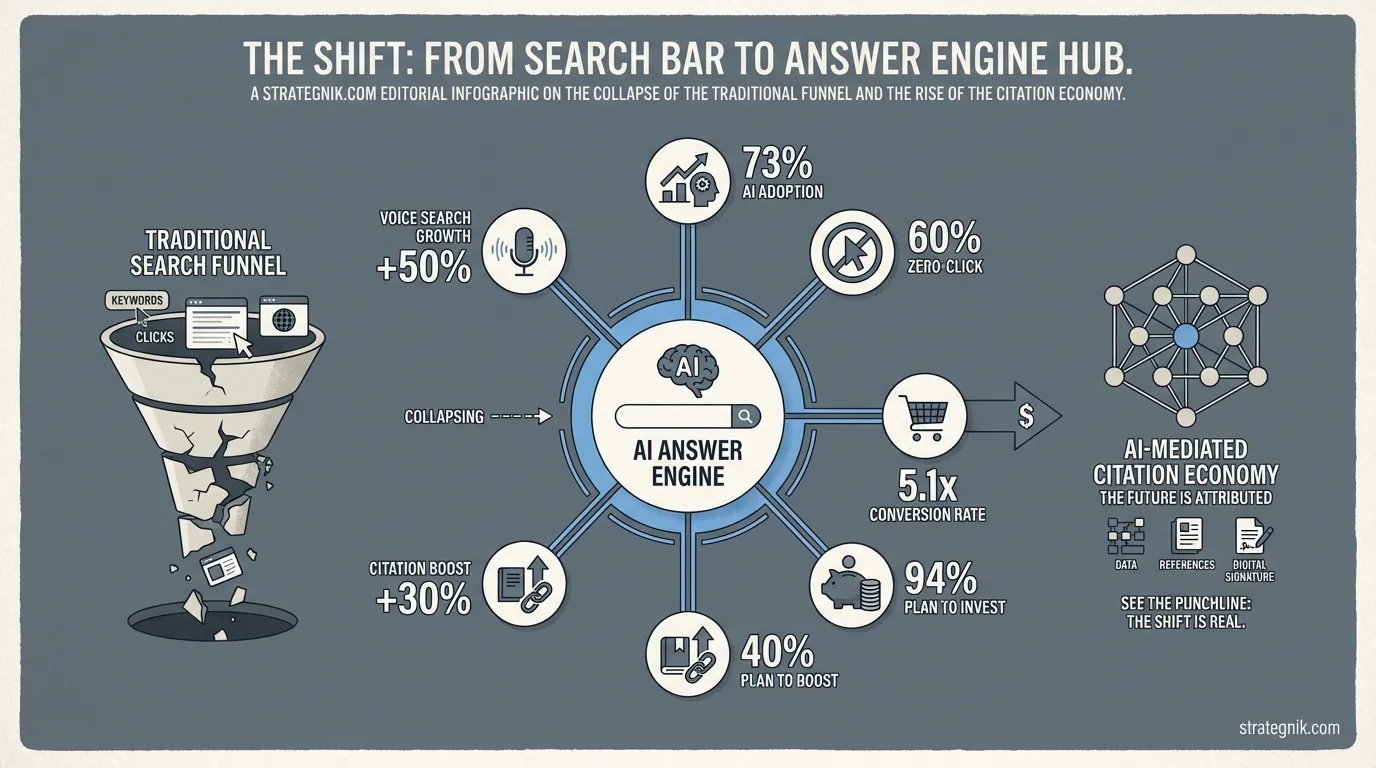
The argument for Answer Engine Optimization is over. The data won. If you’re a B2B SaaS leader still treating AI search as an emerging trend to “keep an eye on,” these numbers should end that posture. This is not a forecast piece. It’s a reference page — 40+ statistics on how AI systems are reshaping B2B discovery, what content gets cited, and where the gaps are widest.
I built this as the page I wished existed when I started running Digital Context Audits for B2B clients. Every stat is sourced. The commentary is mine — because data without interpretation is just a spreadsheet.
Bookmark this. Send it to your CEO. Use it to justify the budget.
AI Search Adoption: The Shift Is Not Coming — It Happened
The first question every B2B leader asks: “Are buyers actually using AI search?” The data is unambiguous.
73% of B2B buyers now use AI tools in their purchase research process. Averi’s March 2026 analysis of 680 million citations across ChatGPT, Perplexity, and Google AI Mode confirmed this across multiple source studies. (Source: Averi via PR Newswire, March 2026)
ChatGPT reached roughly 900 million weekly active users in February 2026, more than doubling from 400 million in February 2025. That’s not a niche tool. That’s a primary research channel. (Source: Sherwood News / OpenAI, February 2026)
ChatGPT users send 18 billion messages per week — roughly 2.5 billion prompts per day. Many of those are research queries that used to be Google searches. (Source: DemandSage, 2026)
Perplexity AI processes 35-45 million queries per day, up from roughly 30 million in 2025. (Source: DemandSage, 2026)
What This Means for GTM Leaders
Your buyers are already researching solutions through AI. The question isn’t whether to invest in AI visibility — it’s how far behind you already are. If 73% of your prospects use AI in their buying process and your company doesn’t show up in those answers, you’re losing deals you’ll never see in your CRM. This is the invisible pipeline problem I cover in why B2B content doesn’t show up in ChatGPT.
Zero-Click Search: The Traffic Model Is Breaking
The foundation of a decade of B2B content marketing — write it, rank it, get clicks — is collapsing under zero-click dynamics.
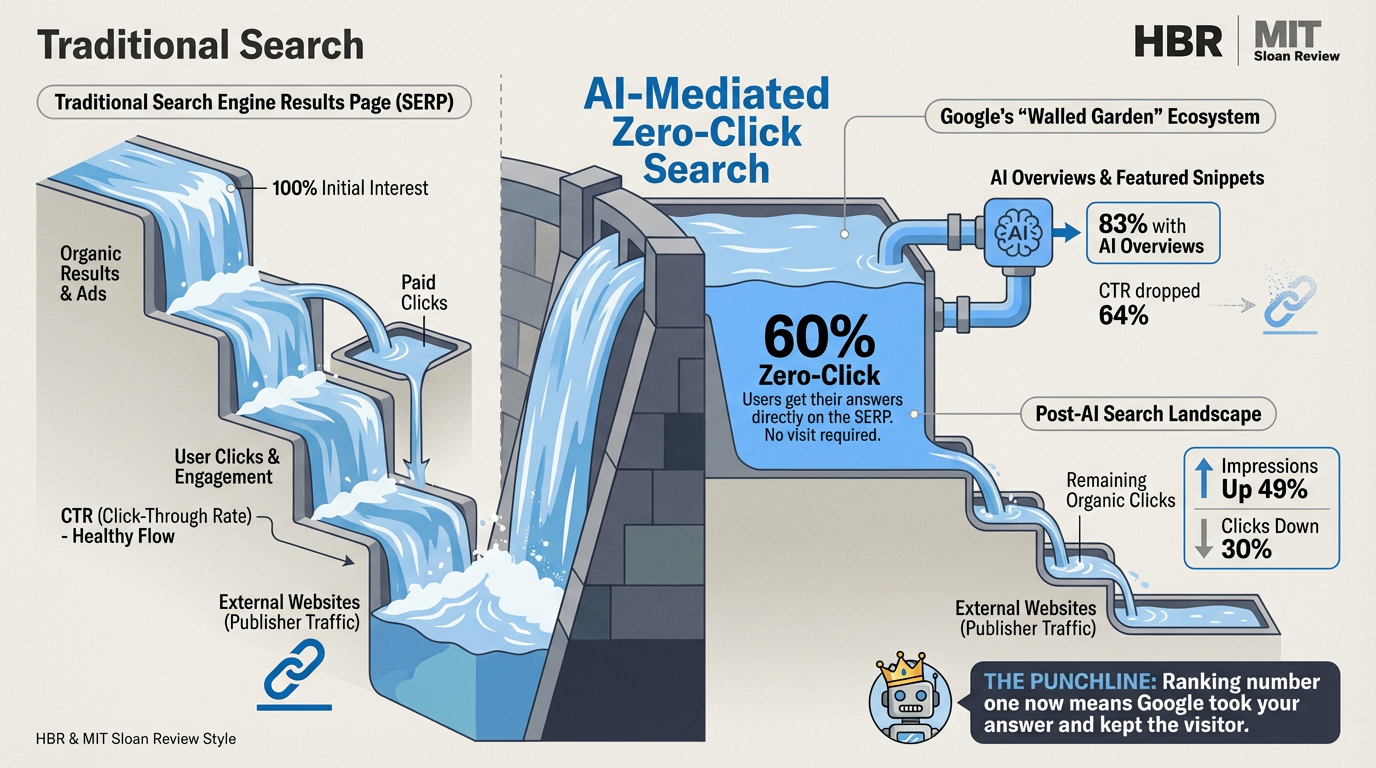
60% of Google searches in 2026 end with zero clicks. The user gets what they need from the search results page itself and never visits a website. (Source: SparkToro / Datos Group, 2026)
AI Overviews now trigger on 48% of all tracked search queries, a 58% increase year-over-year. (Source: BrightEdge 12-month analysis, February 2025-2026)
AI Overviews correlate with a 58% lower average click-through rate for the top-ranking page, as of December 2025 — up from 40% earlier in the year. (Source: Ahrefs, December 2025)
Google search impressions are up 49% year-over-year, but CTRs are down 30%. More people are searching. Fewer are clicking. (Source: BrightEdge, 2026)
Mobile searches end without clicks 77.2% of the time, versus 46.5% on desktop. Your mobile visitors aren’t visiting. (Source: SparkToro, 2025)
B2B tech AI Overview trigger rates grew from 36% to 70% in a single year. Healthcare and education are approaching 90%. (Source: BrightEdge, 2026)
What This Means for GTM Leaders
If your content strategy is still optimized for “rank and click,” you’re optimizing for a diminishing return. Ranking #1 used to mean traffic. Now it often means Google extracted your answer, displayed it in an AI Overview, and the user moved on without ever seeing your site. The new game is being cited inside the answer — not just ranking near it. This is the structural shift that makes AEO a GTM-level priority, not an SEO project.
LLM Citation Patterns: What Actually Gets Cited
Not all content is created equal in the eyes of AI systems. The data on what gets cited — and what gets ignored — should reshape how every B2B team thinks about content.
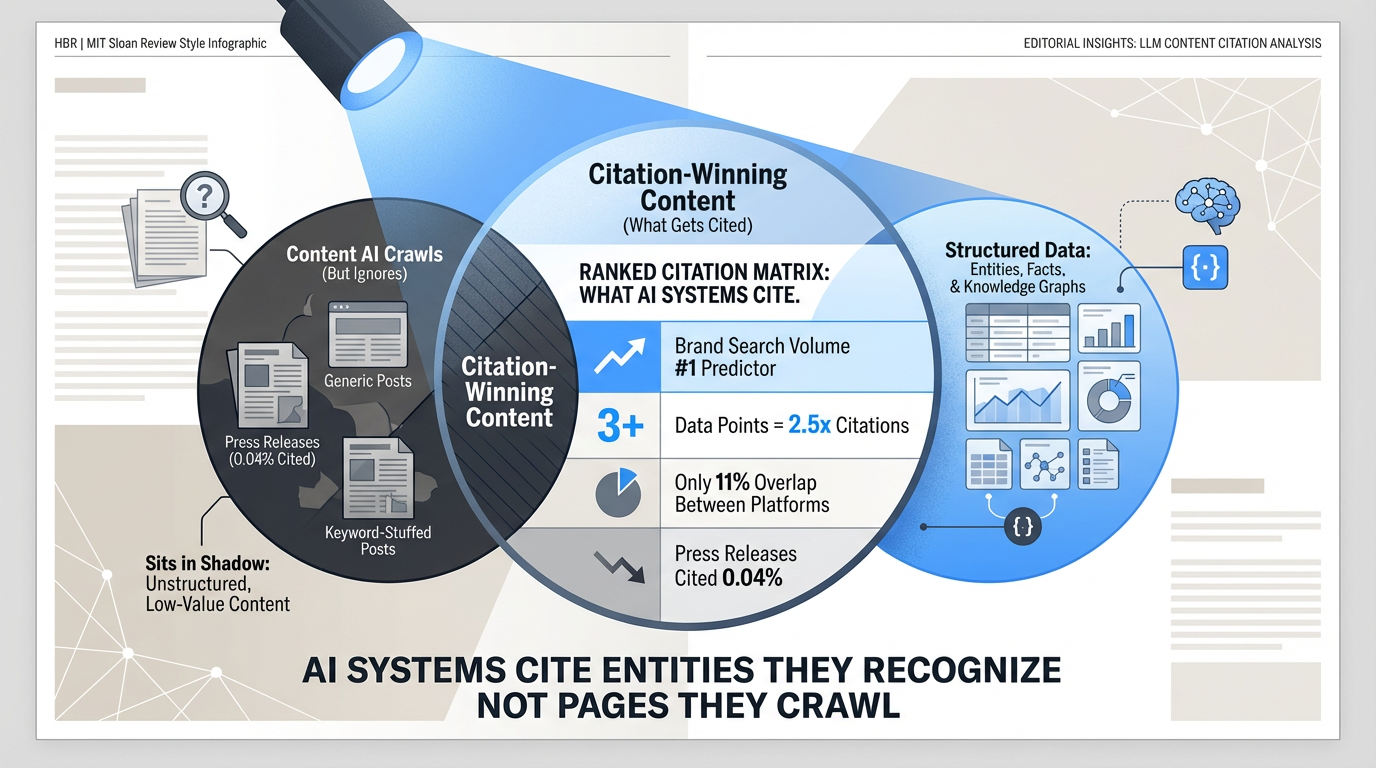
Brand search volume — not backlinks — is the strongest predictor of AI citations. Brand-building activities that seemed disconnected from SEO now directly impact AI visibility. (Source: Seer Interactive, 2025)
Only 11% of domains are cited by both ChatGPT and Perplexity. Each AI platform has dramatically different source preferences. (Source: Averi via PR Newswire, 680M citation analysis, 2026)
Citation volumes for the same brand can differ by 615x between AI platforms. Winning on ChatGPT doesn’t mean winning on Perplexity. (Source: Superlines via PR Newswire, 2026)
LinkedIn is the #1 most-cited domain for professional queries across ChatGPT, Gemini, Google AI Overviews, Google AI Mode, Copilot, and Perplexity. LinkedIn’s ChatGPT citation rank climbed from #11 to #5 between November 2025 and February 2026. (Source: Profound, 2026)
Reddit accounts for 46.7% of top Perplexity citations. Platform-specific strategies are non-negotiable. (Source: Averi via PR Newswire, 2026)
What This Means for GTM Leaders
The citation data reveals a clear pattern: AI systems cite entities they recognize, content that’s structured for extraction, and sources with original data. Press releases, keyword-stuffed blog posts, and gated PDFs are invisible. Named frameworks, proprietary research, and structured answer blocks are citation magnets. This is the Context Field model in action — the more mass you build through genuine authority, the stronger your pull in AI systems. I break down the five reasons B2B companies get ignored in why your content doesn’t show up in ChatGPT.
Content Quality and Structure: Human vs. AI, and What Machines Can Parse
The quality bar for AI visibility is rising. The data paints a clear picture of what performs.
Human-written content is 8x more likely to rank #1 on Google than purely AI-generated content. (Source: Search Engine Land, 2025)
Pages with schema markup are 36% more likely to appear in AI-generated summaries. Structured data is the API layer between your content and AI retrieval. (Source: BrightEdge, 2025)
Sites implementing structured data and FAQ blocks saw a 44% increase in AI search citations. (Source: BrightEdge, 2025)
ChatGPT’s crawler doesn’t execute JavaScript. If your content requires JavaScript to render, it can’t be read for citation. (Source: Passionfruit, 2026)
What This Means for GTM Leaders
The content strategy that wins in 2026 is human-led, AI-assisted, and structurally engineered for machine extraction. That means schema markup on every page, answer-first content structure, self-contained passage blocks, and original data that machines can cite. This is the Machine Readability component of the Context Field — and most B2B companies haven’t built it. The technical detail on what the Context Field contains is in the six components breakdown.
AI Search Conversion and Traffic Quality
AI search traffic doesn’t just exist — it converts.
AI search traffic converts at 14.2% compared to Google organic’s 2.8% — a 5.1x advantage. (Source: Exposure Ninja, March 2026)
Conversion rates vary by AI platform. Claude users convert at 16.8%, ChatGPT at 14.2%, and Perplexity at 12.4%. (Source: Exposure Ninja, 2026)
Brands cited inside AI Overviews earn 35% more organic clicks and 91% more paid clicks than brands on the same queries that aren’t cited. Getting inside the answer amplifies everything else. (Source: BrightEdge, 2025)
What This Means for GTM Leaders
AI search traffic is higher-intent, higher-converting, and earlier in the buying process than traditional organic. A visitor who arrives at your site because an AI recommended you is fundamentally different from one who clicked a blue link. They’ve already been told you’re relevant. Your job is to confirm that assessment, not convince them from scratch. This is why AEO isn’t a marketing channel — it’s the discovery layer that feeds every other channel.
The AEO Investment Gap: Who’s Moving and Who’s Watching
The gap between recognizing AEO and actually doing it is the biggest strategic risk in B2B right now.
97% of surveyed digital leaders reported a positive impact from AEO/GEO in 2025. (Source: Conductor, State of AEO/GEO Report, 2026)
94% plan to increase their AEO/GEO investments in 2026. (Source: Conductor, 2026)
But only 20% of organizations have begun implementing AEO, despite 70% believing it will significantly impact their digital strategy within 1-3 years. That’s a 50-point gap between belief and action. (Source: Conductor, 2026)
Experts recommend allocating 20-30% of SEO budget to AEO/GEO initiatives, scaling as AI referral traffic grows. (Source: Conductor, 2026)
71% of CMOs plan to invest over $10 million annually in generative AI over the next three years — up from 57% the previous year. (Source: BCG, 2025)
But McKinsey found that while 50% of CMOs rank generative AI as a top-three investment, it ranked 17th of 20 in actual execution priorities. Everyone says it matters. Almost nobody is doing it. (Source: McKinsey, 2025)
62% of organizations are experimenting with AI agents. Only 23% are scaling them. The 39-point gap is exactly where infrastructure — what I call the Context Layer — determines who breaks through. (Source: McKinsey, 2025)
Only 29% of marketers actively track content’s contribution to revenue. If you can’t measure it, you can’t optimize it — and most B2B teams are flying blind on AI visibility. (Source: HubSpot State of Marketing, 2026)
What This Means for GTM Leaders
The window is open. Most of your competitors know AEO matters but haven’t done anything about it. This is the same pattern we saw with content marketing in 2012, ABM in 2017, PLG in 2020. The early movers don’t just get a head start — they set the terms. The compounding nature of AI citations means the companies that build entity authority now will train the models that cite them tomorrow. Waiting is a decision to fall behind a compounding curve.
Agentic AI and the Marketing Operating Model
The shift isn’t just about visibility. AI is restructuring how marketing teams operate — and the data on that transformation is stark.
Gartner projects 60% of brands will use agentic AI for one-to-one interactions by 2028. (Source: Gartner, 2025)
BCG expects agentic AI to handle over 20% of marketing’s workload within two to three years. (Source: BCG, 2025)
AI agents accelerate business processes by 30-50% and reduce low-value work time by 25-40%, translating to 5-10% incremental top-line growth and 15-20% cost efficiencies. (Source: BCG, 2025)
AI could drive $463 billion in marketing productivity, with agentic AI powering over 60% of the increased value from marketing and sales deployments. (Source: McKinsey, 2025)
Accenture deployed 14 AI agents across their 600-person marketing team, reducing campaign steps from 135 to 85 with 25-55% speed-to-market improvement. (Source: Accenture, 2025)
What This Means for GTM Leaders
The companies moving fastest aren’t just using AI for content. They’re restructuring their entire operating model around it. But agents without shared context produce fragmented output at higher velocity — which is worse than doing nothing. The Context Layer is what makes the difference between a chatbot and an operating system. I wrote about this distinction in your AI is still a chatbot.
Gartner’s Search Traffic Prediction: Where We Stand
The most-cited prediction in the AEO space deserves its own checkpoint.
Gartner predicted in February 2024 that traditional search engine volume would drop 25% by 2026 due to AI chatbots and virtual agents. (Source: Gartner Newsroom, February 2024)
An earlier Gartner prediction was even more aggressive: organic search traffic would decrease by 50% or more as consumers embrace generative AI-powered search. (Source: Gartner, 2023)
79% of respondents in Gartner’s survey expected to use AI-enhanced search within a year. (Source: Gartner consumer survey, August 2023, via Search Engine Land)
The 25% prediction appears to be tracking. BrightEdge data shows CTRs down 30%, AI Overviews triggering on 48% of queries, and B2B tech AI Overview coverage jumping from 36% to 70%. The traffic isn’t gone — it’s being redirected to AI answer surfaces.
Where We Actually Are
The decline isn’t as clean as “25% less traffic.” It’s more nuanced: impressions are up, clicks are down, and the traffic that does arrive is being filtered through AI intermediaries that may or may not name your brand. The companies that are cited inside those AI answers are actually gaining. The ones that aren’t are losing more than 25%.
B2B Buyer Behavior in the AI Era
Beyond the platform stats, the underlying buyer behavior has fundamentally changed.
61% of the B2B buying journey completes before the buyer contacts a vendor — a figure that increases when AI tools provide synthesized comparisons. (Source: Forrester, 2025)
B2B content marketing generates an average 3:1 ROI, and when executed with strong SEO integration, returns exceed 5:1. But that ROI depends on the content being visible — and increasingly, visible means AI-visible. (Source: HubSpot / industry studies, 2026)
97% of content marketers say their program is successful to some degree, up from 73% in 2025. But only 41% actively measure ROI. The confidence-measurement gap suggests many teams don’t know what’s actually working. (Source: HubSpot State of Marketing, 2026)
61% of B2B marketers are increasing overall content spend, with top investment going to AI-powered tools (45%), events (33%), and owned media (32%). (Source: HubSpot, 2026)
What This Means for GTM Leaders
Buyers are making decisions before your sales team gets involved, and they’re increasingly making those decisions with AI assistance. If your brand isn’t represented accurately in AI answers during that pre-contact research phase, you’re not in the consideration set. This isn’t a marketing problem. It’s a revenue architecture problem.
The So What
Here’s what this data adds up to, stated plainly:
The discovery layer for B2B has been rebuilt. 73% of buyers use AI in research. 60% of searches end without a click. AI Overviews trigger on 48% of queries. Your content strategy needs a structural upgrade, not a blog refresh.
Citation is the new ranking. Brand authority, structured content, original data, and schema markup drive AI citations. Keyword-stuffed posts, press releases, and gated PDFs don’t. If you’re not being cited, you’re invisible in the channel that’s replacing the one you spent a decade optimizing for.
The conversion math favors AI visibility. AI search traffic converts at 5.1x the rate of traditional organic. Brands cited in AI Overviews get 35% more organic clicks. The ROI on AEO compounds — and the companies building citation authority now will train the next generation of models.
The gap between belief and execution is your window. 94% of leaders plan to invest more in AEO. Only 20% have started. The 50% of CMOs who say AI is a top-three priority but rank it 17th in execution are your competition. Move while they’re still in committee.
The Context Layer is the unlock. AI tools without shared operating context produce fragmented output faster. The companies winning aren’t just “doing AEO” — they’re building the infrastructure that makes every piece of content citable, every agent effective, and every AI system an ally instead of a black box.
Three things to do this quarter:
-
Run a Digital Context Audit. Know where you actually stand in AI search — not where you assume you stand based on Google rankings.
-
Build the Context Layer. Entity definitions, schema markup, structured content architecture, and machine-readable brand context. Without this infrastructure, every AEO tactic underperforms.
-
Restructure your content for citation. Answer-first format. Self-contained passage blocks. Comparison tables. Original data. Named frameworks. Every piece of content should be built to be extracted, not just read.
The data is clear. The window is open. The question is whether you’ll move before your competitors do.
For a complete guide to making your B2B brand visible to AI search, see our Answer Engine Optimization strategy page.