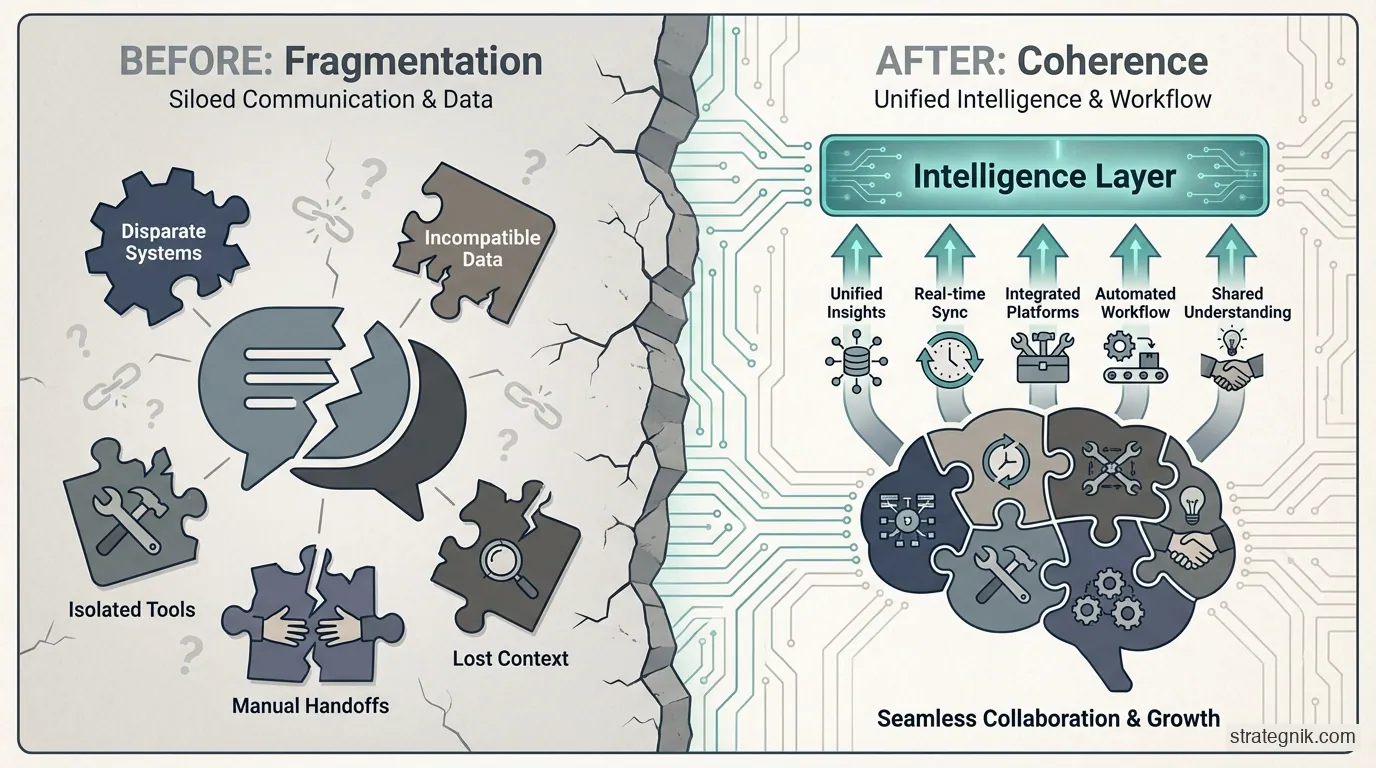
Most “AI adoption” in B2B marketing is still the chatbot pattern: a human types a prompt, the model answers from zero context, and the result depends entirely on who typed. The step beyond it is shared, encoded operating context (brand, ICP, competitive framing, measurement) that agents work from automatically, so the system produces on-strategy output without a person prompting it into existence each time.
That distinction is the whole argument of this post.
Your marketing team has AI access. They’re writing better emails. Maybe better landing pages. Maybe better sales outreach.
That’s not transformation. That’s a typing upgrade.
I’ve watched this pattern at a dozen companies over the past year. The CEO reads the BCG report on agentic marketing. The CMO rolls out ChatGPT Enterprise. The team starts prompting. Output goes up. Quality stays flat. Pipeline doesn’t move. Six months later, the same headcount is doing the same work slightly faster, and the CEO is wondering why the AI investment didn’t change anything.
The reason is structural. And it maps to the same physics that governs every other GTM problem.
The Control Degradation Problem
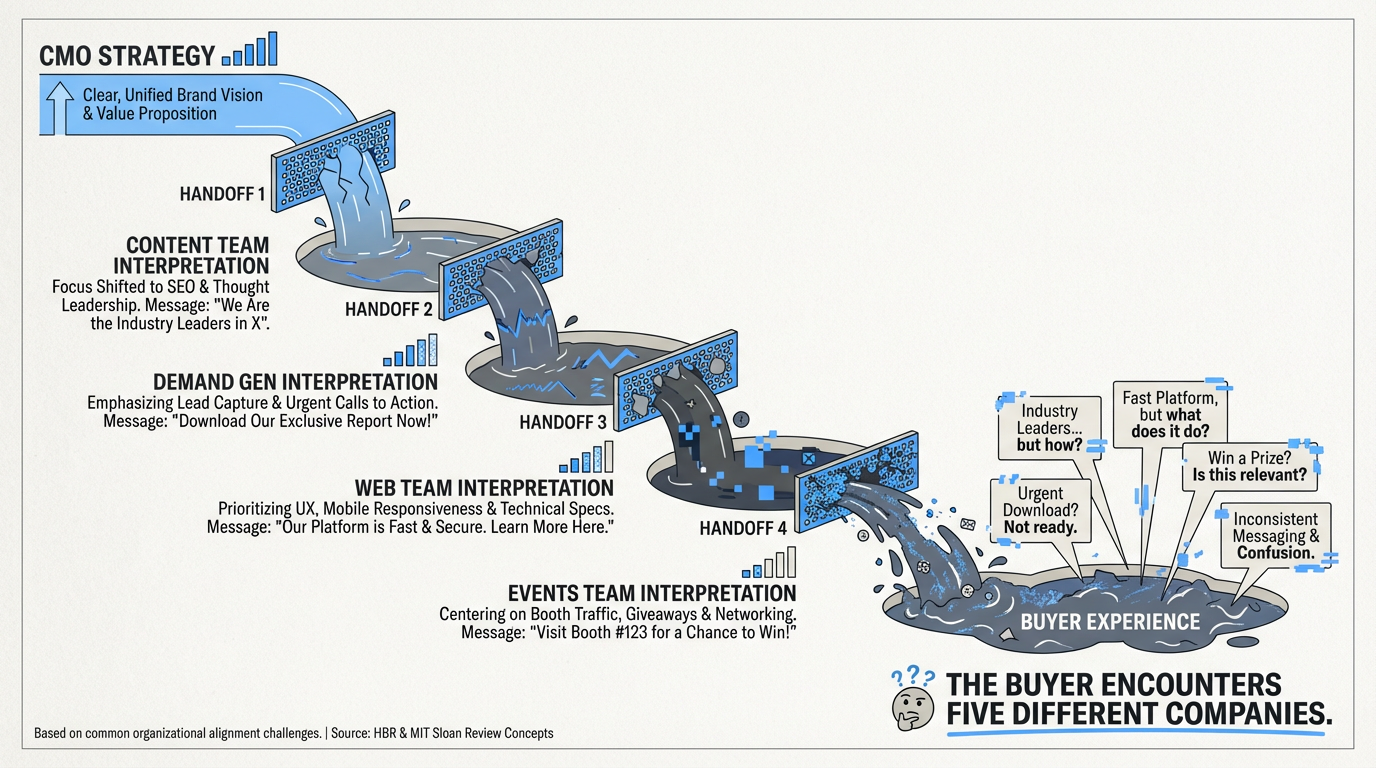
In a typical 20-person marketing org, strategy enters at the top and degrades at every handoff on the way to the market. The CMO defines positioning, ICP, and messaging. The content team interprets the brief one way. Demand gen interprets it differently. Web does its own thing. Events uses whatever deck was built last quarter. Marketing ops is tracking metrics that don’t match the goals.
The buyer encounters five different companies. Brand dilutes. Pipeline slows. Conversion drops. Sales cycles lengthen.
This is a friction problem, compounding at every handoff in the system. In the Coherence Model framework, friction is the force that eats momentum. And the organizational structure of most marketing teams is a friction machine.
Now add AI to that system. What happens?
AI amplifies output, not quality. More content produced faster from a fragmented system means more fragmented content at higher velocity. Five different voices become five louder voices. Agents prompted without shared context start from zero every time: no brand memory, no ICP knowledge, no competitive framing. The agent is a fast intern with no institutional knowledge.
A chatbot trained on fragmented context produces fragmented output — faster.
How Do You Know Your AI Is Still Just a Chatbot?
The tell is that nothing happens until a person asks. If every AI interaction on your team starts with someone opening a window and typing, you are at the chatbot stage, regardless of how sophisticated the prompts are or how many seats you bought.
Most companies ask: “How do we use AI in marketing?”
This is the wrong question. It focuses on tools and access. It generates activity, not architecture. It leaves the foundation unbuilt.
The right question is: What does our AI actually know about us, and is that enough to act on?
Ask your team that question. Ask them what happens when they prompt an AI tool to write a competitive email sequence. Does the tool know your ICP’s pain hierarchy? Does it know which competitor the prospect evaluated last? Does it know your brand voice well enough to produce something you’d send without editing every line?
If the answer is no, and for most companies it is, then you don’t have an AI strategy. You have ChatGPT access.
Here is the diagnostic I run when a CEO tells me the team is “using AI.” These are the signs a team is stuck at the chatbot stage:
- Every interaction is human-initiated. No output is produced on a signal, a trigger, or a schedule. The AI does nothing between prompts.
- Results vary by who typed. One person on the team gets great output and everyone else gets generic mush. The capability lives in individuals, and it walks out the door when they do.
- The “context” is a prompt library. A Notion page or shared doc of prompt templates that was ambitious in month one and stale by month three. Nobody owns it, nothing updates it.
- Every output needs a rewrite. The AI doesn’t know your voice, your ICP’s pain hierarchy, or your competitive position, so a human reapplies all of that by hand, on every draft, forever.
- The AI has no memory of your business. It doesn’t know what shipped last quarter, which campaign worked, or which competitor you keep losing to. Every session starts from zero.
- You measure usage, not outcomes. The AI report to the board is seat counts and adoption percentages, not pipeline, cycle time, or cost per program shipped.
- The org chart hasn’t moved. Same headcount, same roles, same review layers. If AI changed nothing about how work flows, it changed nothing.
None of this means individual prompting is worthless. Used well, ChatGPT is genuinely useful for marketing work, and a team that prompts well beats a team that doesn’t. My argument is that it’s a floor, not a strategy. Three or more of the signs above and you’re paying for transformation while running a typing pool.
What Comes After the Chatbot Stage?
The progression I see at every company that gets past this has three stages, and you can’t skip the middle one.
| Stage | What it looks like | Where context lives | Who initiates work |
|---|---|---|---|
| 1. Chatbot | Individuals prompt a general-purpose model. Output quality tracks prompting skill. | In each person’s head | A human, every time |
| 2. Assistant with context | Tools reference a shared, encoded spec: brand voice, ICP, competitive framing, measurement targets. Output is on-strategy by default. | In a maintained, machine-readable layer | Still mostly humans, but from a shared foundation |
| 3. Governed agents | Agents execute defined plays on signals (content from briefs, nurture on intent, account variants at scale) with human review at defined gates. | In the layer, consumed autonomously | Signals and triggers; humans govern |
Stage two is the unglamorous one, which is why it gets skipped. Companies jump from ChatGPT seats straight to “let’s deploy agents,” and the agents fail for the same reason the chatbot underwhelmed: no shared context to act on. An agent without encoded context is the same fast intern, now unsupervised.
Stage three is where the economics change, because work initiates itself. I’ve written a fuller version of that path in From Chatbot to Agent Fleet, and a practical breakdown of what agents can actually take over in AI Agents for Marketing. The short version: getting from stage one to stage three means building the layer in the middle, not buying a new tool.
What Does an AI Operating System Actually Look Like?
The difference between “using AI” and “being powered by AI” is a layer of infrastructure I call the Context Layer: the encoded operating context that makes every AI tool, every agent, and every team member work from the same shared foundation.
It’s a system every tool references automatically, not a document people forget to check. The context persists across every use case instead of living in one prompt template, and the spec updates as the market moves.
The Context Layer has six components: brand and voice specification, ICP and buyer context, competitive framing, content architecture, machine readability and distribution schema, and measurement targets. Each one is encoded in machine-readable format: not a PDF on a shared drive, but structured context that agents consume autonomously.
But the field serves two audiences. The obvious one is your internal agents and team, giving them the context to produce on-brand, on-strategy output. The less obvious one is every external machine your buyer consults. ChatGPT, Perplexity, and Google AI Overviews are now the first touch in B2B research. If your content isn’t structured for LLM citation, you don’t exist in that buyer’s process. The Context Layer doesn’t just make your AI tools work better. It makes your company legible to every machine your buyer consults.
When the layer exists, the entire marketing function changes character. Content isn’t “write me a blog post about X.” It’s an agent generating from a keyword brief, brand spec, and ICP context — autonomously. Demand gen isn’t “draft this email sequence.” It’s signals triggering nurture flows without manual prompting. ABM isn’t “personalize this one-pager for Acme.” It’s account variants deployed at scale, on signal, in real time. And every page ships with structured data, entity definitions, and passage-level answer blocks that make it citable by AI from day one. That last piece is its own discipline; AI agents for SEO covers how agents run that work continuously instead of as a quarterly audit.
The difference is not better prompting. It is a shared context that every tool operates from.
Why Does This Matter Now?
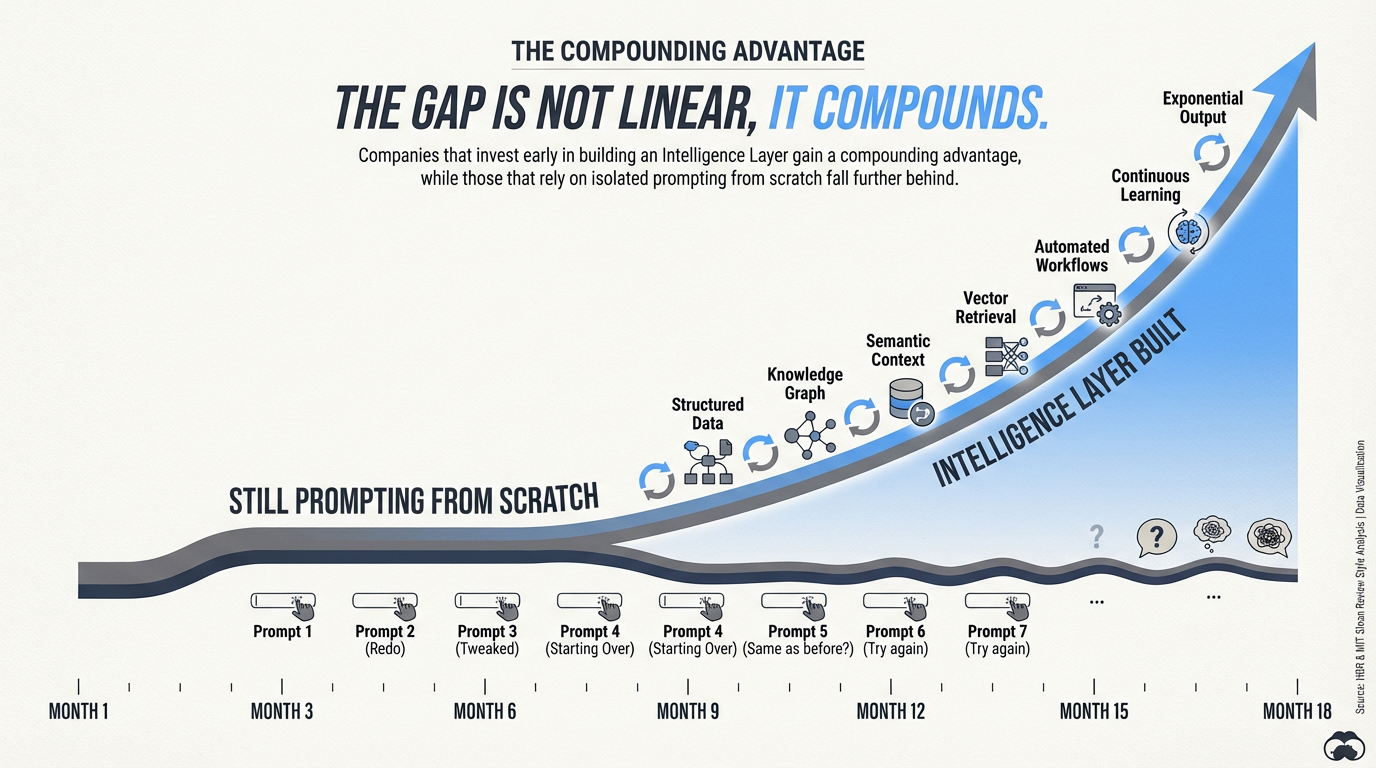
In the Coherence Model, momentum compounds. The companies that build the Context Layer first don’t just get a head start. They get a compounding advantage that widens over time. Every piece of content produced from shared context reinforces brand coherence. Every signal-driven campaign generates data that feeds back into the layer. Every month the layer runs, it gets sharper.
The companies that wait are still prompting ChatGPT from scratch. Still producing fragmented output. Still hiring to scale what architecture should handle.
The market data supports the urgency. Gartner projects 60% of brands will use agentic AI for one-to-one interactions by 2028. BCG expects agentic AI to handle over 20% of marketing’s workload within two to three years. Accenture has already deployed 14 AI agents across their 600-person marketing team, reducing campaign steps from 135 to 85 with 25-55% speed-to-market improvement. Vercel replaced 9 of 10 inbound SDRs with a single AI agent in six weeks. The displacement is not theoretical.
But McKinsey’s data reveals the gap: while 50% of CMOs rank generative AI as a top-three investment, it ranked 17th of 20 in actual execution priorities. Everyone says it matters. Almost nobody is doing it. The challenges, McKinsey notes, are experiential rather than technical, underscoring the need for superior context engineering.
Most companies experimenting with AI agents never manage to scale them, and that gap is exactly where the Context Layer operates. It’s the infrastructure that turns experimentation into a system.
The Escape Velocity Question
Every CEO at a Series B through pre-IPO company is asking some version of the same questions: Should I hire a Head of Marketing or build an AI-native system? My team has AI tools but nothing feels different — why? How many marketers do I actually need? What does marketing look like in 18 months?
They can picture the problem. They cannot picture the solution.
The Context Layer makes the solution visible. It’s the thing that sits between your brand and the AI agents that run your go-to-market. Not AI strategy (too vague). Not marketing automation (last decade’s category). Not a chatbot upgrade. The infrastructure that makes all of those things actually work.
Frequently Asked Questions
What’s the difference between a chatbot and an AI agent?
A chatbot waits for a human to prompt it, answers, and forgets. An agent works from persistent context toward a defined outcome: it can be triggered by a signal, take multi-step action, and operate inside guardrails a human sets. The practical dividing line is initiative. If nothing happens until someone types, it’s a chatbot pattern, whatever the vendor calls the product.
Do we need to buy more AI tools to get past the chatbot stage?
Usually no. Most teams stuck at the chatbot stage already own more capability than they use; the missing piece is encoded context, not another subscription. Before buying anything, write down what your current tools would need to know about your brand, ICP, and competitors to produce work you’d ship unedited. Building that layer is the upgrade. New tools inherit it; without it, they inherit the same fragmentation.
Should we hire a prompt engineer or a Head of AI to fix this?
My opinion: not first. A prompt engineer optimizes the chatbot stage; you’d be paying to get better at the pattern you should be leaving. The prior question is who owns your operating context (positioning, ICP, competitive framing) in a form machines can consume. That’s a strategy and architecture problem before it’s a hiring problem, which is why I’d audit the context gap before writing a job description.
Can a small team skip straight to autonomous agents?
Small teams move through the stages faster because they have fewer handoffs to reconcile, but skipping the context layer fails at any size. Agents act on whatever context they’re given; give them none and they act on none, at higher volume than a human ever could. The sequencing in From Chatbot to Agent Fleet holds for a three-person team the same way it does for a fifty-person org.
Before you hire, build, or buy, know what you’re actually missing.
See all 25 Context Field plays in action → Playbook Catalog