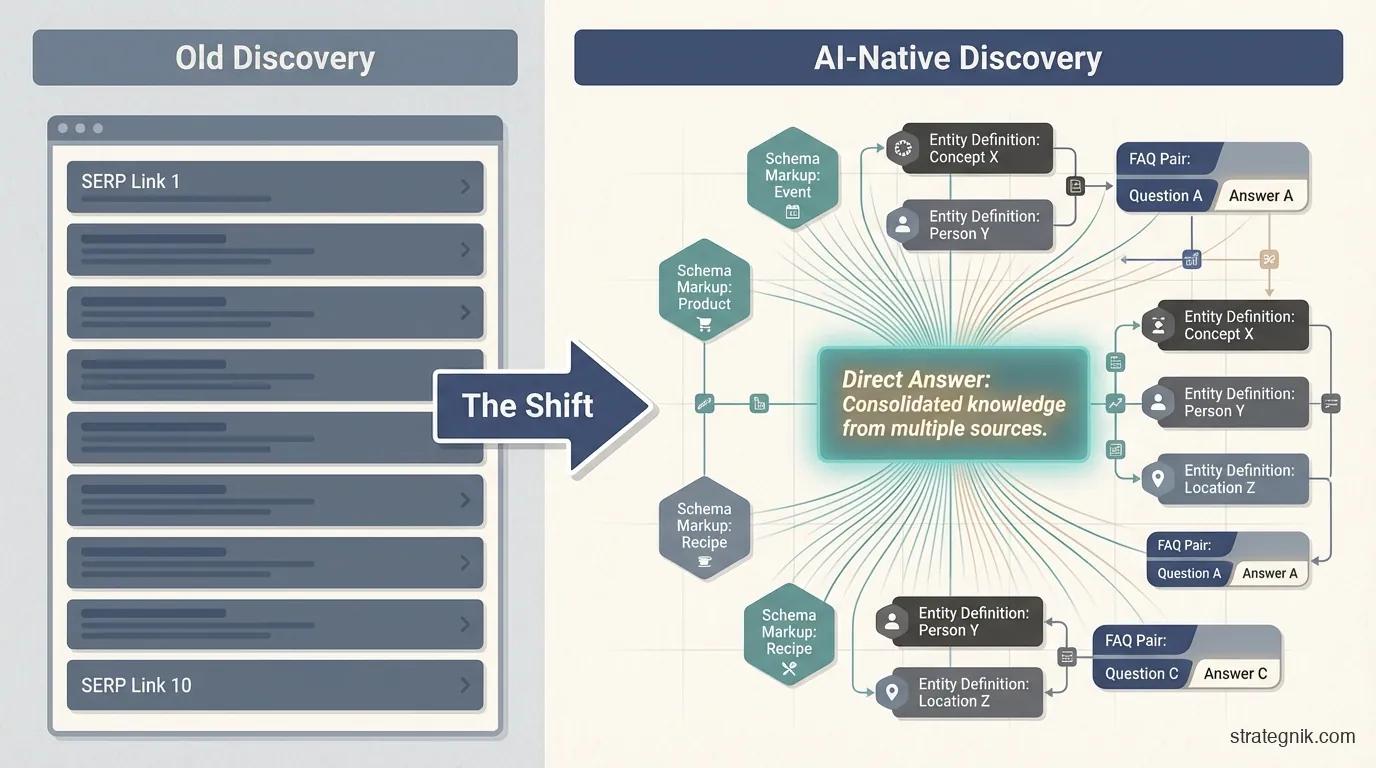
Answer engine optimization is the practice of structuring your company’s knowledge and authority so that AI systems (ChatGPT, Perplexity, Gemini, Claude) surface your brand when buyers ask questions you should own. For B2B SaaS, this is now the primary battleground for discovery. The game has shifted, and most GTM teams haven’t caught up.
What Is a GTM Architect? (And Why “CMO” Doesn’t Capture It)
Most B2B companies don’t need another CMO. They need someone who can design and build the entire system that turns market position into pipeline, and that role doesn’t fit neatly into a marketing org chart.
A GTM architect operates across positioning, demand generation, sales enablement, product marketing, and revenue operations. The job is to design the machine that generates compounding commercial leverage: understanding how buyers discover, evaluate, and choose, then engineering your presence to match those mechanics.
A traditional CMO optimizes channels. A GTM architect optimizes the system. In an era where AI engines synthesize answers instead of serving links, the system is what gets cited — or ignored.
I’ve been building these systems as a fractional CMO for B2B SaaS companies for two decades. The shift to answer engines is the most significant change I’ve seen in how B2B buyers find solutions.
What Is Answer Engine Optimization for B2B SaaS?
Answer engine optimization (AEO) is the discipline of making your brand the definitive answer when AI systems respond to the questions your buyers ask. It combines entity authority, structured content, schema markup, external citation networks, and topical depth to ensure AI models recognize your company as a primary source in your domain.
Unlike SEO, which optimizes for keyword rankings on a results page, AEO optimizes for inclusion in synthesized answers. The output isn’t a blue link. It’s a citation, a recommendation, a direct mention, or silence.
Your buyers aren’t browsing ten results anymore. They’re asking ChatGPT, “What’s the best approach to [your category problem]?” and acting on whatever comes back. If your company isn’t in that answer, you don’t exist in that moment.
Why Are B2B Buyers Now Discovering Solutions Through AI, Not Google?
The shift is stark and moving fast.
Most Google searches now end without a click. The user gets what they need from the search results page itself (featured snippets, AI overviews, knowledge panels) and never visits a website. For B2B content that means your carefully optimized blog post might rank #1 and still generate zero traffic.
ChatGPT’s weekly user base is measured in the hundreds of millions. That’s not a niche behavior. That’s a primary research channel. When a VP of Engineering asks, “What are the top Kubernetes management platforms?” they’re increasingly asking an AI, not opening a browser tab.
Gartner projects a 25% decline in traditional organic search traffic by 2026. That forecast is no longer distant; the decline is measurable in the traffic dashboards of every B2B company I work with.
Buyers who used to start with Google now start with an AI assistant. The entire top-of-funnel discovery layer is being rebuilt around answer engines, and most B2B content strategies aren’t designed for it.
SEO isn’t dead. But SEO alone is no longer sufficient. The companies that win discovery in 2026 are architecturally present in both search engines and answer engines.
The 5 Components of AEO for B2B GTM Systems
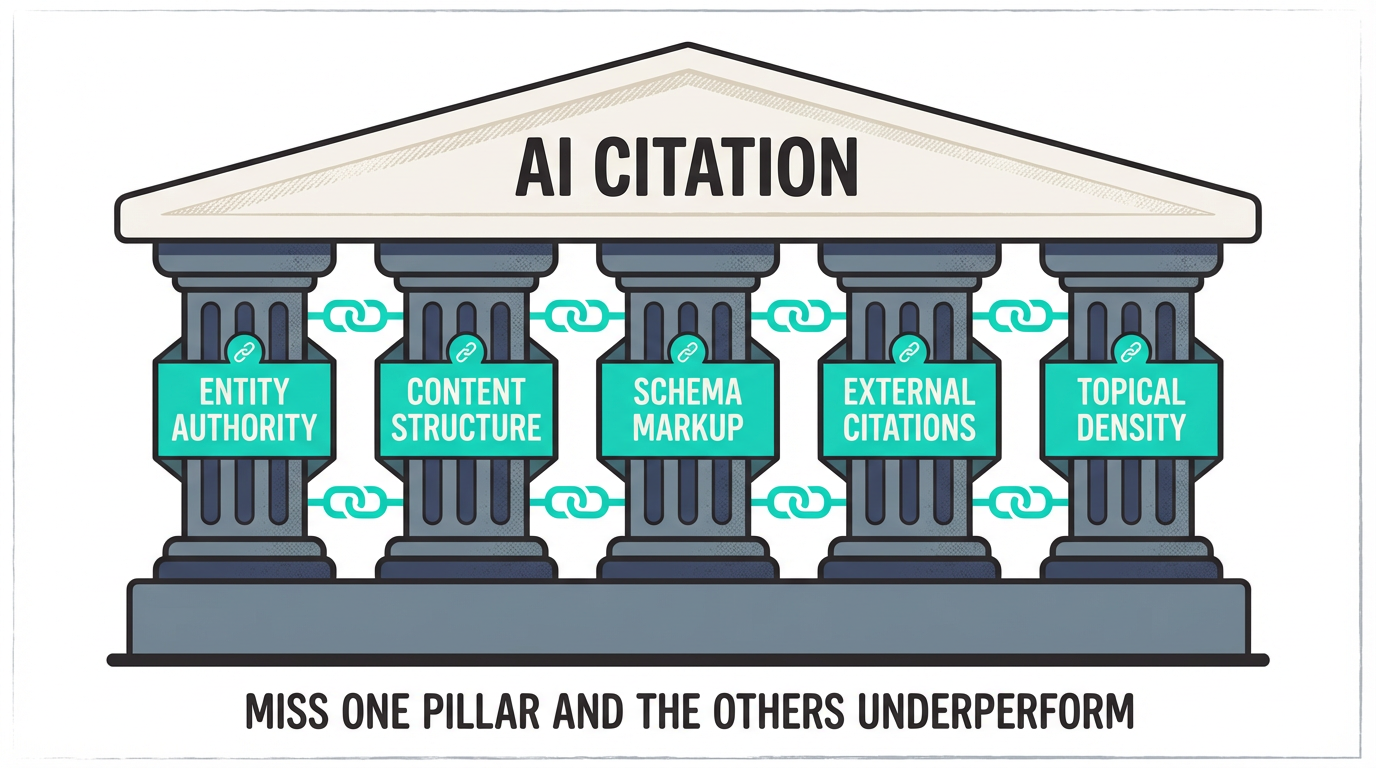
AEO is a system with five interlocking components. Miss one and the others underperform.
1. Entity Authority
AI models don’t rank pages. They rank entities: companies, people, concepts. Your company needs to be a recognized entity in the AI’s knowledge graph, associated with the right topics and categories.
This means consistent naming, clear descriptions across platforms, authoritative third-party references, and structured data that tells AI systems exactly what your company is and does. If an AI can’t confidently describe your company, you won’t appear in answers.
2. Content Structure
Answer engines extract information from content. If your content is structured for humans skimming headlines, it may not be structured for AI extraction. Every key claim needs to be stated in clear, self-contained language. Definitions should be explicit. Lists should be formatted as lists. Comparisons should be tabular.
The best AEO content reads well and extracts well. Precision serves both audiences.
3. Schema Markup
Schema.org markup gives AI systems a machine-readable layer on top of your human-readable content. FAQPage schema, HowTo schema, Organization schema, Article schema: these aren’t SEO nice-to-haves anymore. They’re the metadata that helps answer engines parse your content with confidence.
Most B2B SaaS sites have minimal schema implementation. The companies that invest in comprehensive markup gain a structural advantage in how AI systems interpret and cite their content.
4. External Citations
AI models are trained on, and retrieve from, the broader web. Your company’s presence in third-party sources matters enormously. Guest posts on industry publications. Mentions in analyst reports. Appearances in comparison pages and roundups. Community contributions. Podcast transcripts.
Every external citation signals entity authority. This is the B2B equivalent of link-building, but the value chain is different. You’re not building links for PageRank. You’re building citations for AI retrieval.
5. Topical Density
AI systems favor sources that demonstrate comprehensive expertise on a topic. A single blog post about Kubernetes security won’t make you the answer. Twenty interconnected pieces covering Kubernetes security from multiple angles (architecture, compliance, tooling, case studies, comparisons) creates topical density that AI models recognize.
This is why GTM architecture and content strategy are inseparable in the AEO era. You can’t optimize for answer engines post-hoc. The architecture has to be designed for topical dominance from the start.
How Does the Coherence Model™ Framework Map to AI Discoverability?
This is where most AEO guides stop: they give you a component checklist without a system model. The Coherence Model™ framework provides the system model. It explains not just what to build but why certain companies compound their AI visibility while others stay invisible.
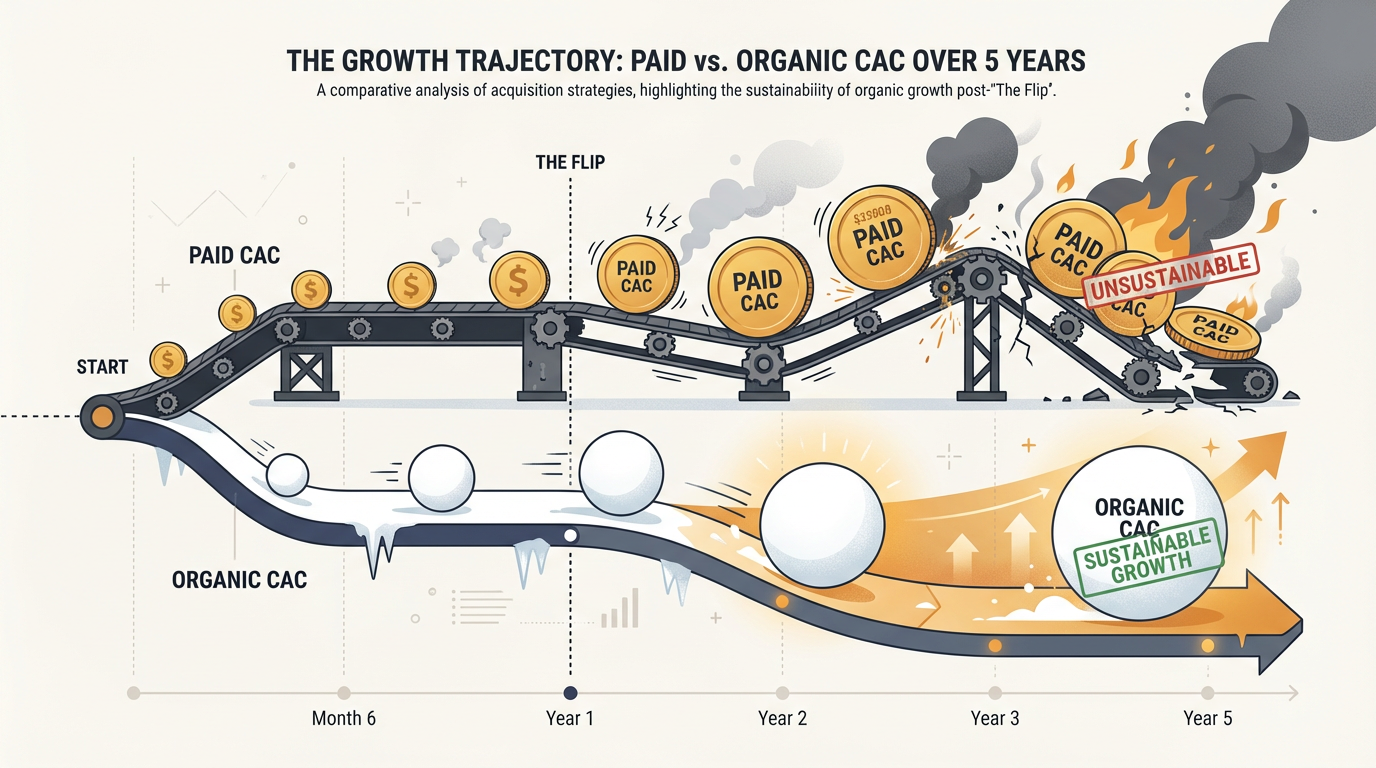
Three forces govern your brand’s behavior in the AI discovery layer: Gravity, Momentum, and Friction.
Gravity: The Organic Pull of AI Discoverability
Gravity is the force that pulls buyers toward you without you pushing. In the AI era, gravity is generated by entity authority and topical density. The more authoritative and comprehensive your presence, the stronger your gravitational pull in answer engines.
A company with high gravity gets cited unprompted. When someone asks an AI about your category, your name appears, not because you paid for placement but because the AI’s training data and retrieval systems recognize you as a primary entity. This is the compound return on sustained, structured thought leadership.
Gravity isn’t built in a quarter. It’s the accumulation of years of consistent, well-structured content, reinforced by external citations and entity signals. Companies that have been investing in real expertise instead of keyword-stuffed blog posts have a massive head start. The first 90 days of a fractional CMO engagement should include an honest assessment of your current gravitational mass.
Momentum: Compounding Citations Over Time
Momentum is what happens when gravity starts working. Each citation begets more citations. Each time an AI surfaces your content, users interact with it, share it, reference it, and the next generation of training data includes those references. It compounds.
This is why early movers in AEO have a structural advantage. The citation graph is self-reinforcing. A company that is cited today trains the models that cite tomorrow. Waiting to “see how AEO plays out” is a decision to fall behind a compounding curve.
Momentum also explains why sporadic content doesn’t work. Publishing three thought-leadership pieces in January and going silent until April breaks the compounding cycle. AI systems reward sustained topical presence, not bursts.
Friction: The Barriers to Being Discovered
Friction is everything that prevents AI systems from finding, understanding, and citing your content. Poor site structure. Missing schema markup. Inconsistent entity descriptions. Content locked behind login walls. PDFs without metadata. Jargon that doesn’t match how buyers actually phrase questions.
Most B2B SaaS companies have enormous friction in their AI discoverability and don’t know it. They’ve been optimizing for Google’s crawler for a decade and assume that transfers to AI systems. It doesn’t. AI extraction has different requirements, and the gaps are invisible unless you look for them.
Friction reduction is often the highest-leverage AEO work. You may already have the content and authority to be cited, but structural barriers are preventing it. A Digital Context Audit is specifically designed to identify and quantify these barriers.
What Does a GTM Architect Do Differently Than a Traditional CMO in the AEO Era?
The difference is operational.
A traditional CMO manages marketing channels: paid, organic, events, content, brand. They optimize each channel for its own metrics and roll up to pipeline and revenue. In the AEO era, this produces a fragmented presence. Each channel generates content, but nobody is architecting the system-level coherence that answer engines reward.
A GTM architect designs the entire discovery system. That means:
Unified entity strategy. Ensuring your company, your founders, your key concepts show up consistently across every surface: your site, third-party publications, social, podcasts, data sources. Not as a branding exercise, but as an AI-legibility exercise.
Content architecture, not content calendars. Designing interconnected content systems that build topical density around the questions you want to own. This is the difference between “let’s publish two blogs a week” and “let’s build an authoritative content network that makes us the definitive answer in our category.”
Cross-functional citation engineering. Working with sales, product, and customer success to generate the external references (case studies, integration docs, community answers, partner content) that build the citation graph AI systems use to assess authority.
Measurement beyond traffic. Tracking AI citations, answer inclusion rates, entity visibility, and brand mentions in AI-generated content. These are the leading indicators in the AEO era. If you’re only measuring organic traffic, you’re watching a lagging metric that’s structurally declining.
This is why the cost of a fractional CMO should be evaluated against system-building capability, not just campaign management. The role has fundamentally expanded.
The Digital Context Audit™: Where to Start Your AEO Diagnosis
If you’re reading this and wondering where your company stands, the answer is almost certainly: worse than you think, but fixable.
The Digital Context Audit is the diagnostic I built specifically for this problem. It assesses your current position across all five AEO components and maps them to the Coherence Model™ framework. Here’s what it covers:
Entity visibility scan. How do AI systems currently describe your company? Where are the gaps between how you see yourself and how AI sees you?
Content structure analysis. Is your existing content extractable by answer engines? Where are the structural gaps?
Citation graph mapping. Where does your company appear in third-party sources? How does your citation footprint compare to competitors?
Friction inventory. What’s blocking AI systems from finding and using your content? Login walls, PDF reliance, inconsistent naming, missing metadata.
Momentum assessment. Is your content velocity sufficient to build compounding citations? Where are the stalls?
The output is a prioritized action plan: what to fix first, what to build next, and how to measure whether it’s working.
Frequently Asked Questions
What’s the difference between AEO and traditional SEO?
SEO optimizes for search engine rankings. AEO optimizes for answer engine inclusion: getting your brand cited when AI systems synthesize answers. SEO focuses on keywords and links. AEO focuses on entity authority, content structure, and citation networks. They’re complementary, but AEO is becoming the higher-leverage investment as buyers shift toward AI-first discovery.
How long does it take to see results from AEO?
Entity authority and citation networks take three to six months to produce measurable changes in AI visibility. Content restructuring can show results within weeks if you already have authoritative content that’s poorly structured for extraction. Compounding effects typically become visible at six to twelve months. This is a structural investment, not a quick fix.
Can a startup with limited content compete in AEO?
Yes, but be surgical. Startups can’t build topical density across every category, but they can dominate a narrow topic. Pick the one question your ICP asks most often, become the definitive answer, and expand from there. Founder thought leadership, strategic guest content, and community contributions build citation graphs faster than blog posts on your own domain.
Does AEO replace demand generation?
No. AEO is a component of a complete GTM system. Paid channels, events, outbound, partnerships still drive pipeline. AEO changes the discovery layer. When a buyer encounters your brand and asks an AI to learn more, AEO determines whether the AI reinforces your positioning or returns a blank. It’s the foundation under your demand gen, not a substitute.
What schema markup matters most for B2B SaaS?
Start with Organization schema, FAQPage schema, Article schema, and HowTo schema. If you have a product with defined features and pricing, add Product schema. Partial schema is better than none, but complete schema is significantly better than partial.
How do I measure whether AEO is working?
Track four things: (1) AI citation monitoring: are AI systems mentioning your brand in relevant answers? (2) Entity visibility: search your company in ChatGPT, Perplexity, and Gemini and assess accuracy. (3) Referral traffic from AI sources: monitor traffic from chat.openai.com, perplexity.ai, and similar domains. (4) Share of voice in AI answers for target queries versus competitors. Traditional organic traffic is still worth tracking but is no longer the primary success metric.
Should I hire an AEO specialist or a fractional CMO who understands AEO?
An AEO specialist handles technical execution: schema markup, content restructuring, citation building. But AEO doesn’t work in isolation. It needs to be integrated into your GTM architecture: positioning, content strategy, sales enablement, competitive narrative. A fractional CMO with GTM architecture experience designs the system that AEO plugs into. Most B2B SaaS companies need both: strategic layer first, technical execution second.
For a complete guide to making your B2B brand visible to AI search, see our Answer Engine Optimization strategy page.