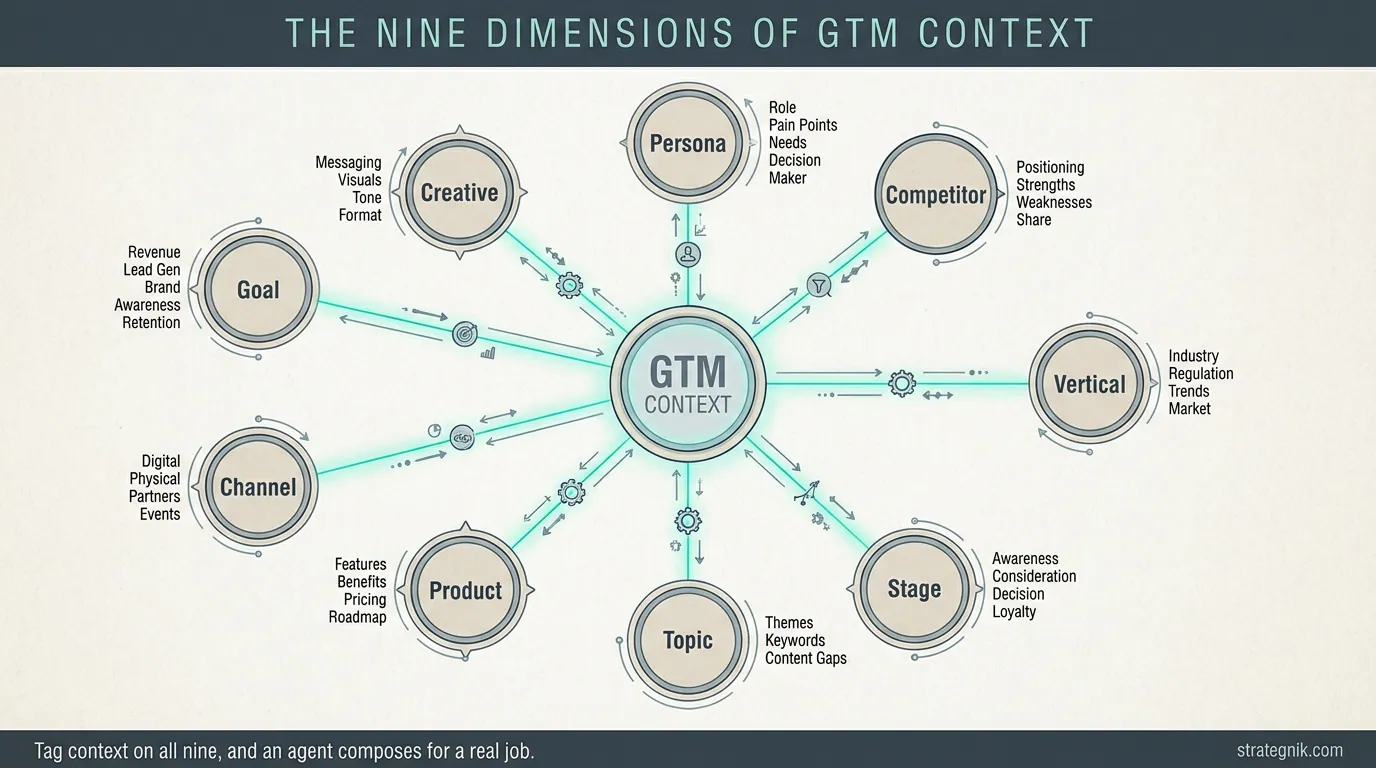
If you read why your AI is still a chatbot, you know the argument: most companies gave their team AI access and called it a strategy. The real work is building the Context Layer: the encoded operating context every tool, agent, and teammate works from. In practice that means an Intelligent Context Layer: the machine-readable version of your business that AI systems can actually use.
This is the practical guide to what that context actually contains. Not a generic knowledge base: your go-to-market context, the operating context behind the work: composing emails, writing blogs, building content, coaching a rep through a live deal.
GTM context has a property most internal knowledge doesn’t: its output is public. The blog that ranks. The landing page a buyer reads. The answer an LLM gives when someone asks about your category. Half of this context makes your own agents smarter. The other half makes your company legible to every machine your buyer consults before they ever contact sales: ChatGPT, Perplexity, Google AI Overviews. Get the context right and the public output is right. Get it wrong and you’ve published the mistake at scale.
Ontogent organizes that context along nine dimensions: the facets every piece of context is tagged on, so the right slice gets assembled for whatever an agent is composing. Miss one and the output degrades in a specific, predictable way.
1. Persona: who it’s for
What it is: the buyer roles and titles a piece of context speaks to: VP of Ops, RevOps lead, CFO.
Built: an agent writing to a pricing-page visitor tailors the message to that persona’s actual pain, not a generic “I noticed your company is growing.”
Missing: every email is one-size-fits-none. The AI writes faster, but writes the same undifferentiated note to the enterprise buyer and the mid-market buyer alike.
Physics: persona context is what makes surface area efficient: every touchpoint aimed, not broadcast into the void.
2. Competitor: who you’re against
What it is: the alternatives you’re positioned against, your displacement narratives, win/loss context.
Built: a case study knows your displacement story, the specific reason to switch and the proof that makes it credible, instead of “like [Competitor X], but cheaper.”
Missing: your blog, your deck, and your cold email each tell a different story about the competition. The buyer who talked to all three this week can’t figure out why you’re different — because you can’t either.
Physics: differentiation is mass. Generic differentiation is no mass at all.
3. Vertical: the industry it’s for
What it is: the industries and segments a piece of context applies to, with their language and constraints.
Built: content for a freight buyer sounds like it was written by someone who knows freight; content for healthcare knows HIPAA is in the room.
Missing: horizontal mush that resonates with nobody because it was calibrated for everybody.
4. Buyer stage: where in the journey
What it is: where the context lands in the buyer’s journey: awareness, consideration, decision, retention.
Built: an unaware buyer gets a problem-framing email; a solution-aware buyer gets a comparison; an existing customer gets an expansion play, not a first-touch pitch.
Missing: the same message fired at every stage: decision-stage urgency aimed at someone who doesn’t yet know they have the problem.
Physics: stage-matched context removes friction. Stage-blind context manufactures it.
5. Topic: the subject matter
What it is: the subjects a piece of context covers, and how they cluster into authority.
Built: your content forms topic clusters that reinforce each other, so machines read the whole as authoritative on a subject, not 200 isolated posts.
Missing: flat, disconnected pieces that compound into nothing. No cluster, no authority, no citation.
Physics: clustered topics accumulate mass. Scattered ones dissipate it.
6. Product: what you actually sell
What it is: the products, features, and capabilities the context describes — accurately.
Built: an agent references the exact feature that solves this persona’s problem, without inventing capabilities you don’t ship.
Missing: vague benefit-speak, or worse, confident hallucination of features that don’t exist, the fastest way to lose a technical buyer for good.
7. Channel: which motion it feeds
What it is: which GTM motion the context is for: email, social post, blog, paid ad, landing section, DM. Each has its own shape.
Built: the same underlying context composes a tight cold email, a scannable landing section, and a long-form blog, each one native to its channel.
Missing: blog paragraphs pasted into a cold email; ad copy stretched into an article. One voice, wrong format, everywhere.
8. Goal: the business objective
What it is: the objective a piece of context serves: pipeline, expansion, retention, category creation.
Built: every asset is tied to an outcome, and the system steers toward it. Underperformance surfaces; targeting adjusts.
Missing: activity mistaken for progress. Forty-seven KPIs in a spreadsheet and no feedback loop connecting any of them to the work.
Physics: the goal is the steering wheel on your momentum. Fast in the wrong direction is still wrong.
9. Creative: the visual point of view
What it is: the visual treatment and the argument a visual makes: the modality, the concept, and the point of view an image is meant to carry.
Built: a featured image argues the post’s thesis; a diagram earns its place. The look is unmistakably yours.
Missing: generic stock photos and decorative clip art that say nothing: visual filler that dilutes distinctiveness instead of building it.
Why you can’t tag half the field
The nine dimensions are interdependent. Persona without competitor is on-target content with no edge. Topic without channel is authority nobody can consume. Goal without the other eight is a dashboard tracking a system nobody built.
Here’s what’s changed since the early version of this argument: this is no longer a consulting engagement you buy or a headcount you hire. It’s a tool. The engine that tags context on these dimensions, enforces your rules, and resolves which context wins when two of them collide is open source: ontogent-core, MIT-licensed. Your domain knowledge lives in packs that stay yours; the mechanism is inspectable and shared.
The field still has to be built for a specific company, in a specific market, at a specific stage; there’s no generic version of your personas, your competitive position, or your goals. But building it is now configuration, not a bespoke project. And because the output is public, getting these nine right isn’t housekeeping. These nine dimensions are whether the machines your buyer consults can find you, cite you, and get you right.
See all Context Field plays in action → Playbook Catalog