The best GEO and AEO tools in 2026 are not magic visibility machines. The market is young, noisy, and full of vendors renaming ordinary AI SEO tools as generative engine optimization tools because the category is hot.
Most “AI SEO tools” are still content generators with a new label. That does not make them useless. It just means they should not be confused with a system for earning citations in AI answers, building entity authority, or making your site easier for machines to understand.
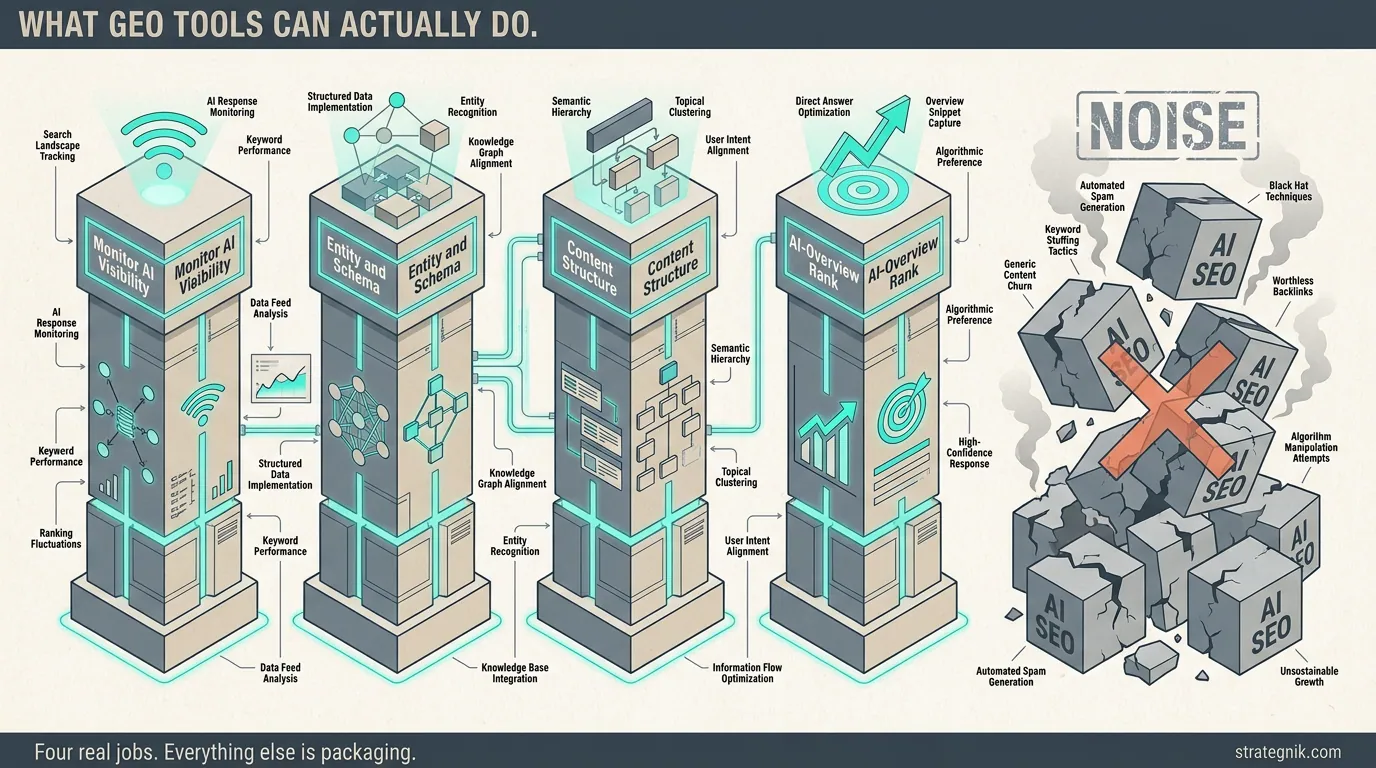
The tools that matter do one of four jobs: monitor AI visibility, improve entity and schema infrastructure, optimize content structure, or extend rank tracking into AI Overviews. Everything else is either workflow convenience or packaging.
The Four Jobs a GEO Tool Can Actually Do
Useful GEO and answer engine optimization tools fit four categories: AI-visibility and citation monitoring, entity and schema infrastructure, content structure and optimization, and rank or SERP tracking extended to AI Overviews.
The distinction matters because buying the wrong category creates false confidence. Monitoring tells you where you appear. Schema helps machines parse who you are and what you offer. Content optimization improves page-level clarity. AI Overview tracking shows whether search results are changing around your brand or category.
AI-Visibility and Citation Monitoring
This is the category most people mean when they go looking for the best-rated answer engine optimization tools: platforms that watch how brands, competitors, and sources appear inside AI-generated answers.
Profound is an enterprise-tier AI citation monitoring platform for tracking how brands appear across generative answer surfaces.
Otterly.AI monitors AI search visibility so teams can see where their brand, competitors, and content are showing up.
Peec AI tracks AI visibility and helps teams understand how they are represented in generative search results.
Semrush has added AI-visibility features to its broader SEO suite for teams that want AI search tracking alongside existing search workflows.
These tools are useful when you already have enough market presence to measure. They are less useful if the real problem is that your site has thin content, weak entity signals, or no credible third-party citations for models to rely on. For what these platforms measure, how the sampling works, and when buying one is premature, see AEO tracking tools: how to measure your AI search visibility.
Entity and Schema Infrastructure
Entity and schema infrastructure is the least glamorous part of GEO, but it is often where the work should start. Models and search systems need clear signals about your organization, products, authors, services, locations, relationships, and proof points.
This category includes schema markup generators, structured data testing tools, knowledge graph cleanup, organization schema, product schema, FAQ schema where appropriate, and content architecture that makes entities explicit. Even the best AI SEO tools cannot compensate for a site that makes your business hard to parse.
If you are serious about answer engine optimization, schema is not the whole strategy. It is the wiring. It helps machines understand the page, but it does not make the page authoritative.
Content Structure and Optimization
Content structure tools help teams make pages clearer, more complete, and easier to compare against the pages already ranking or being cited. This is where traditional SEO tooling overlaps with LLM SEO tools.
Surfer is a content optimization platform that helps teams structure pages around topics, terms, and competitive search patterns.
Clearscope does related work with a focus on topical coverage and page clarity.
These tools can improve the raw material. They cannot decide whether the page deserves to exist, whether the site architecture supports the topic, or whether the brand has enough authority to be trusted in an answer.
Rank and SERP Tracking Extended to AI Overviews
Classic rank tracking still matters because AI answers do not replace the entire search results page. They sit on top of, next to, or inside the same discovery environment buyers already use.
Ahrefs Brand Radar tracks brand mentions and visibility signals in AI Overviews so teams can monitor where they appear in AI-shaped search results.
Semrush also appears in this category because its AI Overview tracking extends traditional search monitoring into AI-generated SERP features.
This category is useful for teams that already watch rankings and want to understand how AI Overviews change visibility. It is not the same thing as full AI citation monitoring across every answer engine, and it is not the same thing as building authority.
What No Tool Does
No GEO tool builds entity authority for you. No AEO tool restructures your content architecture by itself. No monitoring dashboard earns citations from credible third-party sources. Tools measure and assist. They do not create the underlying reasons a model should trust, mention, or cite you.
That is system work. It includes clarifying entities, building high-intent content clusters, earning external references, improving technical structure, and aligning sales, product, and marketing language so the market describes you consistently.
If you need that system built, a GEO agency should be judged by the architecture it creates, not the dashboards it screenshots. The same is true for LLM SEO: the durable work is not prompt tricks. It is making your business legible across the web.
The deeper issue is usually not tooling. It is that the company has not built enough digital context for AI systems to understand why it belongs in the answer. That is why many B2B teams do not show up in ChatGPT even when they publish regularly. The problem is explained more directly in why B2B content does not show up in ChatGPT.
How to Choose
If you are an enterprise brand with existing demand, start with AI-visibility and citation monitoring. You need to know where you appear, which competitors are being cited, and which sources influence the answer.
If your site is structurally messy, start with entity and schema infrastructure. Better monitoring will only tell you that the foundation is weak.
If you already have a strong site but uneven content quality, use content structure and optimization tools to tighten pages, improve coverage, and remove ambiguity.
If your team already lives in SEO dashboards, add AI Overview tracking before buying a standalone platform. It is the shortest path from familiar search reporting to AI-shaped search visibility.
If you are choosing between categories, be honest about the job. Monitoring is not building. Optimization is not authority. Schema is not demand. The right tool depends on the bottleneck.
Frequently Asked Questions
What is the best AEO tool? There is no single best AEO tool because the category covers different jobs. Monitoring tools help you see whether you appear in answers. Schema tools help machines understand your site. Content tools improve page structure. None of those automatically builds the authority needed to be cited.
Are GEO tools worth it? Yes, if you know what you are buying. GEO tools are worth it when they answer a specific operational question: where do we appear, what are models citing, which pages are unclear, or how are AI Overviews changing the SERP?
Can I do GEO without tools? Yes. Start with clear content architecture, strong entity pages, schema, internal linking, and credible external references. Tools help measure progress, but the first layer of GEO is structure.
If you want to know whether your site gives AI systems enough context to trust you, start with a Digital Context Audit.