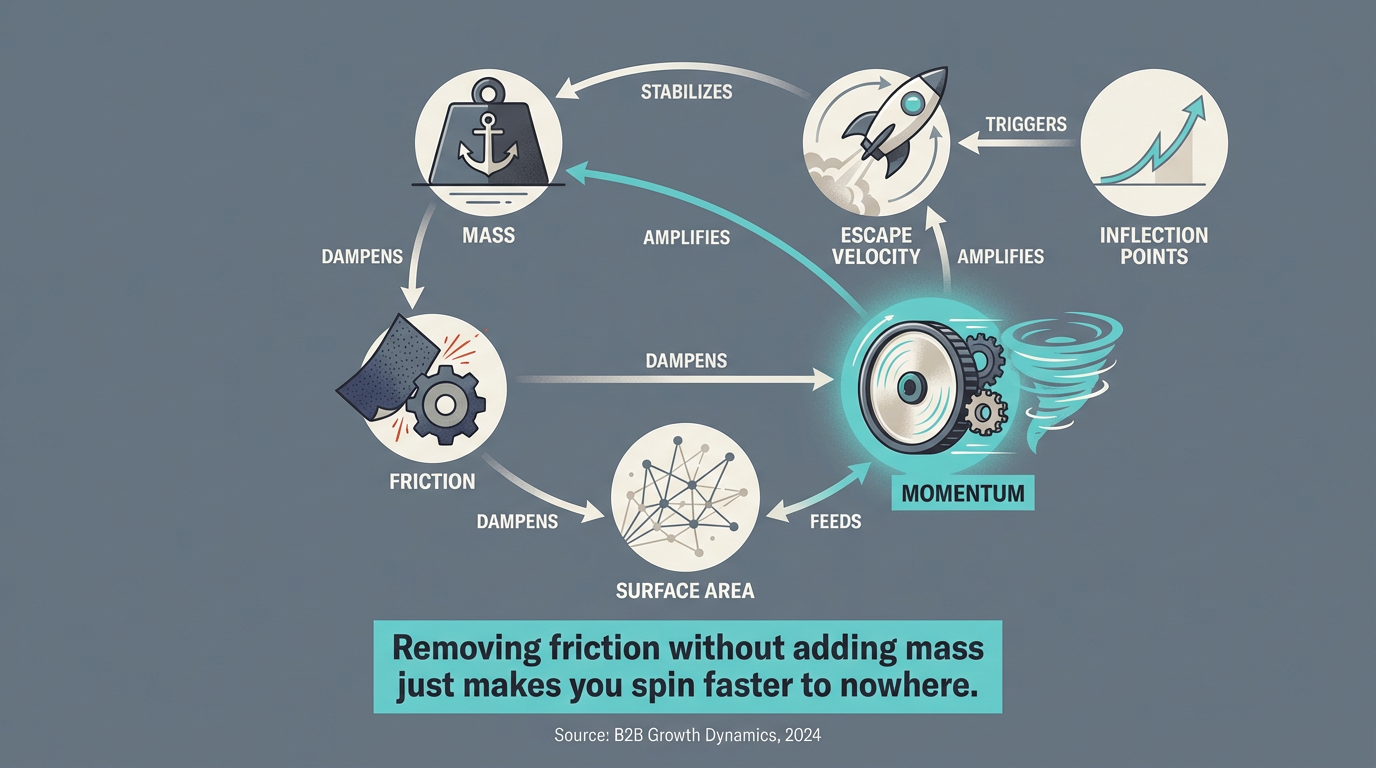
Every B2B company operates inside a growth system governed by forces most leaders never name. They feel the effects — campaigns that should work but don’t, hires who fail in the same pattern, spend that scales linearly while results plateau — but they attribute them to execution problems, talent gaps, or market timing.
Usually, it’s physics.
Over twenty years of building and advising go-to-market organizations, I’ve watched the same dynamics repeat across hundreds of companies. The patterns are consistent enough to be predictive. The companies that break out aren’t the ones with better tactics. They’re the ones — whether they use this language or not — operating with an intuitive grasp of the forces acting on their growth system.
This framework names those forces. Not as metaphor. As an operating model.
The Physics of Growth section of this site explores each concept in depth. What follows here is the complete framework: six forces, how they interact, and how a GTM leader applies them to make better investment decisions.
Mass: The Weight Your Brand Carries
In physics, mass determines how an object responds to force. A heavier object requires more energy to accelerate — but once moving, it’s harder to stop.
The GTM analog: Mass is your accumulated market presence. Brand recognition. Content library depth. Customer base. The breadth of third-party mentions, citations, analyst coverage, and peer recommendations that signal to the market — and increasingly to AI systems — that you are a credible, established player.
Mass is not awareness. Awareness is whether people have heard of you. Mass is whether the market takes you seriously when you show up. A company with high awareness but low mass is one everybody recognizes and nobody trusts. A company with high mass converts at higher rates across every channel, commands pricing premium, and gets cited by AI systems because the accumulated evidence of authority crosses their relevance threshold.
Concrete example: Two companies launch identical paid campaigns targeting the same ICP. Company A has been publishing authoritative content for three years, has 200 customer logos, and gets mentioned in Gartner peer reviews. Company B launched last quarter with a better product but no market presence. Company A’s campaign converts at 3x the rate. Same ad. Same offer. Different mass.
The implication: Mass is slow to build and slow to decay. It is the single most underleveraged asset in B2B — and the single most common thing early-stage companies try to skip. You cannot shortcut mass. You can only start building it earlier. Every month of consistent, quality market presence compounds into the gravitational weight that makes everything else work better.
This is why GTM leaders churn at early-stage SaaS companies — they’re asked to produce momentum-stage results in a mass-building phase. The system is too light for the force being applied.
Surface Area: How Much of the Market You Touch
In physics, surface area determines how much of an object is exposed to its environment — affecting heat transfer, friction, and interaction with surrounding forces.
The GTM analog: Surface area is your market contact. The number of channels, conversations, communities, and contexts where your brand appears. It’s not just distribution. It’s the breadth of your interaction with the market — how many different ways a potential buyer could encounter you before they’re in-market.
Surface area is distinct from mass. A company can have enormous mass (deep authority in a narrow niche) with almost no surface area (only visible in one channel). Or it can have wide surface area (omnipresent across channels) with negligible mass (recognized but not respected in any of them).
Concrete example: A cybersecurity company dominates organic search for five high-intent keywords. Deep mass, narrow surface area. A competitor appears in organic search, LinkedIn, podcasts, analyst reports, partner ecosystems, conference circuits, and AI-generated recommendations. Wider surface area. When the buyer enters the consideration phase, the second company has already appeared in four contexts. The first company appears once — if the buyer searches the right term.
The implication: Surface area determines how many paths lead back to you. In a world where AI is collapsing the walls between discovery channels, the companies with the widest surface area are the ones AI systems aggregate signal from most effectively. A context field that maps where your market actually pays attention — and where you’re absent — is the diagnostic tool for surface area gaps.
Surface area also interacts with mass in a compounding way. Each new surface creates a new opportunity for mass to accumulate. A podcast appearance that gets cited in a blog post that gets summarized by an AI system that gets referenced by a buyer in a Slack channel — that’s surface area creating mass at each step.
Momentum: The Force That Compounds
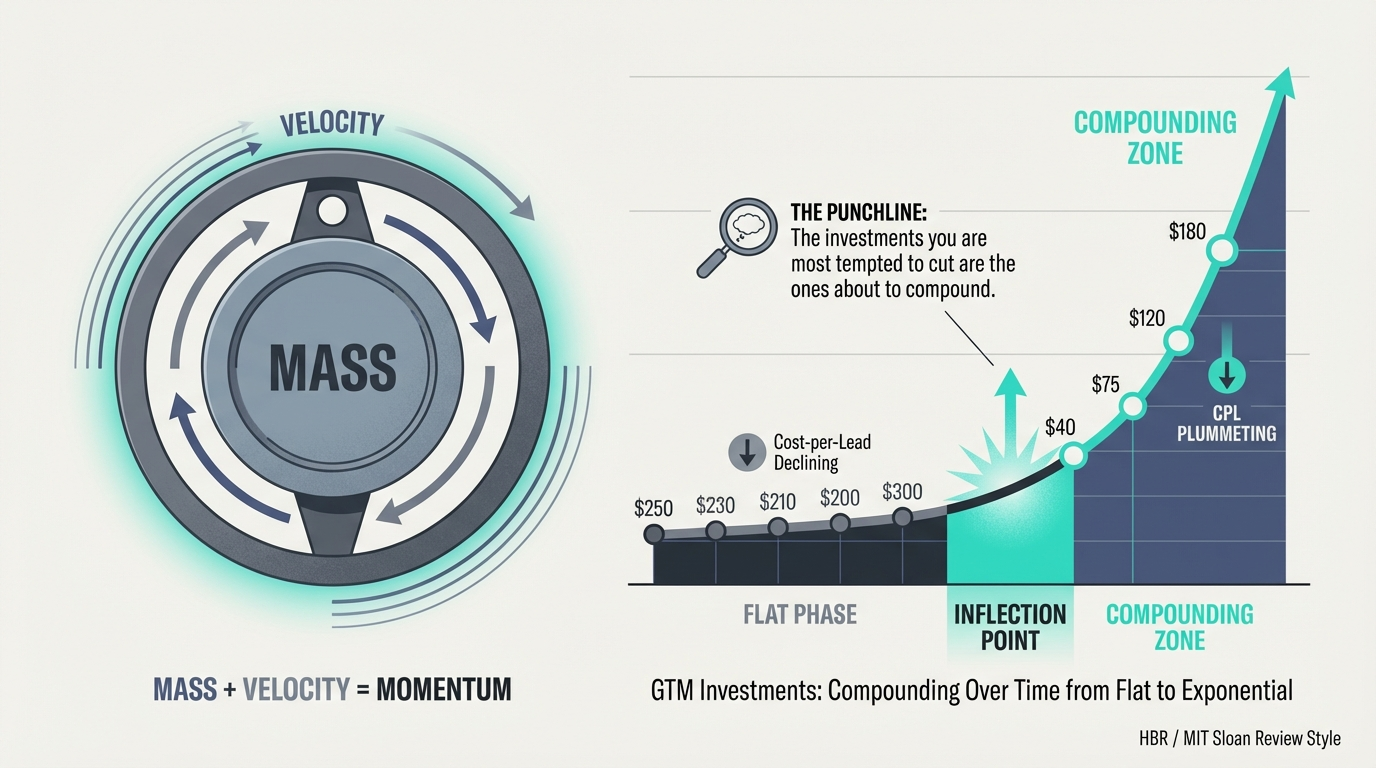
In physics, momentum is mass times velocity. An object with momentum tends to keep moving. The heavier and faster it is, the more force required to stop it.
The GTM analog: Momentum is what happens when accumulated market presence (mass) meets consistent execution (velocity). A growth program with momentum produces improving returns on consistent investment. Each dollar works harder than the last. Cost per lead declines. Brand search volume rises. Content generates pipeline months after publication. Sales cycles shorten because buyers arrive pre-educated and pre-sold.
The deep dive on momentum covers the diagnostic indicators. The critical insight here is that momentum is asymmetric: it takes sustained force over time to build, almost nothing to maintain once achieved, and far more than the original investment to rebuild if you stop and restart from zero.
This is why growth programs that look like they’re failing are often the ones most worth protecting. The compounding curve — flat for months, then steep — is specifically designed to fool quarterly review cycles into killing programs before they inflect. The investments that compound are the ones you’re most tempted to cut.
Concrete example: A Series B company invests in a content program. At month six, cost per lead is 3x paid. The board questions the spend. By month twelve, it crosses over. By month seventeen, it generates 40% of pipeline on 15% of budget — and gets cheaper every month. The CEO who wanted to kill it starts calling it “our moat.”
The implication: Momentum is the most valuable state a growth system can achieve and the hardest to measure in real time. You have to track the trend — cost per lead trajectory, brand search velocity, organic-to-paid ratio over time — not the snapshot. If you only evaluate growth programs at a point in time, you will systematically underfund the ones that matter most.
The Ehrenberg-Bass Institute data is unambiguous: brands that stop investing see 16% sales decline in year one, 25% by year two, 36% by year three. Recovery takes longer than the hiatus. The only thing more expensive than building momentum is building it twice.

Friction: The Force That Eats Your Pipeline
In physics, friction is the force that opposes motion. It converts kinetic energy into heat — energy lost from the system, unable to do useful work.
The GTM analog: Friction is every point of resistance in the buyer journey and sales motion that converts interested prospects into lost opportunities. Forms with unnecessary fields. Pricing pages that require a spreadsheet to decode. Demo request processes that take eleven days and seven meetings when the buyer was ready to sign on day one.
The friction deep dive catalogs where friction hides — cognitive friction (messaging too complex to parse), process friction (internal procedures imposed on buyers), and trust friction (missing social proof and credibility signals). I wrote separately about the compound cost of friction — the fact that friction doesn’t just lose you the individual lead, it trains the market that you’re hard to work with.
Concrete example: A SaaS company requires a form with twelve fields, a mandatory discovery call, a technical evaluation, a security review, and a procurement process to buy a $24,000/year product. At each stage, they lose 15-25% of prospects. Five stages at 80% conversion each means only 33% of interested buyers make it through. But the damage goes further: every buyer who bounced told someone. Every buyer who fought through the process warns others. The friction creates negative word-of-mouth that never shows up in attribution.
The implication: Friction and momentum are opposing forces. You can build momentum through brand investment and content authority, then dissipate it entirely with a buying process that punishes the people you attracted. Friction reduction is multiplicative — a 5% improvement at each of five funnel stages nearly doubles the gap in final conversion compared to additive improvements at the top.
The funnel math makes this explicit. Most revenue plans fail because the conversion assumptions are internally inconsistent, and the inconsistency is usually hidden friction that nobody audited.
Escape Velocity: Breaking Out of a Market
In physics, escape velocity is the minimum speed an object needs to break free of a gravitational field. Below that threshold, gravity pulls it back. Above it, the object moves into a fundamentally different trajectory.
The GTM analog: Escape velocity is the momentum threshold a company must cross to break out of its current competitive set and occupy a category position that becomes self-reinforcing. Below escape velocity, you’re fighting for every deal, competing on features and price, and spending disproportionately to maintain position. Above it, the market starts coming to you. Inbound exceeds outbound. Analysts include you unprompted. AI systems cite you as a default answer. Buyers enter the sales cycle already preferring you.
Escape velocity is not just “more growth.” It’s a phase change. The system behaves differently on the other side. Before escape velocity, every dollar of reduced spend causes proportional decline. After it, the brand carries momentum on its own — you can reduce spend and results hold because the market itself is doing your distribution.
Concrete example: A project management SaaS spends two years building mass — deep content on specific workflows, a community of practitioners, integrations with the tools their ICP uses daily, a pricing model that eliminates purchase friction. At some point, they stop competing with the five other tools in their category and start being the one people recommend by default. The sales team notices: deals close faster, competitive mentions decrease, pricing objections drop. They’ve crossed escape velocity. The market’s gravitational field is now working for them, not against them.
The implication: Most companies never reach escape velocity because they distribute force across too many directions. Surface area matters, but at the escape velocity stage, concentrated force on the right vector matters more. The companies that break out are usually the ones that were unreasonably focused on one ICP, one use case, one channel — until the mass built in that narrow wedge was enough to achieve escape velocity, after which they expanded.
This is why premature scaling destroys companies. Scaling spend before you’ve built the mass to absorb it doesn’t move you toward escape velocity — it disperses energy across a system too light to convert it into momentum.
Inflection Points: When the Curve Changes
In mathematics, an inflection point is where a curve changes from concave to convex — where the rate of change itself changes.
The GTM analog: The inflection point is the moment when incremental investment starts yielding exponential returns. Before it, you’re building. After it, you’re scaling. The entire question of growth timing — when to scale — reduces to whether you’ve crossed this threshold.
Inflection points don’t announce themselves. They leave clues: conversion rates stabilize above target, CAC payback hits acceptable range, win rates against specific competitors improve, sales cycle duration decreases, the inbound-to-outbound ratio shifts. The key word is consistent. One good month isn’t an inflection point. Three quarters of improving metrics might be.
Concrete example: A company runs aggressive outbound for eighteen months. Pipeline grows, but CAC stays flat or rises. Then they notice organic inbound starting to contribute — first 5%, then 12%, then 20% of pipeline. Win rates on inbound deals are 2x outbound. Sales cycles are 40% shorter. CAC on the blended number starts declining for the first time. That’s the inflection. The mass they built through eighteen months of consistent market presence is now generating its own gravity.
The implication: The two failure modes are symmetric but not equally costly. Scaling too early — pouring spend into a system that hasn’t inflected — burns cash on an engine that isn’t ready. Scaling too late — maintaining conservative spend after the system has inflected — cedes market position to competitors who recognized the moment first. Most companies err toward premature scaling because external pressure (investors, boards, aggressive targets) pushes for growth before the physics support it. The companies that time it right are the ones tracking leading indicators of inflection, not lagging ones.
How the Forces Interact
These forces don’t operate in isolation. They form a system, and understanding the system is where the framework becomes useful.
Mass enables momentum. You cannot generate momentum without accumulated market presence. Velocity without mass is a treadmill — constant effort producing constant (not compounding) results. This is why brand investment must precede aggressive campaign spend. It’s why the sequence matters as much as the allocation.
Friction destroys momentum. You can build mass through years of brand investment and content authority, then dissipate the resulting momentum with a buying process that punishes interested prospects. The highest-leverage GTM intervention is often not generating more demand — it’s removing the friction that’s wasting the demand you already have.
Surface area accelerates mass accumulation. Every new channel, community, and context where your brand appears is a new surface for mass to accumulate. But surface area without depth is noise. The interaction is: expand surface area after you’ve built enough mass in your primary channels to carry credibility into new ones.
Momentum creates the conditions for escape velocity. Escape velocity isn’t a goal you set — it’s a threshold you cross when mass and momentum reach a critical combination. The companies that achieve it are usually the ones that resisted the pressure to diversify too early and instead concentrated force on building mass in a narrow wedge.
Inflection points signal when to change strategy. Before the inflection, invest in mass and reduce friction. After it, increase velocity and expand surface area. The stage-appropriate metrics are different at each phase because the physics are different. Applying Series C tactics to a Series A system is not ambition — it’s a misunderstanding of what forces are available.
The interplay means there’s a natural sequence to GTM investment:
- Build mass — brand, content, positioning, credibility. This phase feels slow and looks unproductive on a dashboard.
- Reduce friction — audit the buyer journey, eliminate unnecessary steps, make buying easy. This is the highest-leverage investment per dollar at early stages.
- Generate momentum — with mass as the foundation and friction reduced, consistent investment starts to compound. Protect these programs through the flat part of the curve.
- Expand surface area — once momentum is building, extend into new channels and contexts. Each new surface amplifies the existing mass.
- Achieve escape velocity — if you’ve sequenced correctly, the system eventually crosses a threshold where the market itself does your distribution.
Applying the Framework
The Physics of Marketing is a diagnostic tool, not a playbook. The same forces act on every B2B company, but they act differently depending on stage, market, and current state.
If you’re a founder or CEO: The framework tells you what kind of investment to prioritize and what metrics to track at each stage. If your company has almost no mass, you’re in a mass-building phase — and the metrics that matter are mass indicators (brand search volume, domain authority, content depth), not pipeline volume. If you’ve been investing consistently and the compounding curve hasn’t inflected yet, the question isn’t whether to cut — it’s whether you’ve given the physics enough time to work.
If you’re a CRO or VP of Sales: Friction is your primary enemy. Every deal that takes too long, requires too many meetings, or stalls in procurement is energy lost from the system. The Physics framework gives you language to quantify what “hard to buy from” costs — not just in the deal you lost, but in the market reputation that compounds against you.
If you’re a CMO or growth leader: Momentum is your north star metric. Not leads. Not MQLs. The trend in cost per lead, the ratio of organic to paid, the trajectory of brand search volume. If those indicators are improving on consistent spend, you’re building momentum — even if the absolute numbers are modest. If they’re flat or declining despite increasing spend, you don’t have a budget problem. You have a mass problem.
If you’re a board member or investor: The framework explains why GTM leader churn is structural at early stages, why the best growth programs look like they’re failing in their first year, and why premature scaling produces the exact outcome it was supposed to prevent. The question isn’t “are we growing fast enough?” It’s “do we have the mass to support the velocity we’re demanding?”
Diagnosing Your System
If you want to know which forces are working and which are stalling your growth, the Digital Context Audit is the diagnostic tool I built for this framework. It maps the six forces against your current state and identifies where the system is losing energy.
The patterns are remarkably consistent. Companies struggling with growth almost always have one of three problems:
- Insufficient mass — trying to generate momentum in a system too light to hold it
- Undiagnosed friction — building demand at the top while destroying it in the middle
- Missequenced investment — applying the right tactics at the wrong stage
The physics don’t change. The question is whether you’re working with them or against them.
For how this framework applies to B2B SaaS specifically, see our B2B SaaS Marketing Strategy guide.
Nick Talbert is a GTM strategist and the founder of Strategnik. He advises B2B SaaS founders and revenue leaders on go-to-market strategy, positioning, and growth architecture. The Physics of Marketing is his operating framework for diagnosing and building growth systems that compound.