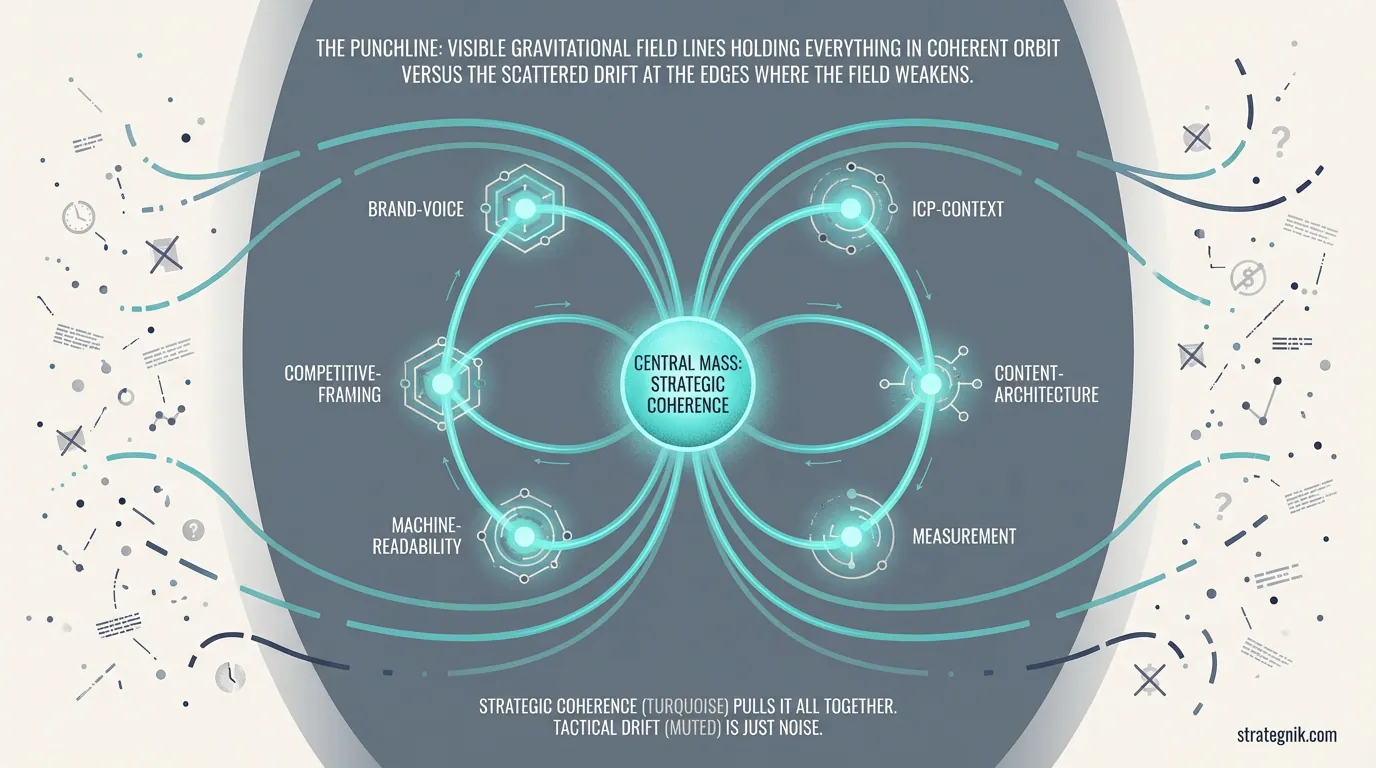
An operating context is the shared, encoded foundation (who you are, who you sell to, why you win, how you sound) that every team, tool, and agent in your go-to-market system works from. It is the single biggest factor in whether your marketing compounds, each piece reinforcing the others, or fragments into disconnected output you reconcile by hand.
In The Coherence Model, that operating context is a named force: the Context Field.
You gave five teams access to AI. Each one produced content last week. Read all five pieces back to back and tell me if they sound like the same company.
I’ll save you the trouble. They don’t. One sounds like a blog post from 2019. Another reads like a press release written by committee. The third uses competitor language your positioning explicitly avoids. The fourth nails the tone but targets the wrong buyer. The fifth is genuinely good — and completely disconnected from the other four.
This is what scaling AI without shared context looks like. You didn’t get more output. You got more fragmentation, delivered faster.
What Is an Operating Context?
In The Coherence Model, every company accumulates mass: brand credibility, market presence, accumulated authority. Mass is real. You can feel it in the difference between a cold outbound email from a company nobody’s heard of and the same email from a company the prospect already respects.
In physics, mass generates gravity. Not as a choice. As a consequence. Mass bends the space around it, creating an invisible field that tells every object in the system how to move. Planets don’t decide to orbit the sun. The gravitational field makes orbit the only coherent path.
Your company’s equivalent is the Context Field: the structured operating context that tells every tool, agent, team member, and channel how to behave. Not through policies people forget. Not through brand guidelines gathering dust on a shared drive. Through encoded context that is present every time a decision gets made, whether a human or a machine is making it.
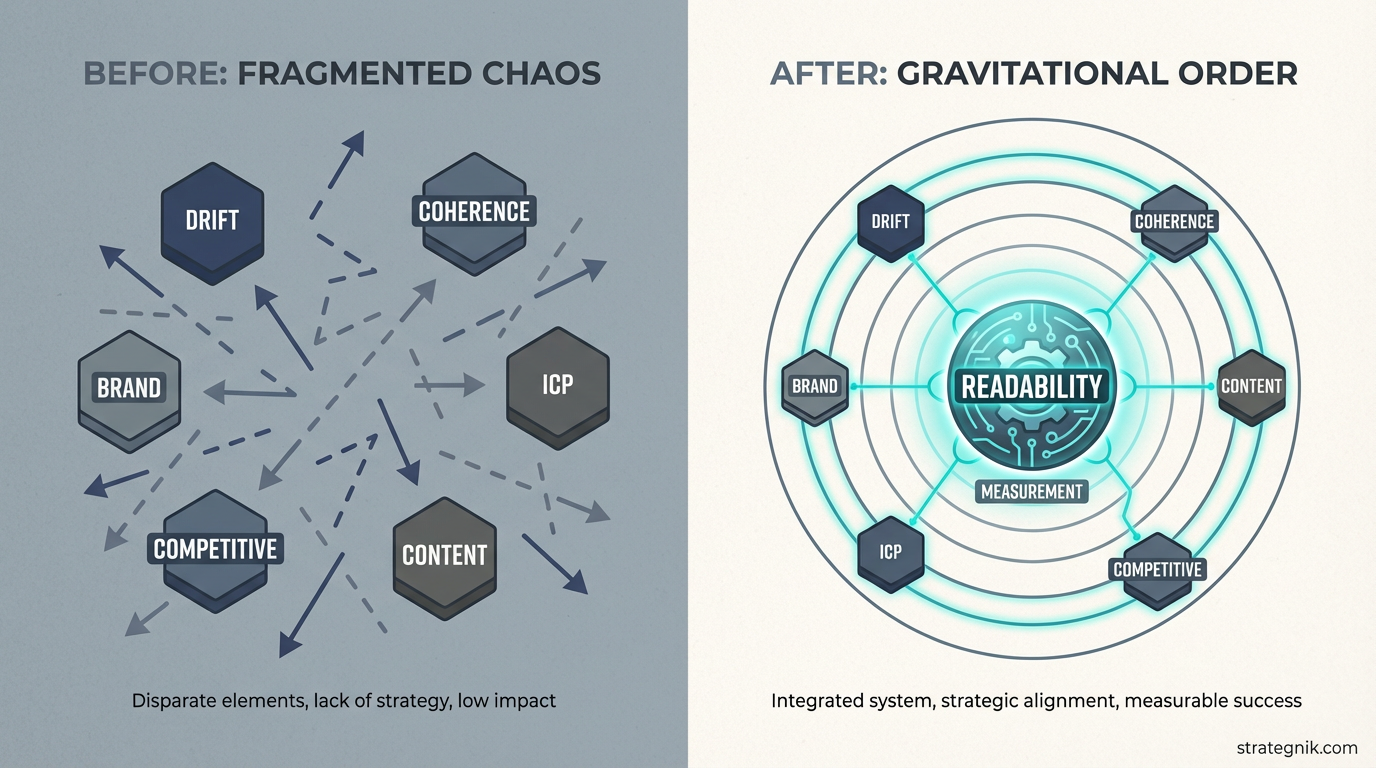
Without a gravitational field, objects drift. They move in random directions, collide with each other, or fly off into space. The same thing happens to your GTM motion when five teams, eight agents, and twelve channels all operate without a shared foundation. Everyone is working. Nobody is coherent.
Why Does Marketing Fragment Without One?
The gap is predictable. Most companies go from “we know who we are” straight to “let’s be everywhere,” and they skip the step in between.
That step is encoding what you know into a system.
The founders know the voice. The head of marketing knows the ICP. The competitive intelligence lives in one person’s head or a Slack channel nobody searches. The content strategy exists as institutional memory, not documented architecture. And the measurement framework is a spreadsheet that gets updated when someone remembers.
This works at small scale. The founding team carries the context in their heads, and proximity keeps everyone roughly aligned. Then you add AI tools. You add agencies. You add new hires who weren’t in the room when the positioning was debated for three months. You expand to new channels. And suddenly the context that used to travel through hallway conversations doesn’t travel at all.
The field was never built. It was implied. And implied fields don’t scale.
What Does the Context Field Contain?
The Context Field has six components, each encoded in machine-readable format: structured context that agents reference autonomously, not a PDF people forget to check.
Brand + Voice Spec. Tone, editorial standards, banned language, writing style rules. This is what makes five different agents produce output that sounds like one company.
ICP + Buyer Context. Ideal customer profiles, buying committee maps, pain hierarchy by persona, objection framing. This is what makes outreach targeted instead of generic.
Competitive Framing. Positioning against alternatives, displacement narratives, win/loss context, differentiated value claims. This is what makes content take a position instead of hedging.
Content Architecture. Topic cluster design, semantic entity relationships, atomization frameworks, internal linking logic. This is the structural blueprint that makes every piece of content reinforce every other piece.
Machine Readability + Distribution Schema. JSON-LD structured data, entity definitions, llms.txt, AI crawler accessibility, citation architecture. This is what makes your company legible to the machines your buyers consult before they ever contact sales.
Measurement Targets. Revenue influence metrics, conversion benchmarks, feedback loops. This is the steering mechanism that tells the system whether it’s working and what to adjust.
I wrote a detailed breakdown of each component, what built looks like versus missing, and why you can’t skip any of them: The Six Components of a Context Field.
How Does the Field Connect to the Rest of the Coherence Model?
The Context Field is the connective tissue of the entire framework; the definitive guide to The Coherence Model maps all six forces and how they interact. Here’s where the field sits.
Mass generates the field. Your accumulated brand credibility, market presence, and content authority create the raw material. The Context Field is what that mass actually does: it bends the behavior of everything around it toward coherence. A company with significant mass but no encoded field is a star that generates heat but no orbital system. Lots of energy, no structure.
The field extends across Surface Area. Every channel, every touchpoint, every agent-generated piece of content operates within the field — or it doesn’t. Surface area without a context field is random drift at every touchpoint. You’re present everywhere and coherent nowhere. The field is what makes wide reach compound instead of fragment.
A strong field reduces Friction. When every team member and every agent works from the same encoded context, people stop wasting time re-deriving first principles. The SDR doesn’t need to ask marketing how to position against Competitor X. The content agent doesn’t need a briefing on buyer persona pain points. The agency doesn’t need a three-week onboarding to understand the brand voice. The context is in the field. The friction disappears.
The field compounds Momentum. Each month the Context Field runs, it gets sharper. Measurement targets feed back into ICP context. Win/loss data refines competitive framing. Content performance sharpens the content architecture. The field learns. And because every agent and team member draws from it, the entire system gets better simultaneously, not one piece at a time.
How Can You Tell Your Team Lacks a Shared Operating Context?
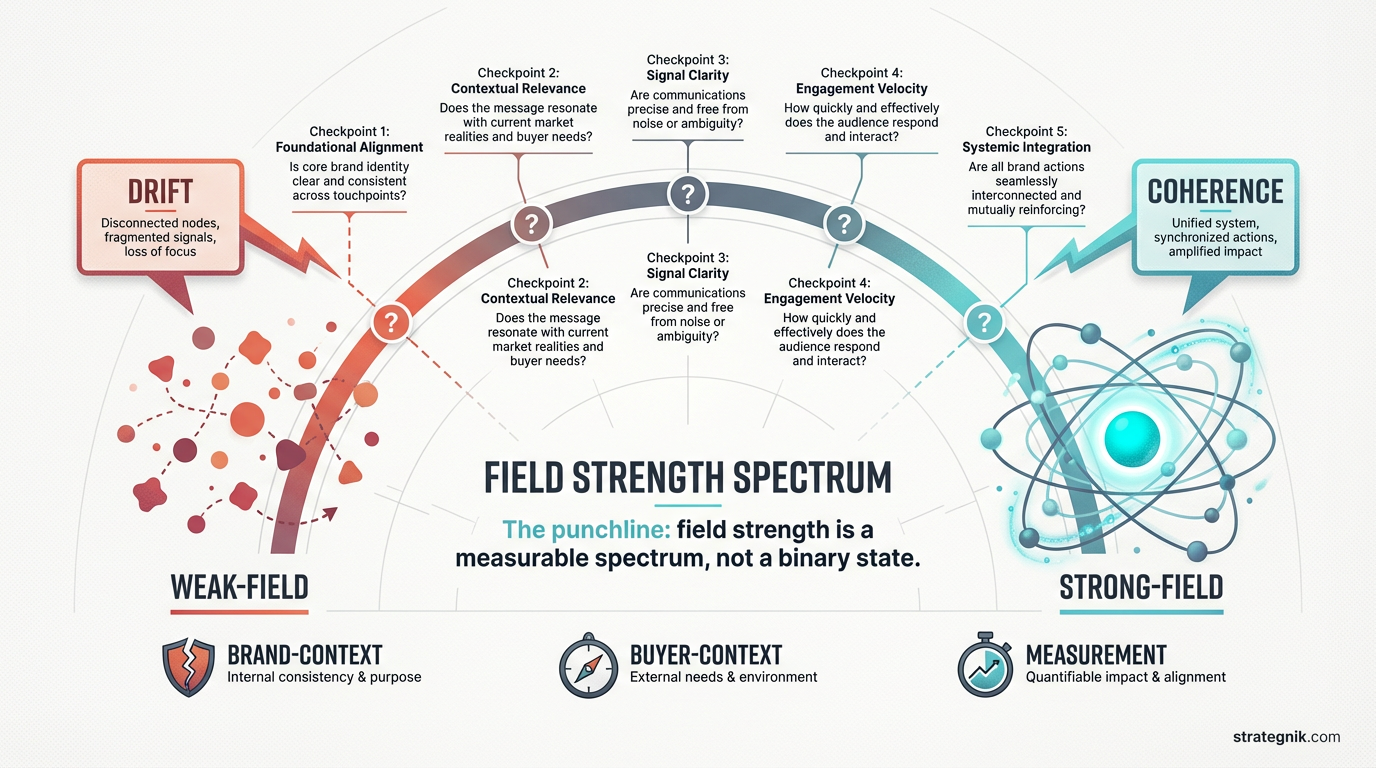
You can diagnose field strength in about thirty minutes. In my experience, teams without a shared operating context show the same behaviors regardless of size or talent. Count how many of these you recognize:
- Ask three people for the one-sentence positioning and you get three different sentences. Not three phrasings of the same idea. Three ideas.
- “Can you send me the latest messaging doc?” produces a Slack scramble. Someone eventually surfaces two candidates, and nobody is sure which one is current.
- Every new agency or contractor needs weeks of onboarding and still ships work that requires correction rounds, because the context was never written down anywhere findable.
- AI output always needs a full rewrite. Not polish. A rewrite. The tool did its job; it just had nothing true about your company to work from.
- The sales deck, the website, and the SDR sequences make different arguments. Each was written by a competent person working from a private version of the story.
- When a competitor comes up on a call, everyone freelances the response. There is no shared displacement narrative, so each rep invents one live.
- The same brief given to two people produces unrecognizably different output. The brief carried the task but not the context.
- Your content calendar is a list of topics, not an architecture. Pieces get published; nothing accumulates.
Three or more of these and the field is weak. The contrast on the other side is just as recognizable: a new agent or team member produces coherent output on the first attempt because the context is encoded and accessible. Content across channels reinforces the same positioning without anyone coordinating it manually. Competitive framing is consistent whether it shows up in a blog post, a cold email, or a case study. The company sounds like one company, everywhere, every time.
The difference isn’t talent or effort. It’s infrastructure. A strong field makes average performers look coordinated. A weak field makes excellent performers look incoherent.
If you want a structured assessment instead of a gut check, the Digital Context Audit is the diagnostic I run with clients to map the gaps.
Does AI Make a Shared Operating Context More Important or Less?
More, and here is the mechanism.
A human hire absorbs context slowly and informally. They sit in meetings, overhear positioning debates, get corrected a few times, and after six months they carry a workable version of the company in their head.
An agent gets none of that. Every AI agent you deploy for marketing starts from zero organizational context and works only from what you explicitly hand it. Deploy ten agents against a weak field and you haven’t hired ten fast employees; you’ve hired ten confident strangers, each producing at machine speed. The fragmentation that used to accumulate over quarters now accumulates over days. Agents don’t dilute the need for a Context Field. They multiply the cost of not having one, because output volume scales while shared judgment doesn’t.
There’s a second mechanism on the buyer side. Your prospects increasingly ask LLMs about your category before they ever reach your website; I broke down how that changes marketing work in ChatGPT for marketing. The machines answering those questions assemble their picture of you from whatever context you’ve made legible. A company with an encoded, machine-readable field presents one coherent story to those systems. A company without one gets summarized from fragments, and the fragments disagree.
The AI era raises the stakes in both directions: your own machines need the field to produce coherent output, and the market’s machines need it to describe you accurately. My opinion, stated plainly: a shared operating context is now the prerequisite for deploying AI in marketing at all.
Why Does the Field Compound?
Here’s what most companies underestimate: the Context Field is a compounding asset. Every month it operates, it captures more signal and makes every downstream activity more efficient.
The company that builds this first in a competitive market gets an advantage that widens over time. While competitors are still briefing agencies, correcting AI output, and reconciling inconsistent messaging across channels, the company with a functioning Context Field is running a system where every new piece of content, every new agent, every new channel automatically inherits the full context of the organization.
This isn’t a one-time project. It’s infrastructure that appreciates. The gap between a company with a twelve-month-old Context Field and one that just started isn’t twelve months of content. It’s twelve months of compounded learning that no amount of sprint work can replicate.
The companies that figure this out in 2026 will look back on it the way we look back on companies that invested in SEO in 2010. Not because the tactic was novel, but because they built the infrastructure while everyone else was still debating whether it mattered.
Frequently Asked Questions
What is a Context Field in marketing?
The Context Field is one of the forces in The Coherence Model: the shared, encoded operating context that tells every team member, tool, agent, and channel who the company is, who it sells to, why it wins, and how it sounds. It functions like a gravitational field. Everything inside it moves coherently; everything outside it drifts. It has six components, from voice spec through measurement targets.
Is a Context Field just brand guidelines with a new name?
No. Brand guidelines are one input to one of the six components, and they’re usually a static PDF nobody consults at the moment of decision. A Context Field is encoded in machine-readable form and sits in the workflow itself, so humans and agents reference it every time they produce something. Guidelines describe intent. The field enforces behavior, the way gravity does — by being present, not by being remembered.
How do I start building a shared operating context?
Start by finding out what’s actually missing rather than guessing. A Digital Context Audit maps which of the six components exist, which are implied, and which are absent. Then encode the two components your tools touch most often, which in my experience are the brand voice spec and the ICP buyer context. Those two alone eliminate most of the rewrite cycles. Build the rest in order of pain.
Does the Context Field matter if we aren’t using AI agents yet?
Yes, because humans fragment too — just more slowly. New hires, agencies, and channel expansion all leak context the same way agents do. But if agents are anywhere in your plans, build the field first. An agent inherits only what you’ve encoded, so the field determines whether AI agents for marketing become leverage or become a fragmentation machine running at full speed.
So What
If you’re adding AI tools, expanding channels, or scaling content production, the bottleneck isn’t the tools. It’s the operating context those tools work from.
Before you buy another platform, hire another agency, or deploy another agent, ask one question: does a shared, encoded, machine-readable operating context exist that tells every part of our system who we are, who we’re talking to, why we win, and how to sound like us?
If the answer is no, you’re scaling the chaos. More tools will produce more output. The output won’t cohere. And you’ll spend more time correcting the fragmentation than you saved by automating the production.
Build the field first. Everything else orbits it.
Nick Talbert transforms how B2B companies go to market. As founder of Strategnik, he helps founders and revenue leaders turn scattered tools and teams into pipeline, conversion, and growth that compounds.