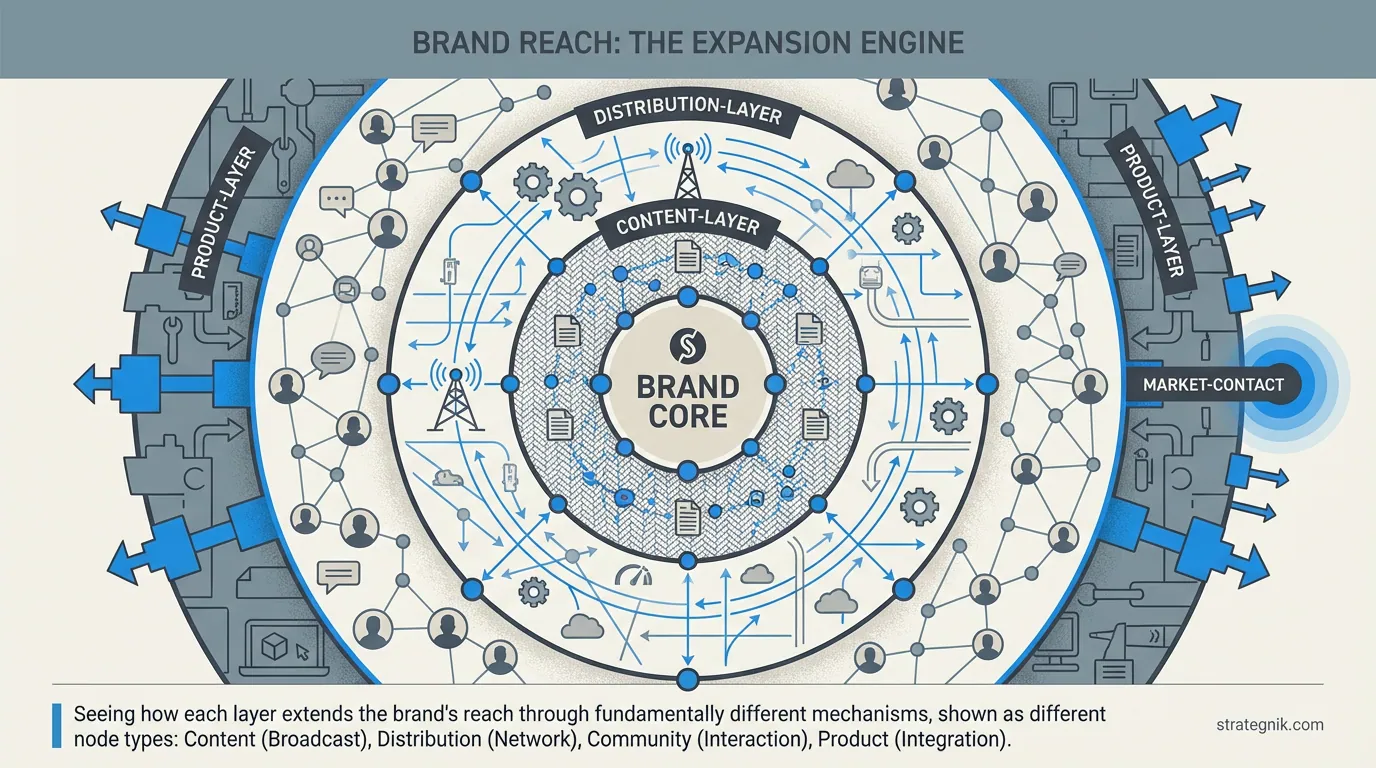
A company I advise was running paid campaigns on LinkedIn, Google, and Meta. They had a podcast, a blog, a monthly webinar series, and a Slack community. They sponsored two industry conferences per quarter. Their marketing team called it “full-funnel, multi-channel coverage.”
Their pipeline was flat.
When we dug in, the problem was obvious. They were present in eight channels and memorable in zero. Every blog post restated the same positioning. The podcast was interview-format filler with no editorial point of view. The webinar replayed the demo. They had surface area in the most literal sense, spread across a lot of surface, but none of it carried weight. The market saw them everywhere and retained nothing.
That’s not a surface area strategy. That’s a budget allocation plan with extra steps.
What Surface Area Actually Means
In physics, surface area is how much of an object is exposed to its environment. More surface area means more interaction with surrounding forces: more heat exchange, more chemical reaction.
In B2B GTM, surface area is how much of the market you’re in contact with. Not “how many channels are you on” but “where does your brand exist in the environments where your ICP works, learns, evaluates, and buys?” The distinction matters. Channels are plumbing. Surface area is presence at the points of transaction and decision.
The Coherence Model framework treats surface area as one of six forces governing growth. And like the physics concept, it doesn’t operate in isolation. Surface area without mass is exposure without substance. Surface area with mass is how you build compounding authority across the entire buyer journey.
The Four Layers
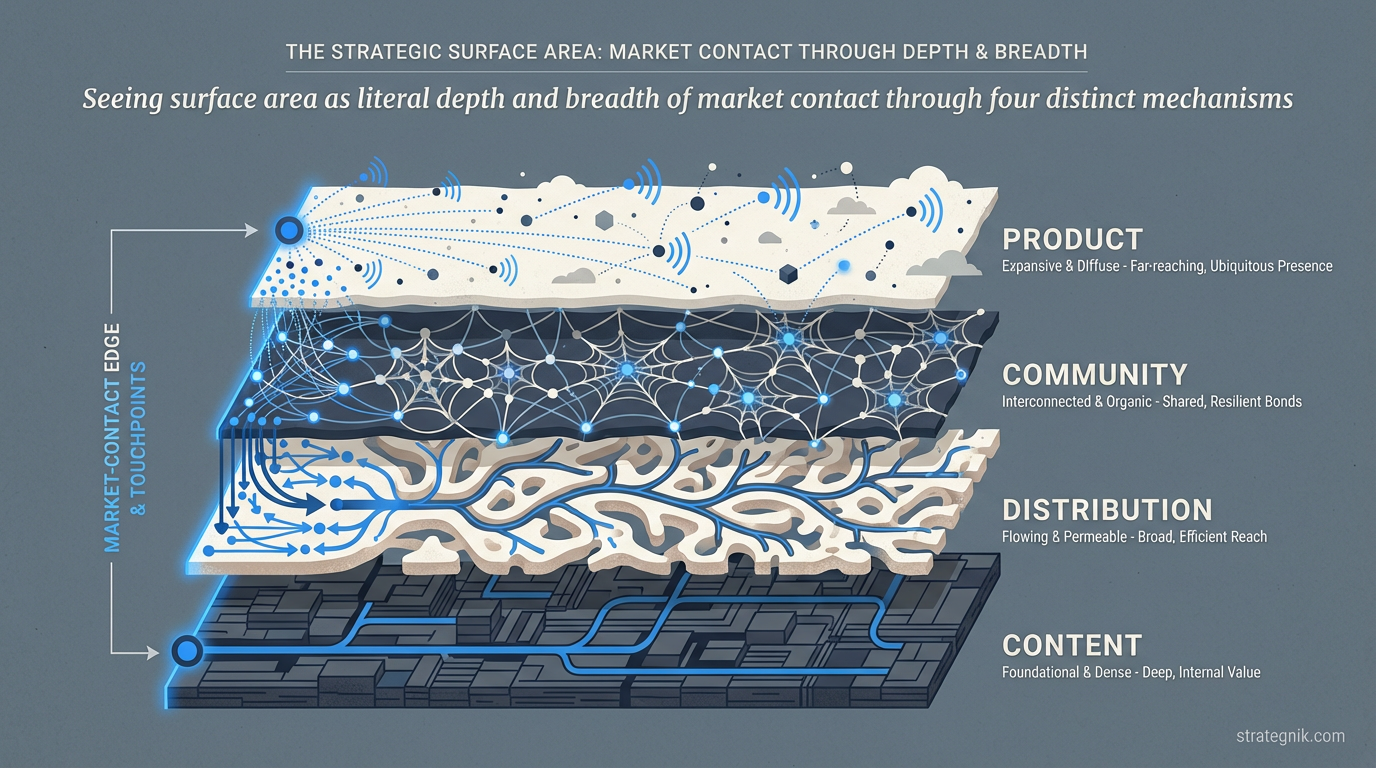
Surface area isn’t monolithic. It exists in four distinct layers, and most companies only think about one of them.
Content surface area is the most obvious: blog posts, guides, research, documentation, videos, podcasts. Each piece is a discoverable touchpoint. The test isn’t how much content you produce. It’s whether a buyer searching for any problem in your category, not just your brand name, finds you. Comprehensive content surface area means every conceivable search query in your space returns something from you. Thin coverage means you’re invisible until someone already knows your name.
Distribution surface area extends your reach through structures you don’t own. Integrations, technology partnerships, marketplace listings, referral networks, co-marketing relationships. A company with 1,600 integrations appears in buying conversations it never initiated. A company with three integrations appears only when it shows up under its own power. Distribution surface area is earned presence: the market surfaces you without you asking.
Community surface area is where your brand exists in conversations you don’t control. Events, forums, Slack groups, LinkedIn comments, user communities. The strongest version of this is user-generated: customers recommending you in peer conversations, answering questions about your category with your name attached. You can’t manufacture this, but you can create the conditions for it by building a product and brand worth talking about.
Product surface area applies to companies with usage-driven distribution. Every Calendly link in an email, every Loom video in a Slack channel, every Notion doc shared with a partner is a brand impression that compounds with adoption. The product becomes its own growth channel. For PLG companies, product surface area is often the most powerful layer because it scales with the customer’s own activity, not your marketing budget.
Surface Area and the Context Field
Here’s where most people confuse two related concepts. Your context field determines how you show up at each touchpoint: your positioning and the weight your brand carries when someone encounters it. Surface area determines where you show up. How many touchpoints exist. How many contexts contain your brand.
You need both, and the sequence matters. If you expand surface area before you have a context field worth projecting, you’re amplifying nothing. Every new channel broadcasts the same empty message to a wider audience. But if you build mass and a strong gravitational pull, then refuse to expand surface area, you’re the best-kept secret in your market. Deeply credible to the twelve people who found you; invisible to the four thousand who should be buying from you.
The play is: build enough mass to be substantive at each touchpoint, then systematically expand surface area into every context where your ICP transacts, learns, and decides. Let the context field do the work at each point of contact.
The Trap: Surface Area Without Mass
This is the failure mode I see most often, especially in venture-backed companies with pressure to show “brand awareness” metrics.
The symptoms are easy to spot. Forty-seven blog posts that all say roughly the same thing in different words. Six social platforms with sporadic posting and no real engagement on any of them. Conference sponsorships where the booth staff can’t articulate the differentiation. A podcast that’s been running for eighteen months with flat listenership because every episode is a generic industry conversation that three hundred other podcasts are also having.
Wide reach. Zero weight. The market encounters you everywhere and forms no impression worth acting on.
This is worse than having narrow surface area, because it trains the market that you’re generic. The buyer who sees you in ten places and learns nothing new in any of them has now categorized you as background noise. That impression is hard to reverse. You’ve spent money and time to become forgettable at scale.
How AI Changes the Surface Area Equation
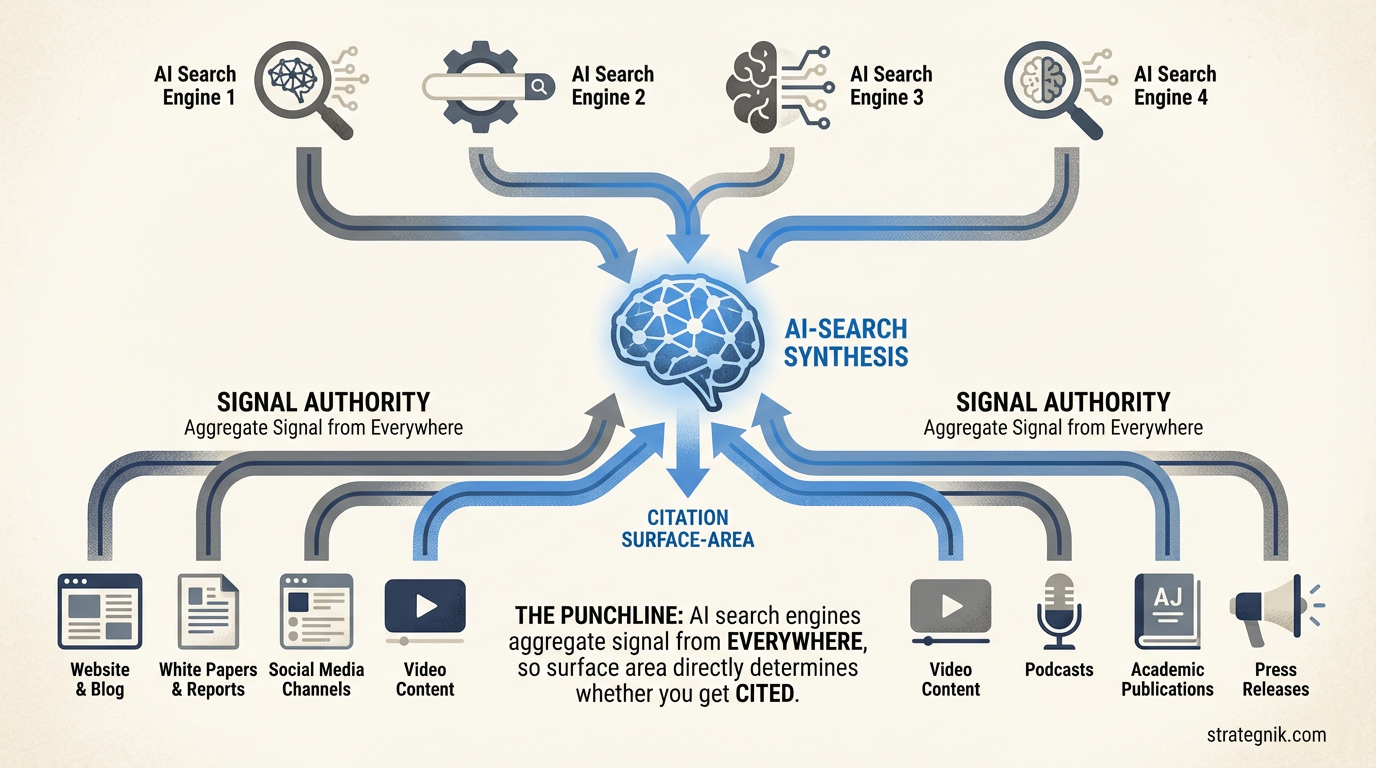
Here’s the part most B2B marketing teams haven’t internalized yet. AI search (ChatGPT, Perplexity, Gemini, Claude, AI Overviews) doesn’t work like traditional search. It doesn’t return ten blue links ranked by page authority. It synthesizes answers from across the entire surface of the internet.
That means surface area is now a prerequisite for AI visibility. If your brand exists in only two or three contexts, the AI has limited signal to draw from. If your brand appears across content, documentation, community discussions, partner ecosystems, and earned media, the AI has a dense web of references to synthesize. More surface area, assuming it carries mass, means more raw material for AI systems to cite.
This collapses a wall that used to exist between channels. In the old model, your blog and your conference sponsorship and your integration marketplace listing operated semi-independently. In the AI search model, they’re all inputs to the same synthesis engine. A prospect asking ChatGPT “what’s the best platform for X?” gets an answer assembled from everywhere you’ve ever shown up. Or everywhere you haven’t.
Surface area with substance is now the price of admission to AI-mediated discovery.
The Diagnostic
When I work with clients on surface area, we start with three questions adapted from a framework I’ve used with companies like Afiniti:
Where is the market transacting? Not where you wish they were buying, but where they actually evaluate, compare, and purchase solutions in your category. Marketplaces? Direct? Through partners? Through consultants? If you’re not present where the transaction happens, the rest of your surface area is awareness without conversion.
Where is the market talking? Which communities, forums, conferences, and peer networks do your buyers participate in? Where do they ask for recommendations? Where do they share warnings? If you’re absent from these conversations, your competitors are filling the gap with their narrative.
Where is the market deciding? What does the last mile of their evaluation process look like? Do they check G2 reviews? Ask their network on LinkedIn? Read analyst reports? Search for comparison content? The decision context is where surface area has the highest conversion leverage. Being present there with credible, substantive content is worth more than being present in fifty awareness channels.
Map all three. Then honestly assess: are you present at each of those points with substance, or are you missing from the places that matter most?
So What
If your pipeline growth has plateaued despite steady content production and marketing spend, the problem might not be your message or your budget. It might be that you’re covering the wrong surface area: present in channels that don’t map to where your ICP actually transacts, talks, and decides.
Run the diagnostic. Map where your market is actually active. Compare that map to where your brand shows up. The gaps are your growth opportunities, and the filled-in areas without mass behind them are your efficiency drains.
And if you’re not thinking about AI search as part of this equation, you’re building surface area for a discovery model that’s already being displaced. The companies that show up in AI-mediated answers in 2027 will be the ones that built substantive, distributed surface area in 2026. The window to build that foundation is now.
Surface area is a growth strategy, not a channel plan. Treat it accordingly.
Nick Talbert transforms how B2B companies go to market. As founder of Strategnik, he helps founders and revenue leaders turn scattered tools and teams into pipeline, conversion, and growth that compounds.