For twenty years, SaaS go-to-market teams had a structural advantage: the product did the heavy lifting. Deep codebases, long roadmaps, compounding technical complexity, and expensive implementations meant that a strong feature set could create durable differentiation. Sales could lean on demos. Marketing could build campaigns around launches. Customer success could count on switching costs to protect retention.
That advantage is eroding. AI has compressed product development timelines to the point where a well-funded team can rebuild the functional equivalent of most SaaS products in months, not years. In some categories, it is faster than that. The feature you launched last quarter gets matched this quarter.
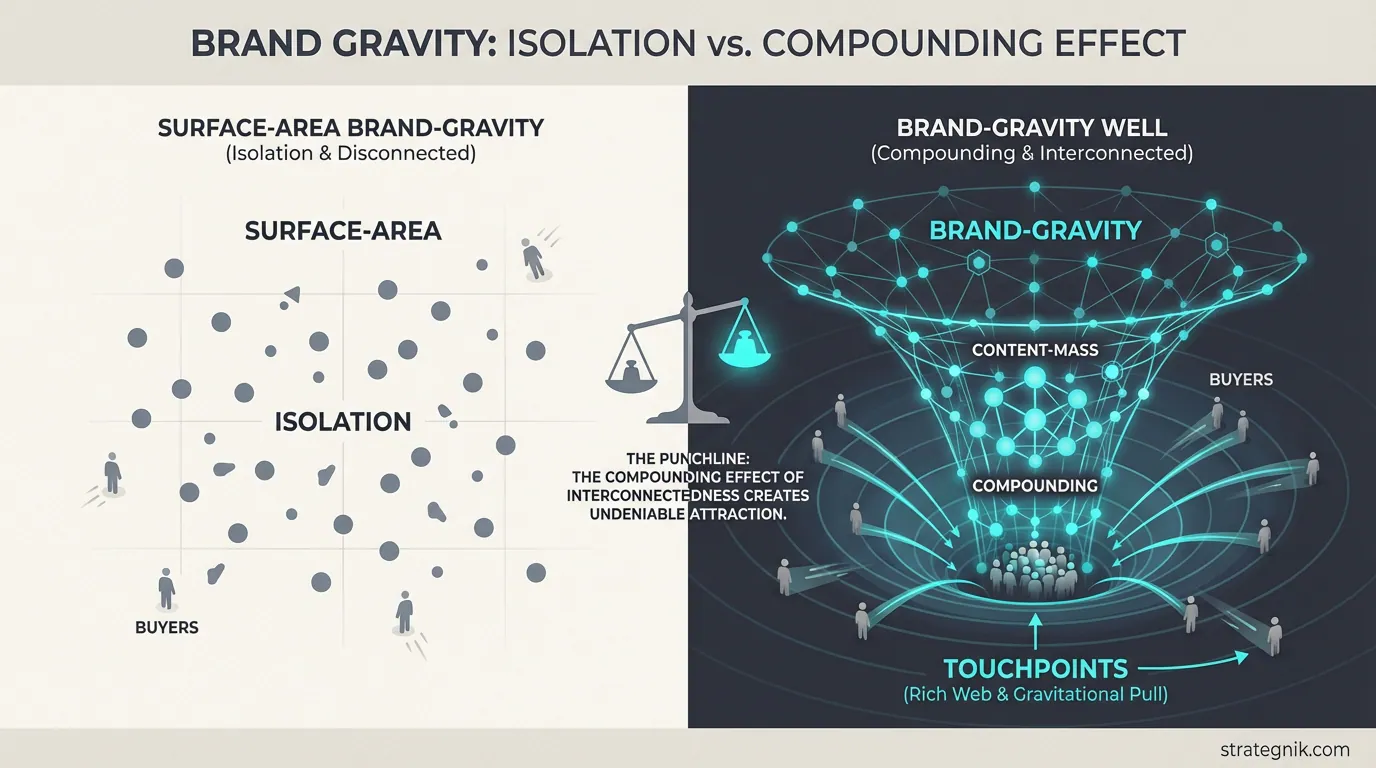
At Strategnik, we describe this using a physics framework. Features used to be a primary source of mass: the accumulated weight that creates gravitational pull toward your product and makes displacement expensive. When products were hard to replicate, that mass was intrinsic. When features become easy to replicate, each launch adds less mass. The gravitational pull weakens. Buyers drift more easily. Evaluations happen more frequently. Displacement gets cheaper.
But the same AI that erodes your product moat can build a different kind of moat faster than was possible two years ago. The teams that win the next five years are not the ones defending feature advantages. They are the ones using AI to build friction, brand gravity, and operational mass across the full go-to-market system.
And the infrastructure matters as much as the intent. Giving every team an enterprise license to Claude or ChatGPT does not get you there. A model without context is a fast intern who does not know your business. The system between the foundation model and the operator is what determines whether AI becomes a compounding advantage or an expensive autocomplete.
Two companies show how this plays out from opposite ends of the spectrum: Gong and Airtable. Gong built conversation intelligence through a top-down, sales-led motion. Airtable built a flexible database-spreadsheet hybrid that spread through organizations bottom-up, one team at a time. Both face the same structural threat from completely different positions.
Gong’s core call recording and transcription is a commodity. Airtable’s structured database with a clean interface is what every AI-native productivity tool is converging on. So if the features are replicable, where does the mass live? For Gong, it is the proprietary data: the organization’s conversation history, deal patterns, coaching models, and forecast signals. For Airtable, it is the operational surface area: hundreds of bases across teams, each connected to automations, integrations, and workflows nobody fully maps and nobody wants to untangle.
The Sales Playbook
The old motion is breaking. A prospect can watch your demo on Tuesday, see an AI-native competitor ship something comparable on Wednesday, and ask on Thursday why they are paying a premium for a codebase that took a decade to build when the alternative took a quarter.
When your product carried intrinsic mass, discovery was about mapping the prospect’s pain to your feature set. The implicit message was: “we built something you can’t get elsewhere.” That message worked because it was true. It is becoming less true by the month.
The shift is from selling capabilities to creating friction. The conversation has to move from what happens before implementation to what happens after. How deeply does this integrate into your workflows? How much proprietary data accumulates inside it? How painful would it be to unwind?
A Gong AE who leads with “we record calls, transcribe them, and surface deal insights” is competing on a feature checklist that AI-native tools are replicating monthly. Call recording is free. Transcription is a commodity API. Deal scoring is a feature every CRM is bolting on.
The winning pitch sounds completely different: “Your team has eighteen months of conversation data inside Gong. Every discovery call, every negotiation, every objection pattern. Your coaching models are trained on what winning looks like at your company, not in general. Replacing Gong does not mean finding a better call recorder. It means starting your conversation intelligence from zero.”
That pitch is built on data mass, not features. In a data-driven sales org, losing eighteen months of accumulated pattern recognition is a cost that no feature comparison can offset.
Now layer AI onto that motion. A Gong AE using AI well does not walk into discovery with generic questions about sales process pain points. They walk in with a pre-built analysis of the prospect’s revenue motion, pulled from job postings that reveal team structure and hiring velocity, earnings calls that surface sales productivity metrics, G2 reviews of the tools they currently use, and LinkedIn data that maps reporting relationships across the revenue org.
Airtable’s sales motion is different because the product enters through PLG. By the time sales engages, the product is already embedded. The challenge is not getting the prospect to try it. It is converting grassroots adoption into an enterprise commitment before a competitor swoops in with a cheaper or shinier alternative.
The friction story lives in the operational graph already built: “Your marketing team runs their content calendar on Airtable. Your ops team tracks vendor management. Your product team manages the launch roadmap. Each base is connected to Slack, integrated with your data warehouse, and wired into automations that trigger downstream workflows. Replacing Airtable does not mean finding a better database tool. It means auditing, rebuilding, and reconnecting every workflow built on top of it across every team that adopted it independently.”
AI makes this pitch surgical. An AI-equipped Airtable AE can analyze the prospect’s existing usage data and generate an operational dependency map that visualizes exactly how embedded the product already is. That map becomes the enterprise sales narrative: “Here’s what you’ve already built. Here’s what it would cost to rebuild it somewhere else. Here’s what it looks like when you formalize and expand it.”
The AI-powered sales playbook has four shifts.
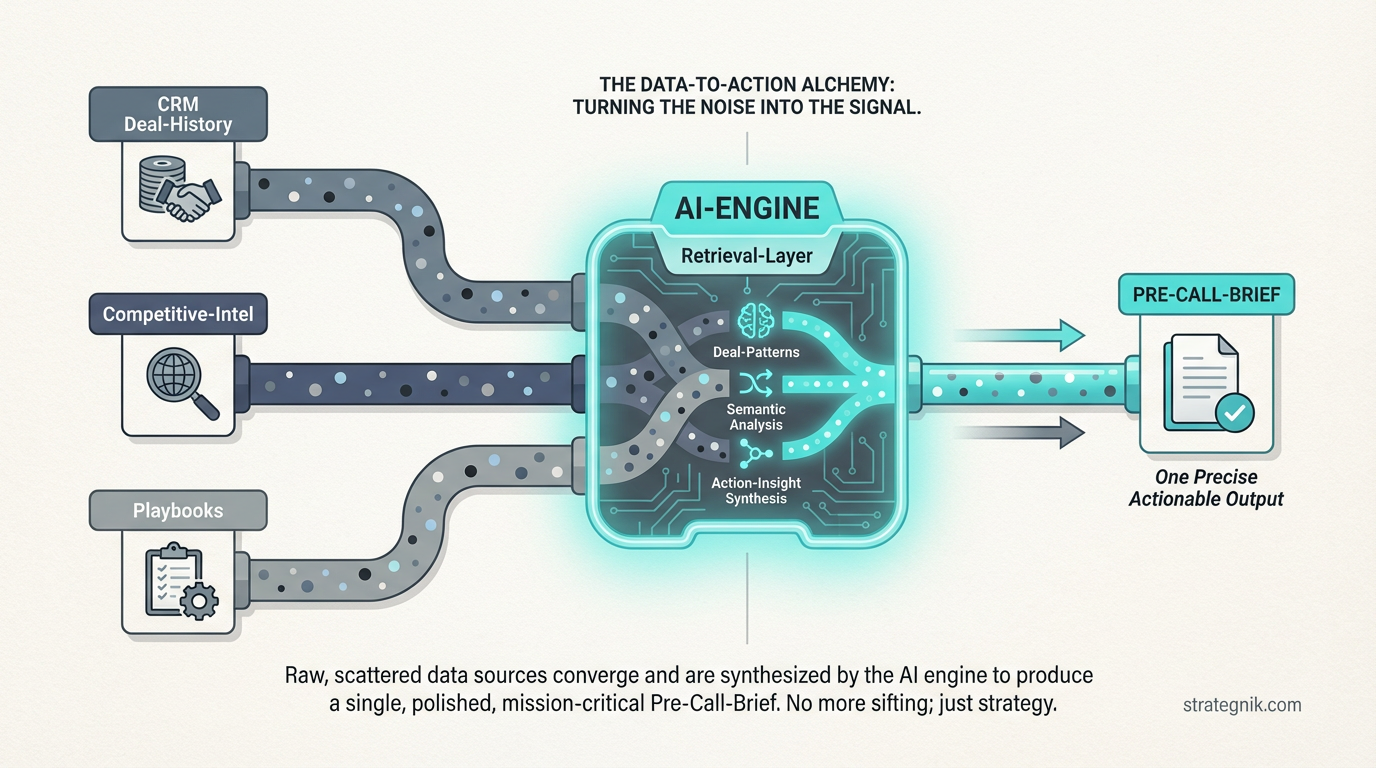
Pre-call intelligence at depth, for every account. The preparation that used to be reserved for six-figure deals can now happen for every qualified opportunity. AI agents can pull data from public filings, job boards, review sites, and API documentation to build a connection map before the first meeting. When every AE walks in with solutions-engineer-level context, discovery calls become architecture conversations. Architecture conversations produce implementation-heavy deals. Implementation-heavy deals create friction.
Custom proposals in hours, not weeks. AI can generate tailored implementation plans, ROI models, and integration architecture documents that used to take a solutions team days to build. When you deliver a custom-scoped proposal in the same week as the discovery call, you compress the sales cycle and shrink the window where competitors can insert themselves.
Competitive displacement playbooks that update in real time. Instead of static battlecards that are stale the week they ship, AI can monitor competitor product launches, pricing changes, and customer reviews continuously and surface relevant counter-positioning to AEs in the context of specific deals.
Pricing that adapts to the deal. As seat-based pricing loses its structural logic, sales teams need the ability to model consumption-based, outcome-based, and hybrid pricing for individual accounts. AI can model scenarios in real time during negotiations, grounded in the prospect’s own publicly available financial data.
None of this happens by handing an AE a ChatGPT login. The company needs a connected data layer the model can query, pre-built workflows instead of blank prompts, competitive intelligence that feeds the model continuously, and guardrails that prevent hallucination in high-stakes contexts. Without that infrastructure, AI knows everything about the world and nothing about your business.
The Marketing Playbook
Most SaaS marketing organizations are still structured around product marketing as the center of gravity. Launch the feature. Write the blog post. Update the battlecard. Brief the analysts. Run the webinar.
That cadence made sense when features were durable. When the replication timeline compresses to weeks, the half-life of every announcement shrinks with it. You are constantly launching, constantly chasing, and the pipeline impact of each launch keeps diminishing. That is velocity without mass, and velocity without mass does not compound.
The shift is toward the things that do not commoditize. Features commoditize. Brand gravity does not. Distribution advantages do not. Proprietary data does not. The density of your presence across the channels and conversations where buyers make decisions does not. Marketing needs to reorient around these sources of mass, and AI is the tool that makes it possible to build them at the pace the market now demands.
Gong’s durable mass is not the call recorder or the deal board. It is the dataset: millions of sales conversations across thousands of companies, plus the individual customer’s own conversation history that grows more valuable with every call logged.
If marketing keeps leading with “we launched a new AI insight” or “our transcription is more accurate,” they are competing on features every competitor is shipping simultaneously. The mass Gong should be marketing is harder to replicate: the proprietary data advantage that only exists because thousands of sales teams have been feeding their conversations into the platform for years.
AI changes the scale at which Gong can make that data advantage visible and authoritative. The marketing team can use AI to produce research-grade content derived from aggregated conversation data, content no competitor can replicate because no competitor has the dataset. That is not a feature announcement. That is a data moat turned into a content moat.
AI can also power real-time competitive response at a speed that used to require a war room. When a competitor launches a new AI feature and the LinkedIn discourse cycle starts, Gong’s marketing should not be scrambling to draft a take. An AI-powered workflow can monitor the launch, draft a point-of-view piece grounded in Gong’s proprietary data, route it through a human editor, and publish within hours.
Airtable’s brand presence lives in a place most marketers would envy: the product distributes itself. One person signs up, builds a base, shares it with their team, and the tool spreads through the organization without marketing lifting a finger. The challenge is converting that passive distribution into active surface area before a competitor captures the same users with a shinier free tier.
AI makes this possible at a scale that changes the economics. Airtable’s team can use AI to produce deep, specific workflow content for every use case emerging organically in their user base. Not generic “how to use Airtable” guides, but function-specific playbooks: how to build a content operations pipeline in Airtable that connects to your CMS, triggers Slack notifications for review cycles, and syncs with your analytics dashboard.
AI also enables Airtable to build and ship free tools that extend the brand’s surface area into adjacent workflows: a project staffing calculator, an operations maturity assessment, a workflow automation audit that benchmarks a team’s current process against best practices. Each tool captures data, generates leads, and reinforces Airtable’s position as operational infrastructure rather than a spreadsheet alternative.
The PLG motion gives Airtable something else AI can amplify: user-generated social proof at scale. Thousands of teams are building workflows on the platform daily. AI can identify the most compelling use cases from product telemetry, generate case-study frameworks from usage patterns, and arm community managers with data-backed stories that turn organic adoption into marketing fuel.
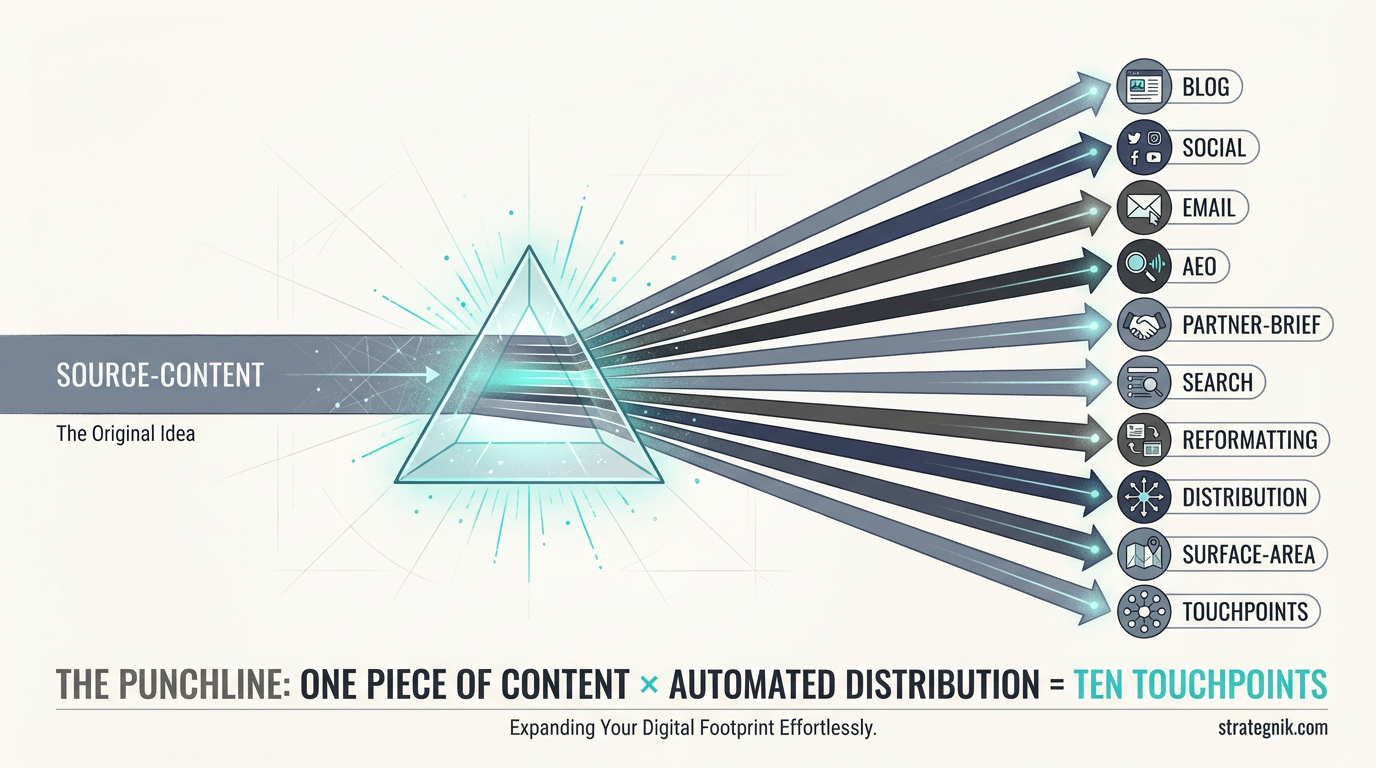
The AI-powered marketing playbook, the core of a modern B2B SaaS marketing strategy, has four shifts.
Content velocity as a mass strategy. AI does not just make content faster to produce; it makes comprehensive coverage possible. For Gong, that means producing data-derived research content at a cadence no competitor can match. For Airtable, it means producing workflow-specific content for every use case, persona, and integration combination.
Answer engine optimization at scale. AI search is reshaping how buyers discover and evaluate software. The vendors whose content gets cited in AI-generated answers are the ones with the densest, most authoritative content corpus. If you are not in the AI-generated answer, you are not in the consideration set.
Free tools that compound brand gravity. Engineering-as-marketing used to require engineering resources that marketing could not access. AI has removed that constraint. Marketing teams can now build and ship diagnostic tools, calculators, and interactive assessments on their own.
Competitive monitoring that never sleeps. AI agents can track competitor launches, pricing changes, messaging shifts, customer reviews, and hiring patterns continuously, then surface actionable intelligence to the marketing team in real time.
Marketing needs breadth across the entire market and the ability to maintain quality at volume. The company needs a brand knowledge base the model works from, a content pipeline with human editorial gates, data connections to product and customer data, a multi-channel distribution layer, and an AEO layer built for how buyers actually find software now. AI-generated content at volume without editorial oversight is not a content strategy. It is a spam cannon.
The Customer Success Playbook
The traditional CS operating model is built around a simple assumption: if the customer is happy, they will stay. Measure NPS. Run QBRs. Resolve tickets quickly. Celebrate renewals.
That assumption held when switching was expensive regardless of satisfaction. A customer could be frustrated with your product and still renew because the cost of moving exceeded the cost of staying. In a world where switching costs are falling, satisfaction is necessary but not sufficient. A happy customer with shallow integration depth is one compelling demo away from evaluating an alternative.
The CS function has to shift from managing satisfaction to building mass inside each account, making your product so operationally embedded that the energy required to remove it exceeds anything a competitor is willing to subsidize.
Gong’s mass is temporal and proprietary. Every call recorded, every deal tracked, every coaching insight generated adds to a dataset that belongs to that specific customer and cannot be transferred to a competitor. The conversation history is the moat, but only if the customer knows it.
A customer using Gong as a call recorder is one free Zoom transcription feature away from questioning the ROI. A customer whose sales managers run weekly coaching sessions based on Gong data, whose forecast depends on Gong deal signals, and whose competitive strategy uses Gong conversation trends has accumulated enough data mass that leaving means losing the institutional memory of how their team sells.
AI changes the CSM’s ability to deepen that data mass. An AI-powered health model can analyze every account’s usage patterns and generate a specific activation roadmap: “This team records calls but hasn’t activated the coaching scorecards. Teams that activate coaching see a 23% improvement in new-hire ramp time. Here’s the playbook to get their frontline managers running weekly coaching reviews in 14 days.”
AI can also power proactive engagement at scale. When usage patterns shift, the system can flag the risk, generate a re-engagement message specific to that account, and recommend an intervention before the customer starts evaluating alternatives. Reactive CS waits for the churn signal. AI-powered CS catches the pre-signal.
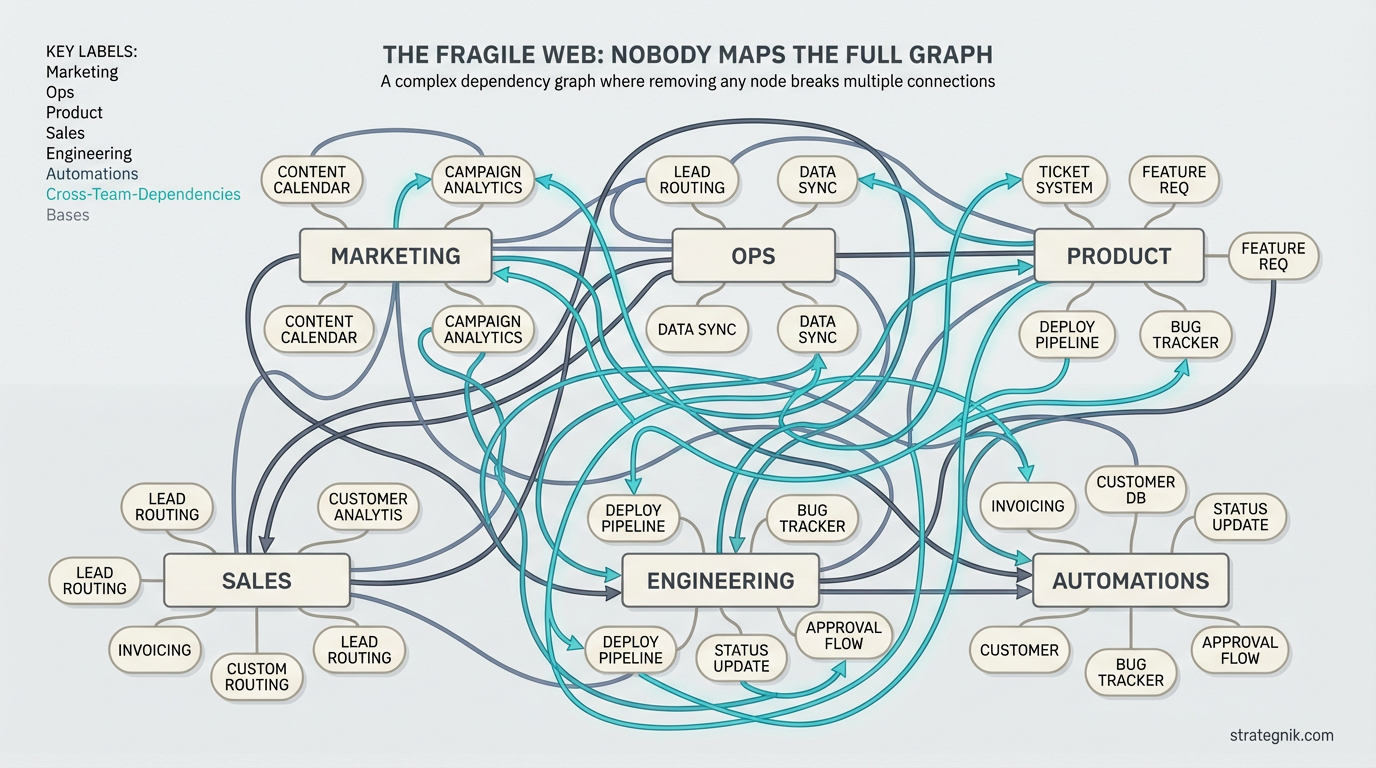
Airtable’s mass is structural and distributed. It does not accumulate in a central dataset like Gong’s; it accumulates in the operational graph: bases spread across teams, each with their own automations, integrations, views, and workflows. The mass is not in any single base. It is in the aggregate, the unmapped web of dependencies nobody fully understands.
AI can close that visibility gap. An AI-powered CS system can analyze the customer’s entire Airtable footprint and generate a dependency map that visualizes the operational surface area: “Your organization has 47 active bases across six teams, connected to Salesforce, Slack, and your data warehouse through 23 automations. Here’s the dependency graph. Here’s what breaks if this goes away.”
AI also changes Airtable’s CS expansion motion. Instead of generic recommendations to “try the enterprise plan,” the system can identify specific expansion opportunities based on usage patterns. Every expansion recommendation that lands adds surface area. More bases, more connections, more mass.
The AI-powered customer success playbook has four shifts.
Predictive health scoring based on mass, not sentiment. Stop measuring account health by survey responses and support ticket volume. Measure it by structural indicators: active integrations, workflow dependencies, data volume, and user penetration across departments.
Automated expansion recommendations, account by account. AI can analyze each account’s configuration, compare it against your highest-retention customer profiles, and generate a specific list of features, integrations, and workflows that would increase that account’s mass.
Onboarding that builds friction from day one. AI-powered onboarding can detect the customer’s tech stack, generate a custom integration plan, and guide the customer through setup in the first week, not the first quarter.
Churn intervention before the signal is visible. Traditional churn models wait for lagging indicators. AI can detect leading indicators: a competitor’s sales team engaging the customer’s LinkedIn connections, a decrease in integration utilization, or a shift in login patterns that suggests evaluation behavior.
CS has the most data-intensive infrastructure requirement in the GTM stack. The AI needs to understand the state of every individual account in real time. The company needs a live account health model connected to product telemetry, integration and workflow mapping per account, automated playbook generation, early warning systems with intervention triggers, and an implementation acceleration engine.
The Moat Is the System
Every integration scoped during a sales cycle is a root that deepens after close. Every piece of content that teaches the market how to think about your category makes the next buyer easier to reach. Every workflow dependency built by CS makes the account harder to unwind.
That is the new moat. Not a feature. Not a launch calendar. Not a QBR deck. The moat is the organizational system connecting sales, marketing, and customer success: sales scopes the friction, marketing builds the gravity, and customer success turns adoption into operational mass.
The foundation model is a commodity. Every company can buy access to Claude or GPT. What is not a commodity is the proprietary data layer, the brand knowledge base, the account-level telemetry, the workflow engineering, and the feedback loops that turn a general-purpose model into a GTM engine that only works inside your company.
Features will not hold the system together anymore. The companies that build the AI infrastructure to sell friction, market brand gravity, and retain through operational mass will compound while competitors are still defending feature checklists.