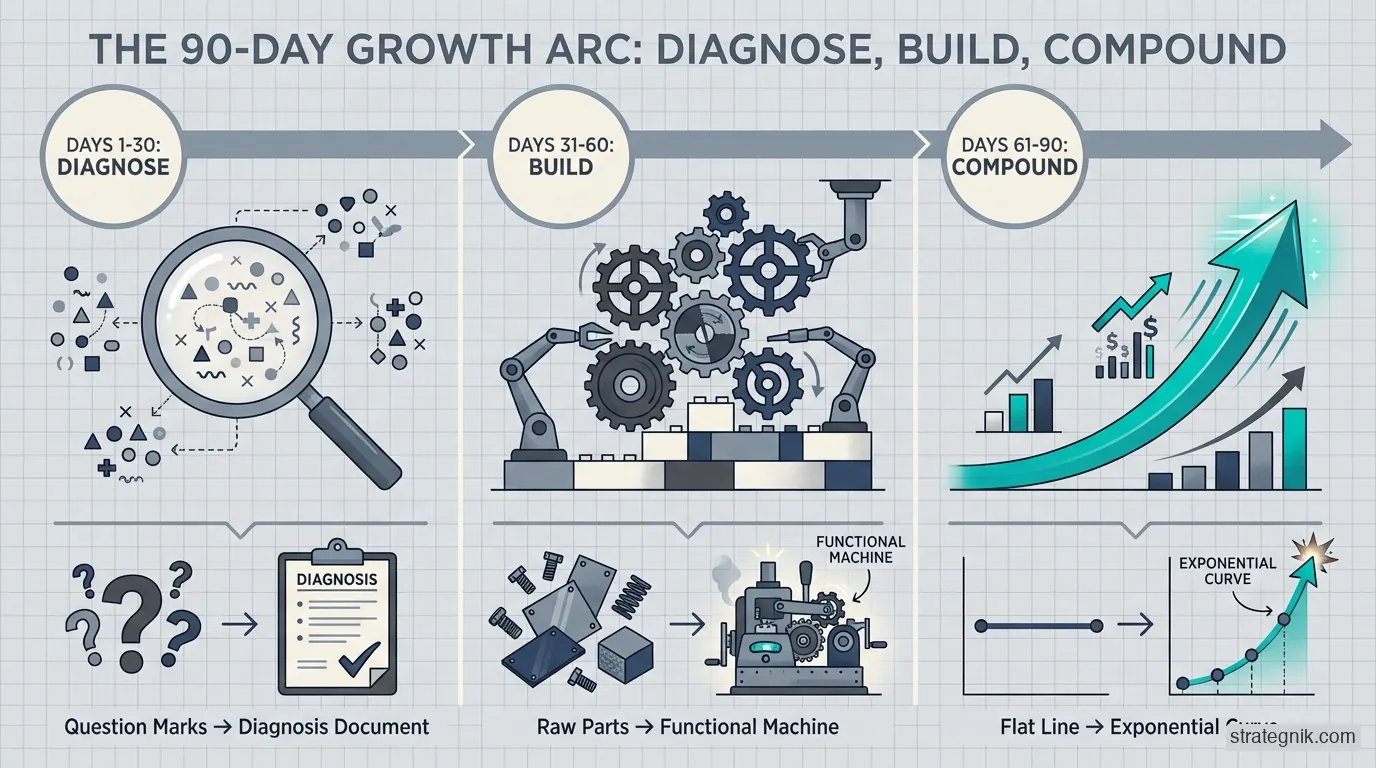
In the first 90 days, a fractional CMO at a Series A company should deliver four things: a complete GTM audit with a written diagnosis, locked positioning and ICP definition, demand gen infrastructure that can run without them, and a measurable pipeline number with data behind it. Anything less and you hired a consultant who makes slides.
I’ve done this enough times to know what works and what doesn’t. The pattern is remarkably consistent across B2B SaaS companies in the $2M–$15M ARR range, and the mistakes are even more consistent. Here’s how I run it. (If you’re still deciding whether the role itself fits your stage, start with what a fractional CMO actually is and come back.)
The 30/60/90 Plan at a Glance
| Phase | Focus | Core deliverables | What the CEO should see |
|---|---|---|---|
| Days 1–30 | Diagnose | GTM Diagnostic document, validated ICP, positioning assessment, pipeline structure review | A written diagnosis of what’s working, broken, and missing. No campaigns yet, and that’s correct. |
| Days 31–60 | Decide and build | Locked positioning statement, precise ICP definition, channel selection, content system design | Decisions in writing that the CEO has signed off on. Fewer options on the table, not more. |
| Days 61–90 | Launch and measure | First campaigns live, instrumented pipeline, weekly and monthly reporting cadence | Early pipeline data, honest attribution, and a system the team can describe without the CMO in the room. |
Each phase gates the next. A fractional CMO who launches campaigns in week two skipped the diagnosis, and you’ll pay for that skip in month four when nothing converts and nobody can say why.
What Should a Fractional CMO Deliver in Days 1–30?
The first month is a listening and diagnosing month. You are not here to execute yet. You are here to understand why the current system produces the results it produces.
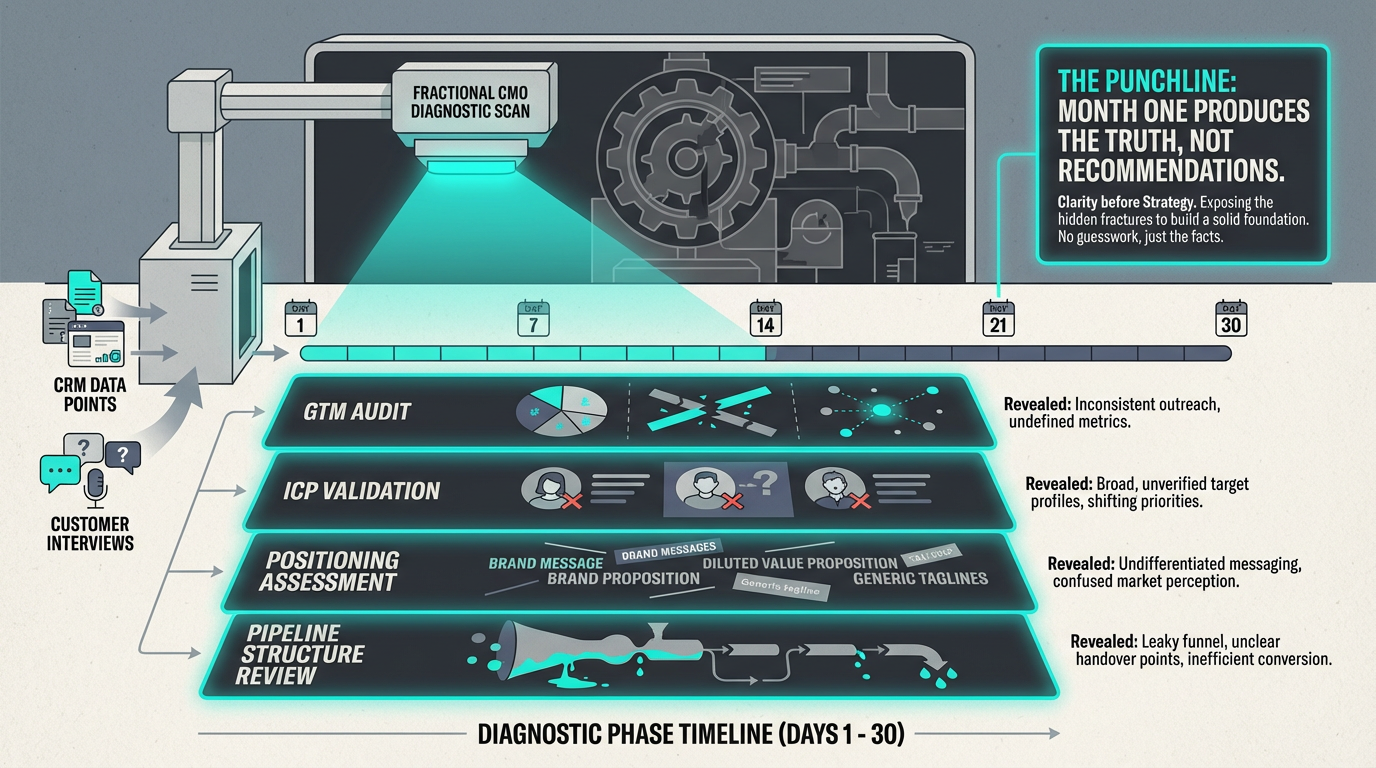
Start with the GTM audit. Pull every number you can get your hands on: pipeline by source, conversion rates at each stage, sales cycle length by segment, win/loss data, CAC by channel. Most Series A companies have some of this in their CRM and the rest in someone’s head. Your job is to get it all into one place and find the gaps.
Next, validate the ICP. The founders have a theory about who their best customer is. Sometimes they’re right. Often they’re describing who they want to sell to rather than who actually buys, deploys, and renews. Look at the last 20 closed-won deals. Who are they? What do they have in common? Where did they come from? That’s your real ICP until the data says otherwise.
Run a positioning assessment. Read every piece of marketing the company has produced. Visit the website. Read the sales deck. Listen to three or four recorded calls. Then ask five customers why they bought. The gap between what the company says about itself and what customers say about it — that gap is your positioning problem.
Finally, review the pipeline. Not the number. The structure. How is pipeline generated today? What percentage is founder-led? What would happen to pipeline if the founder stopped selling tomorrow? At most Series A companies, the answer is “it would collapse,” and that’s exactly the problem you’re here to solve.
By day 30, you should have a written document — I call it the GTM Diagnostic — that lays out what’s working, what’s broken, and what’s missing. No recommendations yet. Just the truth.
What Gets Built in Days 31–60?
Now you build. The diagnostic tells you where to focus. The second month is about making decisions and locking them.
Lock the positioning. This means making choices that exclude. If your positioning describes every company in your category, it’s not positioning — it’s a Wikipedia entry. You need a clear articulation of who you’re for, what you do for them, and why you’re the right choice. Write it down. Get the founder to sign off. Then enforce it everywhere.
Define the ICP with enough precision to be useful. “Mid-market SaaS companies” is not an ICP. “Series B infrastructure software companies with 50–200 employees, a platform engineering team, and a Kubernetes deployment” — that’s an ICP. The specificity matters because it drives every downstream decision: where you spend, what you write, who you target.
Select channels based on evidence, not ambition. A Series A company doesn’t have the budget to be everywhere. Pick two or three channels where you have reason to believe your ICP actually pays attention. According to Gartner’s 2023 B2B buying survey, 75% of B2B buyers prefer a rep-free sales experience — which means your content and digital presence do more of the selling than most founders realize. Choose channels that serve that reality.
Build the content infrastructure. This doesn’t mean “start a blog.” It means building a repeatable system for producing content that serves the buyer journey: awareness content that earns attention, consideration content that builds a case, and decision content that removes objections. Decide on formats, cadence, and who produces what. If you’re working with a fractional CMO who understands B2B SaaS, this system should be designed to run without them long-term.
What Launches in Days 61–90?
Month three is when work becomes visible. You’ve diagnosed, you’ve decided, now you ship.
Launch the first campaigns. These should be narrow and measurable. Don’t try to boil the ocean. Pick one segment of your ICP, one channel, one offer, and run it. The goal isn’t to generate a quarter’s worth of pipeline in 30 days. The goal is to prove the system works and start generating data.
Instrument the pipeline. Every lead source, every conversion point, every handoff from marketing to sales — all of it tracked, all of it reportable. If you can’t tell the CEO exactly how many qualified opportunities marketing generated this month and what they’re worth, your instrumentation isn’t done.
Establish a reporting cadence. Weekly pipeline review with the sales leader. Monthly GTM review with the CEO. Quarterly board-ready metrics. The specific numbers matter less at this stage than the discipline of looking at them consistently. You’re building a habit that the company will need long after your engagement ends.
What Results Should You See by Day 90?
By day 90, you should be able to answer three questions: Is our positioning resonating with the market? Are we generating pipeline from repeatable sources? Do we know what’s working and what isn’t? If you can answer all three with data, not opinions, the engagement is on track.
Be realistic about what “results” means at this checkpoint. In B2B SaaS with a 3–6 month sales cycle, deals sourced in month three won’t close inside the 90-day window. Anyone promising closed revenue by day 90 is either selling to a transactional market or selling you a fantasy. What you can legitimately expect is leading-indicator movement: qualified opportunities entering pipeline from non-founder sources, conversion data at each stage you didn’t have before, and a positioning that sales reps actually use on calls because it’s winning them.
The result I weight most heavily is transferability. Ask a member of the team, not the fractional CMO, to explain the ICP, the positioning, and how pipeline gets generated. If they can do it in plain language, the engagement built capability. If only the fractional CMO can explain the system, you rented a brain instead of building one, and everything stops the day the engagement does.
The second result is a defensible pipeline number. Not a big number. A defensible one: this many qualified opportunities, from these sources, at this conversion rate, worth this much. Small and real beats large and imaginary every time, because small and real is a baseline you can compound from.
What Should a Fractional CMO NOT Do in the First 90 Days?
This is where most fractional CMOs go wrong, and it’s worth being blunt about it.
Do not rebrand. A Series A company does not need a new logo, a new color palette, or a brand refresh. They need pipeline. If a fractional CMO shows up and starts talking about brand guidelines before they’ve looked at your conversion rates, that’s a red flag.
Do not hire. You don’t know enough yet. The GTM diagnostic will tell you what roles you need. Hiring before the diagnostic is how companies end up with a demand gen manager running campaigns to an undefined ICP with unvalidated positioning. That person will fail, and it won’t be their fault.
Do not build a 47-slide strategy deck. The diagnostic should be 5–8 pages. The strategy should be one page with clear bets and metrics. If the deliverable is a deck, you’re paying for theater.
Do not optimize what shouldn’t exist. Some campaigns, channels, and processes should be killed, not improved. A good GTM strategy consultant knows the difference between optimization and elimination.
Do not treat this like an advisory engagement. A fractional CMO should have their hands on the keyboard. They should be in the CRM, in the analytics, in the content calendar. If they’re only showing up for weekly calls and sending you frameworks, you don’t have a fractional CMO — you have a coach. If advisory is genuinely what you need, hire for that on purpose; I’ve broken down when a fractional CMO versus a GTM consultant is the right call.
What Are the Red Flags at Each Checkpoint?
This is my opinion from running these engagements, but I hold it strongly: most failed fractional CMO engagements were visibly off track by day 30, and the CEO didn’t have a checklist to see it. Here’s mine.
By day 30, worry if: there’s no written diagnostic. Verbal findings on a call don’t count. Writing forces precision, and a fractional CMO who won’t commit their diagnosis to paper is keeping their options open at your expense. Worry too if they haven’t talked to customers. A diagnostic built entirely from your CRM and your founders’ opinions inherits every bias already in the building. And worry if the diagnosis contains no bad news. Every Series A GTM system has real problems. A first-month report that flatters everyone is a sales document, not a diagnosis.
By day 60, worry if: positioning is still “in progress.” Month two exists to lock decisions, and a CMO who keeps workshopping is avoiding the accountability that comes with a written position. Worry if the channel plan lists five or more channels. That’s not a plan, that’s a hedge. And worry if the founder hasn’t been asked to sign off on anything. Decisions without founder sign-off get quietly reversed in month four, and the whole engagement resets to zero.
By day 90, worry if: the reporting is activity, not pipeline. “We published eight posts and ran three campaigns” is what you hear when the pipeline number is bad or nobody instrumented it. Worry if every metric is up and to the right. Real first-quarter data is messy; suspiciously clean dashboards usually mean the definitions were bent. And worry most if you still can’t answer “what happens to pipeline if the founder stops selling?” any better than you could on day one. That question is the reason the engagement exists.
None of these red flags is fatal on its own. Two or more at the same checkpoint means you should have a direct conversation about scope and pace, this week, not at the end of the quarter.
How the Coherence Model™ Framework Guides the 90-Day Plan
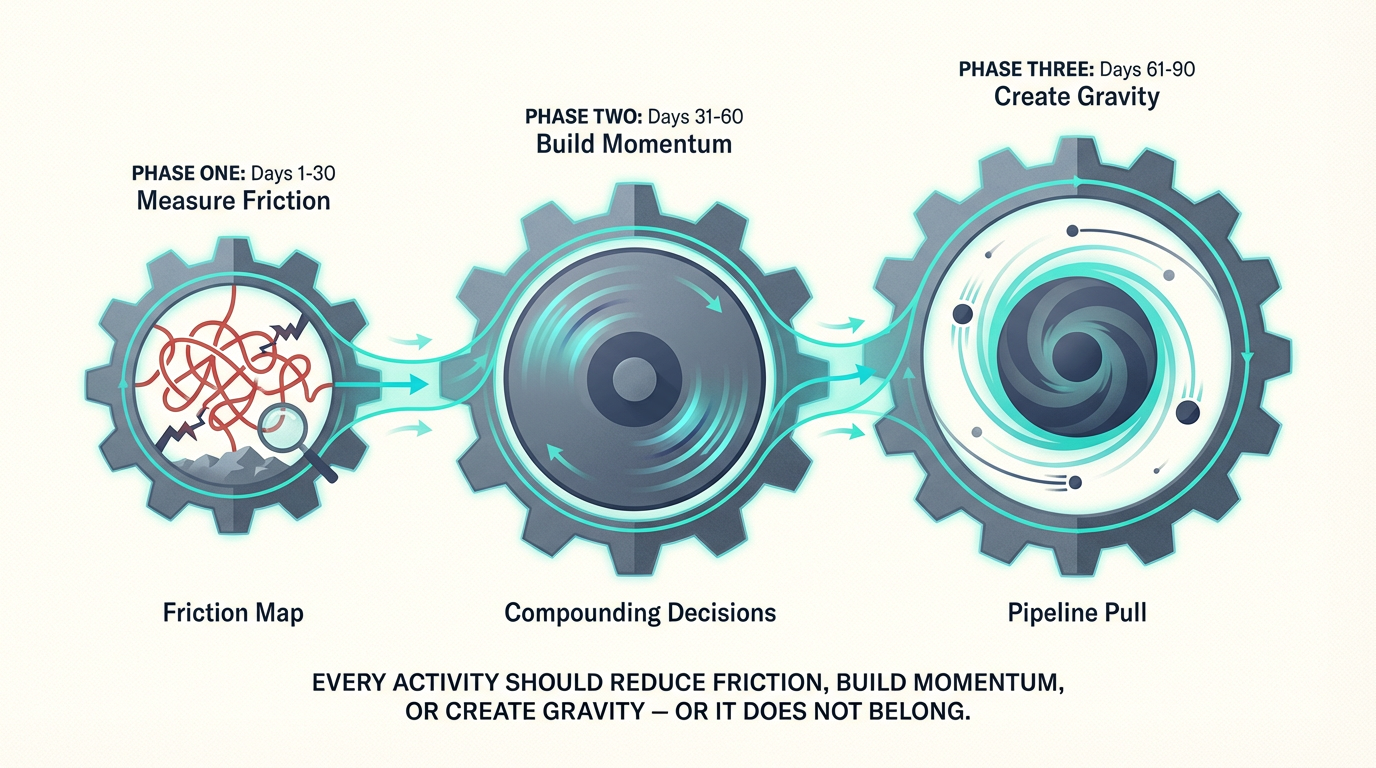
The 90-day plan maps directly to the Coherence Model™ framework that I use in every Strategnik engagement.
Days 1–30 are about measuring friction — identifying every point in the GTM system where energy is being wasted, buyers are dropping off, or the sales motion is fighting against itself. The diagnostic is fundamentally a friction map.
Days 31–60 are about building momentum — making the positioning, ICP, and channel decisions that allow compounding to begin. Momentum in a GTM system doesn’t come from doing more. It comes from doing the right things consistently. The decisions you lock in month two determine whether your efforts compound or dissipate.
Days 61–90 are about creating gravity — building the content, campaigns, and pipeline systems that pull prospects toward you rather than requiring you to chase them. A working demand gen engine with clear attribution is what gravity looks like in practice.
The framework keeps the 90-day plan honest. Every activity should reduce friction, build momentum, or create gravity. If it doesn’t do one of those three things, it doesn’t belong in the plan.
Frequently Asked Questions
How long before a fractional CMO shows results?
Leading indicators should move inside 90 days: a written diagnosis by day 30, locked positioning and channel decisions by day 60, live campaigns with instrumented pipeline by day 90. Closed revenue takes longer because it rides your sales cycle; in B2B SaaS that typically means pipeline sourced in month three closes in months five through nine. Judge the first quarter on system quality and pipeline creation, not bookings.
What should a fractional CMO deliver in the first month?
One thing above all: a written GTM diagnostic, 5–8 pages, covering pipeline structure, conversion data, ICP validation against actual closed-won deals, and the gap between your positioning and what customers say. No campaigns, no rebrand, no hires. If month one produces activity instead of a diagnosis, the rest of the engagement is built on guesses.
How many hours per week should a fractional CMO work during the first 90 days?
More than you think. I typically run 20–25 hours per week in the first 90 days, then taper to 15–20 as systems get built. The diagnostic phase is intensive. Anyone offering 5–10 hours per week for a Series A company is going to produce surface-level work.
What should a fractional CMO cost at the Series A stage?
For a senior operator — someone who’s built and run marketing at venture-backed companies — expect $15K–$25K per month. Below that range, you’re likely getting someone who will learn on your dime. Above it, you should be asking why they aren’t full-time.
How do you measure whether a fractional CMO engagement is working?
By day 90, you should see three things: a functioning pipeline generation system (even if volume is low), clear metrics and reporting, and a written strategy that the team can execute without the fractional CMO in the room. Pipeline volume is a lagging indicator — the leading indicators are system quality and team capability.
Should a fractional CMO manage existing marketing team members?
Yes, if they exist. A fractional CMO who won’t manage people is an advisor, not a CMO. Managing the existing team, identifying gaps, and building the hiring plan are core responsibilities — not optional add-ons.
When should a Series A company hire a full-time CMO instead of fractional?
When you’ve validated product-market fit, have repeatable pipeline generation, and are ready to invest $300K+ per year in a marketing leader plus their team. For most Series A companies, that’s 12–18 months away. The fractional engagement bridges that gap and de-risks the eventual full-time hire by defining exactly what the role needs to be.
For the full pricing breakdown and ROI framework, see our Fractional CMO Cost guide.