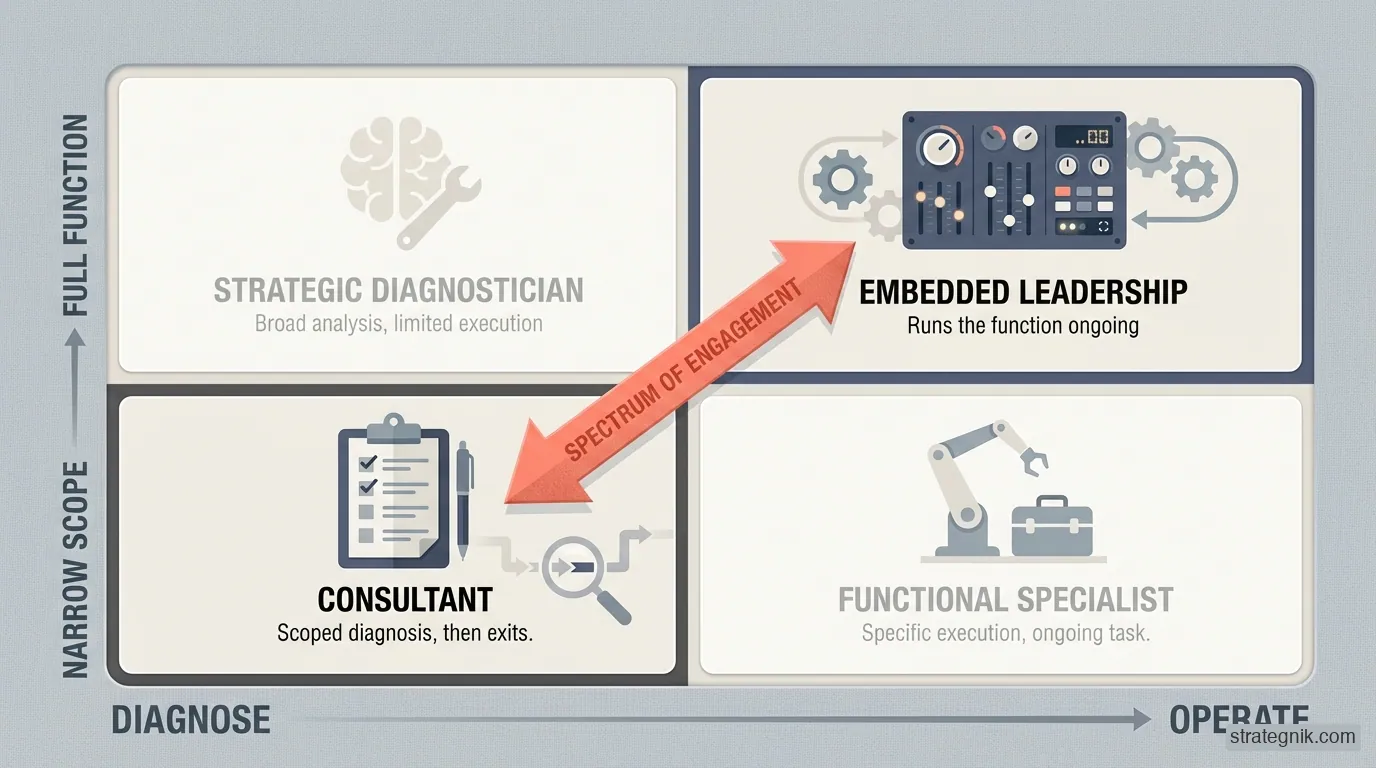
A fractional CMO embeds in your company and runs marketing. A GTM consultant diagnoses your go-to-market system, delivers a strategy, and leaves. Most Series A–C founders conflate the two, hire the wrong one, and end up six months behind. Here’s how to tell which one you actually need.
What Is a Fractional CMO?
A fractional CMO is a part-time marketing executive who owns the function. They sit in your leadership meetings, manage your team (or build one), make budget decisions, and are accountable for pipeline. They’re not advising from the outside; they’re operating from the inside on a fractional schedule, typically two to four days per week.
The reason this model exists is straightforward: most Series A and B companies can’t justify, or afford, a $350K+ full-time CMO. But they still need someone who can set positioning, build demand gen infrastructure, align marketing with sales, and actually ship the work. A fractional CMO fills that gap without the full-time comp package.
What a good fractional CMO is not: a strategist who hands you a deck. They’re in the Slack channels, reviewing the copy, pushing back on the sales team’s “just send more leads” requests, and making tradeoffs with real dollars. If they’re not making decisions that have consequences, they’re a consultant with a better title.
What Is a GTM Consultant?
A GTM consultant is brought in to solve a defined problem. Maybe your positioning is muddled and you’re losing deals you should win. Maybe you’ve scaled spend but pipeline isn’t responding. Maybe you’re entering a new market and need to pressure-test your ICP before you hire a team around it.
The engagement is scoped: diagnose the problem, build the strategy, deliver the playbook, and hand it off. A good GTM consultant works in weeks or months, not quarters. They bring an outside perspective that your internal team, too close to the problem, often can’t see. Then they leave.
The value is clarity and speed. They tell you what’s broken, why, and what to do about it. Execution is on you.
The 3 Key Differences Between a Fractional CMO and a GTM Consultant
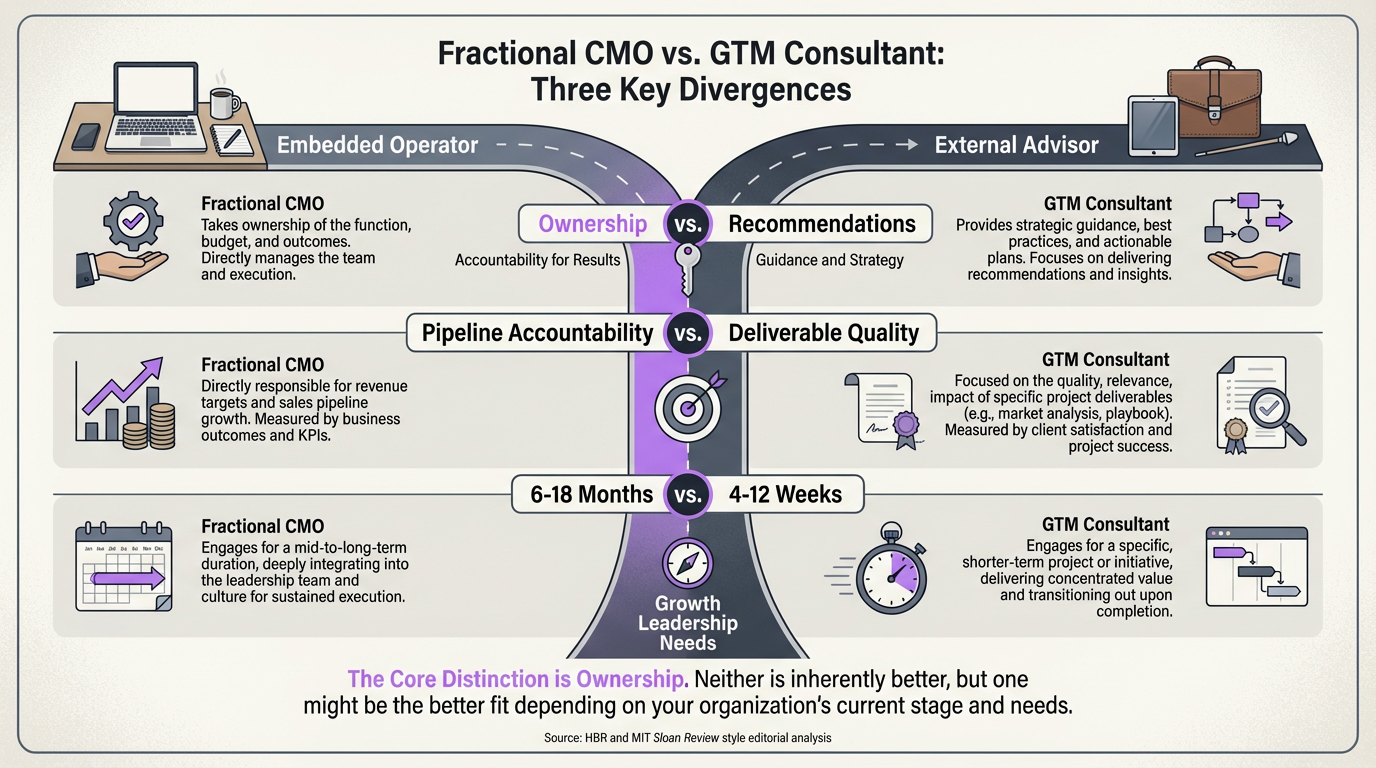
The confusion between these roles is real, and it costs companies time. Here’s where they actually diverge:
| Dimension | Fractional CMO | GTM Consultant |
|---|---|---|
| Relationship | Embedded operator; part of the leadership team | External advisor; defined engagement |
| Accountability | Owns pipeline targets and marketing KPIs | Accountable for deliverable quality, not outcomes |
| Duration | 6–18 months, ongoing | 4–12 weeks, project-based |
| Team management | Hires, manages, and develops the marketing team | Works alongside existing team or leadership |
| Decision authority | Makes budget and prioritization calls | Recommends; you decide |
| Cost structure | Monthly retainer ($10K–$25K/mo typical) | Project fee ($15K–$75K per engagement) |
| Best for | Companies that need someone to run marketing now | Companies that need a specific problem diagnosed and solved |
The core distinction is ownership. A fractional CMO is responsible for results over time. A consultant is responsible for the quality of their analysis and recommendations within a defined scope. Neither is inherently better; they solve different problems.
One pattern I see constantly: a founder hires a GTM consultant expecting them to also execute. The consultant delivers a strong strategy, the founder’s team doesn’t have the capacity or skill to implement it, and the strategy sits in a Google Doc collecting dust. That’s a scoping failure, not a consulting failure. If you don’t have the team to execute, you don’t need a strategy. You need an operator.
Which One Does a Series A SaaS Company Need?
Depends on where the bottleneck is.
If you have a functioning marketing team (even a small one) but the strategy is wrong, the positioning is off, or you’re scaling spend into the wrong channels, a GTM consultant can course-correct fast. You have people to execute; you need someone to point them in the right direction.
If you don’t have a marketing leader and the CEO is making every marketing decision by default, you need a fractional CMO. Not because the CEO lacks marketing judgment (though sometimes that’s true), but because marketing leadership is a full-time cognitive load. Every hour the CEO spends debating email subject lines or reviewing landing pages is an hour not spent on product, fundraising, or closing enterprise deals.
According to Pavilion’s 2025 B2B CMO Compensation Report, the median time-to-hire for a full-time VP of Marketing or CMO at Series A companies is 5.7 months. That’s nearly half a year with no one steering the function. A fractional CMO can be operating within two weeks while you run your search — or, in many cases, instead of running that search at all until you hit Series C.
There’s a third scenario that’s less obvious: you have a marketing leader, but they’re junior. They can execute but can’t set strategy. In that case, a fractional CMO who mentors while operating (building the playbook and developing the person who’ll eventually own it) is often the highest-leverage move.
When You Need Both: The GTM Architect Model
Sometimes the answer isn’t either/or. Some companies need a diagnostic phase before they need an operator, or they need an operator who thinks like an architect.
This is where I landed after twenty years on both sides of this problem. The Coherence Model™ framework I use at Strategnik was built precisely because the fractional CMO vs. consultant binary misses a critical step: understanding which forces are actually working against your growth system before you start building.
Coherence Model™ has three pillars: Momentum, Friction, and Gravity. Momentum is about whether your GTM investments are compounding or dissipating. Friction is the hidden resistance in your pipeline, your buyer journey, your handoff between marketing and sales: the walls between GTM teams that AI is collapsing. Gravity is the organic pull that attracts buyers to you versus requiring you to chase every one of them.
Most companies don’t need a consultant to tell them growth is slow. They need someone who can diagnose why it’s slow — is it a momentum problem (you’re investing in the wrong things), a friction problem (the right things aren’t converting), or a gravity problem (nobody knows you exist)? — and then build the system that fixes it.
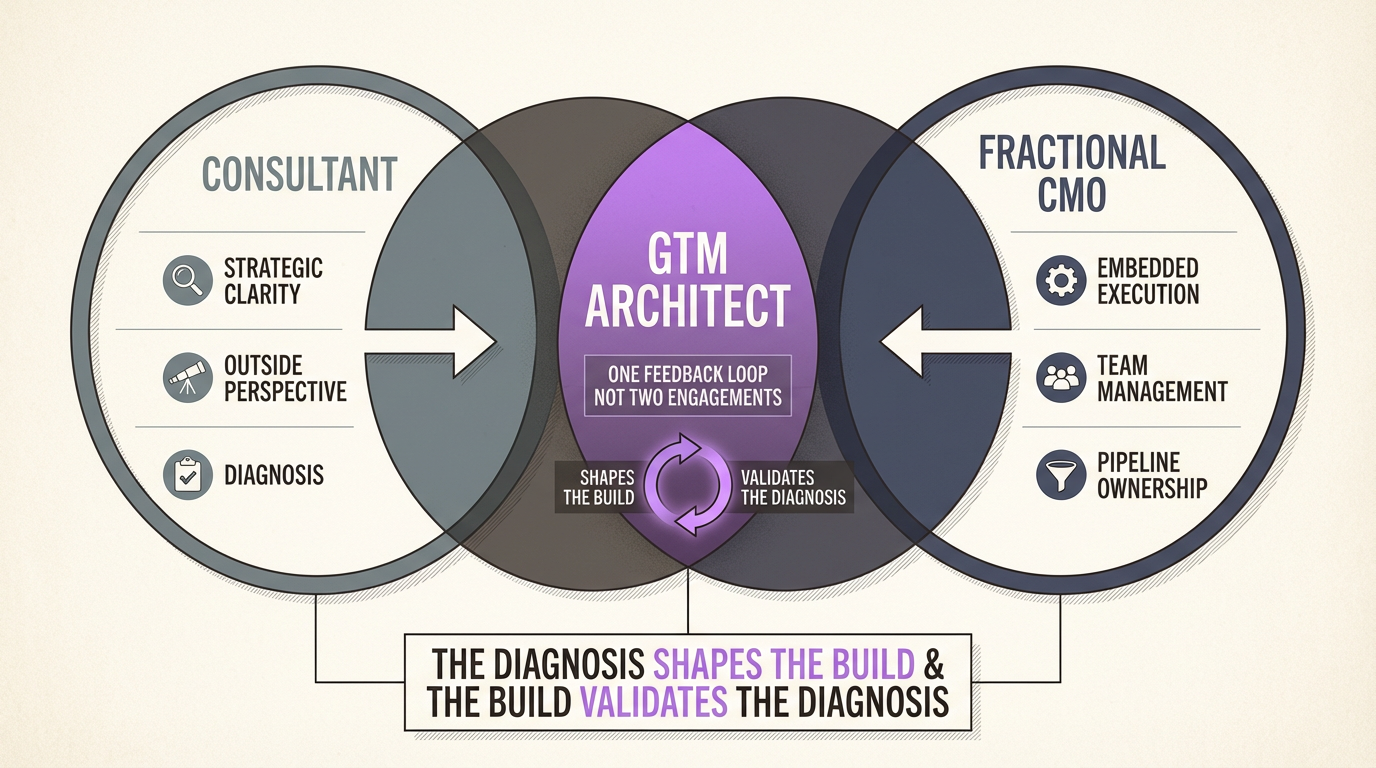
That’s the GTM architect model: consultant-level diagnosis with operator-level accountability. You get the strategic clarity of an outside perspective combined with the embedded execution of a fractional leader. The diagnosis shapes the build. The build validates the diagnosis. It’s one feedback loop, not two separate engagements.
I’m biased here: this is what I do. But I’ve seen enough companies burn through a strategy engagement followed by a fractional CMO who ignores the strategy and starts from scratch to believe the separation itself is often the problem.
Frequently Asked Questions
How much does a fractional CMO cost compared to a full-time CMO? A fractional CMO typically runs $10K–$25K per month depending on scope, stage, and time commitment. A full-time CMO at a Series B company costs $250K–$400K in total comp before you add benefits, equity, and the recruiting fee to find them. For most companies below $10M ARR, the fractional model is both more affordable and lower-risk: you’re paying for outcomes without a full-time commitment that’s hard to unwind if the fit is wrong.
Can a fractional CMO and a GTM consultant work together? They can, but it’s rare and usually unnecessary. If you have a strong fractional CMO, they should be capable of diagnosing GTM problems themselves. The exception is when a specific expertise gap exists: for example, a fractional CMO who’s strong on demand gen but needs help with product-led growth strategy or a market expansion they haven’t done before.
How long should a fractional CMO engagement last? Most engagements run 9–18 months. Anything under six months is usually too short to build systems that sustain after you leave. The goal should be to either transition to a full-time hire or reach a stage where the systems and team are self-sustaining. If a fractional CMO has been in the seat for two years with no plan to transition, someone should ask why.
What should I look for when hiring a fractional CMO for a B2B SaaS company? Stage experience matters more than brand names on a resume. Ask whether they’ve operated at your stage and your ACV range: the GTM playbook for a $15K ACV product-led motion is fundamentally different from a $150K enterprise sale. Look for someone who’s built the thing, not just advised on it. And check whether they have a framework or methodology, or whether they’re improvising. Improvisation doesn’t compound.
When should I hire a full-time CMO instead of a fractional one? When marketing is a core strategic function that needs daily executive attention: typically post-Series B with $8M+ ARR, a team of five or more marketers, and enough pipeline complexity that the role demands full-time cognitive bandwidth. Before that point, a fractional CMO gives you the strategic leadership without the overhead, and the flexibility to adjust if your GTM model pivots.
For the full pricing breakdown and ROI framework, see our Fractional CMO Cost guide.