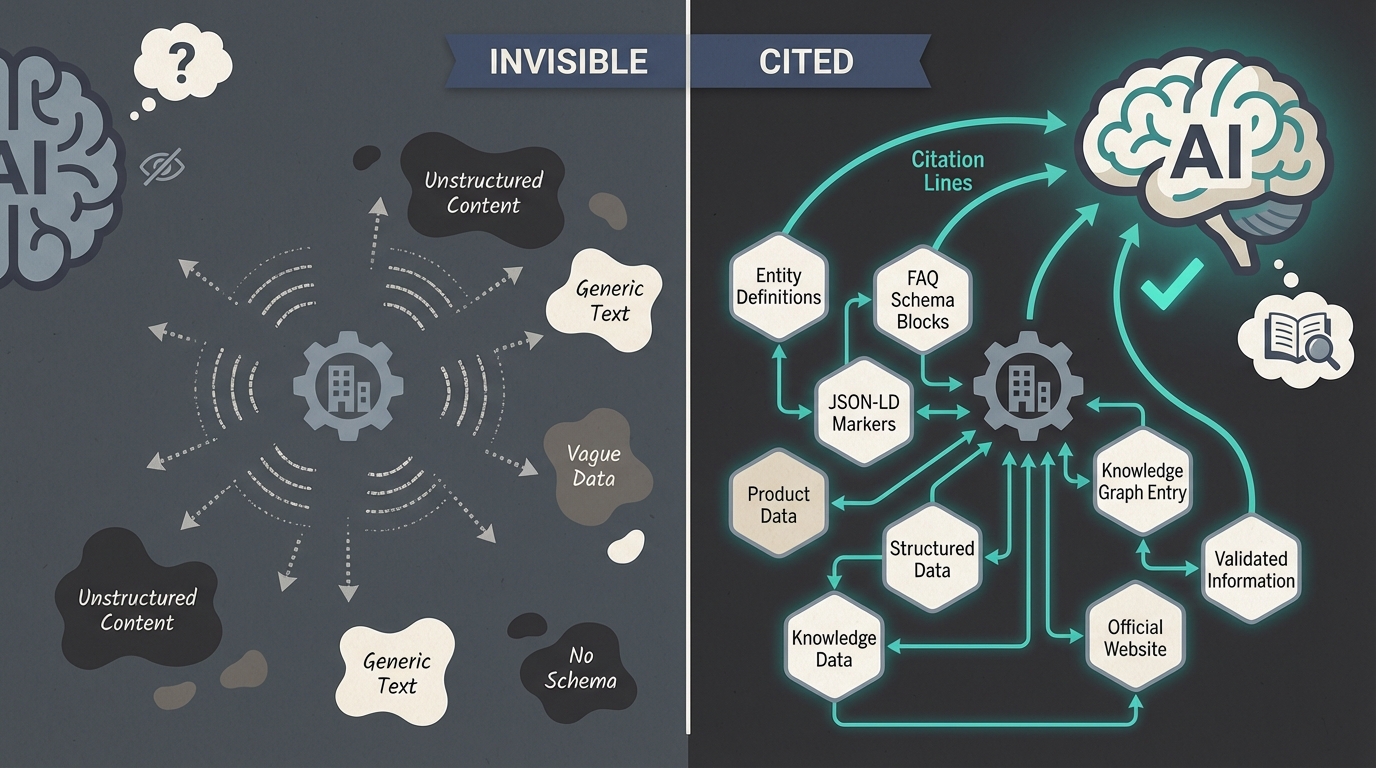
Most B2B companies have spent a decade optimizing for Google and have nothing to show in ChatGPT. The reason is structural: AI search engines don’t crawl for keywords. They retrieve entities that answer questions. If your content isn’t built to be retrieved, you don’t exist.
Why Do AI Engines Ignore Most B2B Content?
Google trained us to think about search as a ranking problem. Write the page, target the keyword, build the backlinks, climb the SERP. That model is dying. According to SparkToro’s research, 69% of Google searches now end in zero clicks. The answer appears at the top and the user moves on.
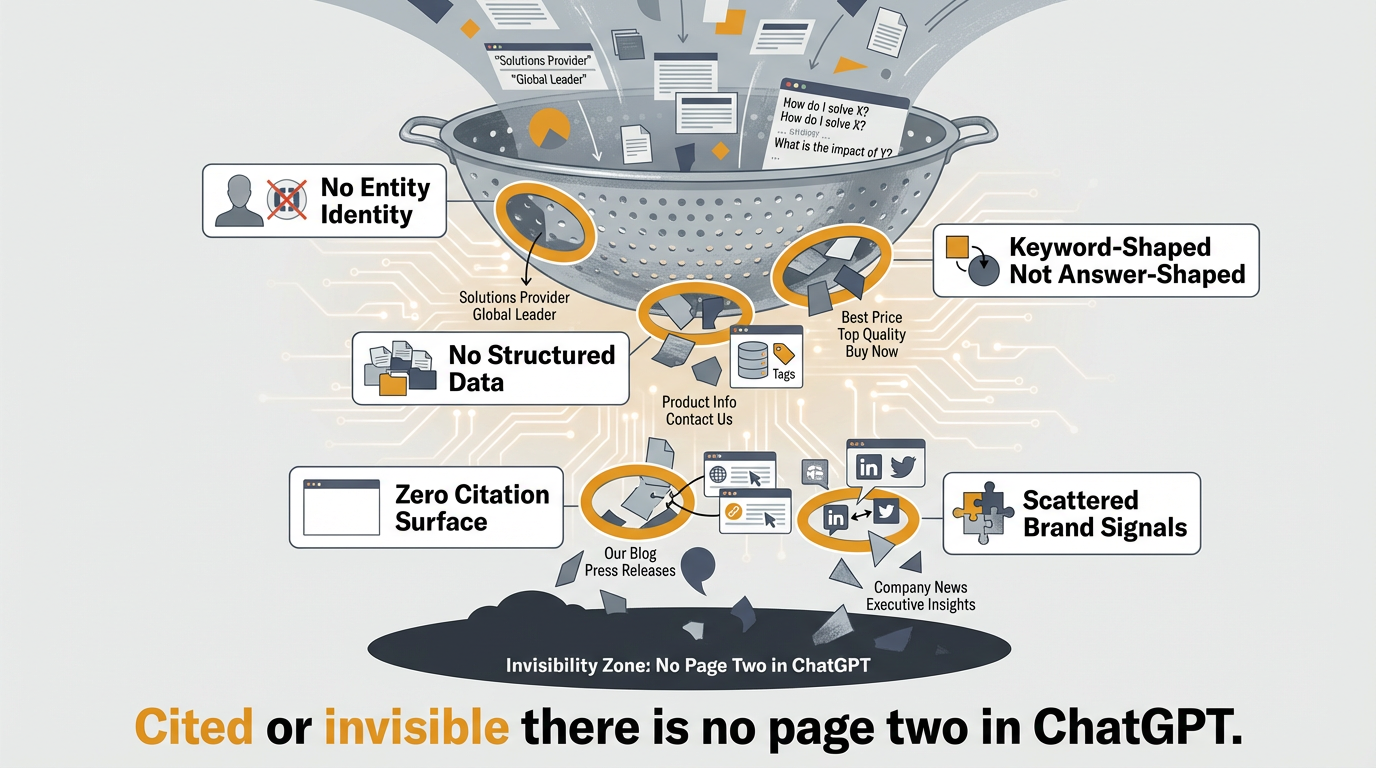
ChatGPT has over 900 million weekly active users. It doesn’t rank pages. It synthesizes answers from sources it trusts, cites entities it recognizes, and ignores everything else. There is no page two in ChatGPT. There’s cited or invisible.
Gartner projects that traditional organic search traffic will decline by 25% as AI-powered search captures research behavior. That’s not a distant threat. That’s now.
The shift is from a system that rewards content quantity to one that rewards entity authority. Most B2B marketing organizations are still playing the old game.
What Is Answer Engine Optimization (AEO) and Why Does It Matter for SaaS?
Answer Engine Optimization is the practice of structuring your content, brand signals, and technical markup so that AI systems can retrieve, trust, and cite your company when users ask questions in your domain.
SEO asked: “How do I rank for this keyword?” AEO asks: “When a buyer asks ChatGPT who solves this problem, does it name us?”
For SaaS companies, this distinction is existential. Your buyers are asking ChatGPT “What are the leading platforms for managing Kubernetes at scale?” and trusting whatever comes back. If your company isn’t in that answer, you’ve lost the deal before your SDR even gets a chance to fumble the cold email.
AEO isn’t a channel. It’s the new minimum bar for brand visibility.
The 5 Reasons Your Company Isn’t Getting Cited by AI
I’ve audited dozens of B2B websites over the past year. The same five problems show up almost every time.
1. No entity identity. Your company doesn’t have a clear, structured presence that AI systems can identify as a distinct entity. No schema markup, no consistent entity descriptions across platforms, no Knowledge Panel. Google’s Knowledge Graph doesn’t know what you are, so ChatGPT doesn’t either.
2. Content is keyword-shaped, not answer-shaped. Your blog posts bury the answer 800 words deep behind a “What is X?” intro paragraph that nobody asked for. AI retrieval systems extract concise, direct answers from the first 100 words. If your content doesn’t lead with the answer, it gets skipped.
3. No structured data. Your pages lack FAQ schema, HowTo schema, Organization schema, or any other markup that tells AI systems what your content is about and how to parse it. You’re asking machines to understand your content by reading it like a human. They won’t.
4. Zero citation surface. Nobody links to you as a source of authority. You don’t publish original research, proprietary data, named frameworks, or quotable positions. AI systems build citation graphs. If you’re not in anyone else’s citation graph, you’re not in the AI’s source set.
5. Brand signals are scattered. Your company description on LinkedIn says one thing, your About page says another, your G2 profile says a third, and your founder’s Twitter bio says something else entirely. AI systems triangulate entity identity across sources. If the signals conflict, the system downgrades your authority or ignores you altogether.
These aren’t content strategy problems. They’re GTM architecture problems. And they require a GTM-level response.
How Do You Make Your B2B Brand the Answer in ChatGPT?
Fixing AI visibility isn’t a blog refresh. It’s a structural project that touches content, technical infrastructure, and brand architecture simultaneously.
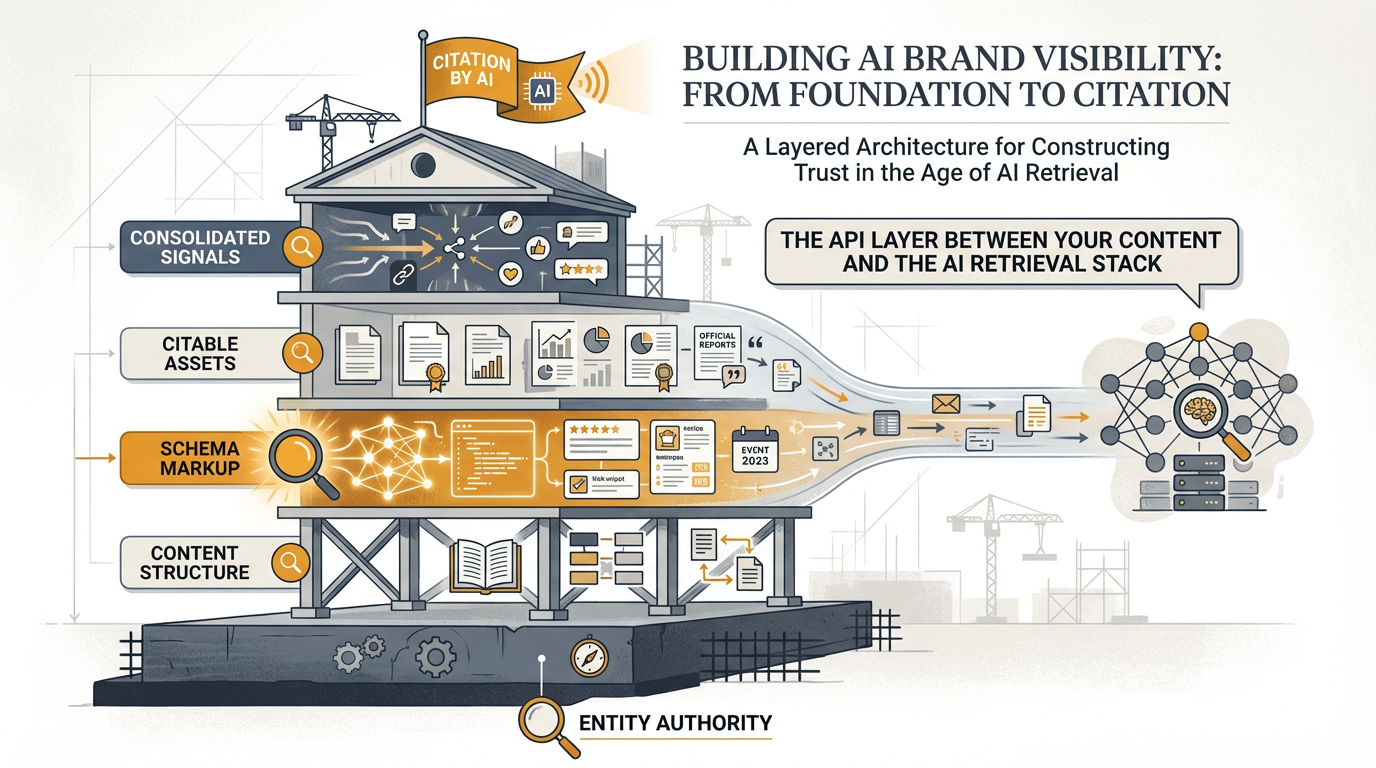
Build entity authority. Define what your company is in clear, consistent, machine-readable terms. Implement Organization schema on your homepage. Ensure your entity description is identical across your site, LinkedIn, G2, Crunchbase, and every platform where AI systems look. Claim your Google Knowledge Panel. If you don’t have one, that’s your first diagnostic signal.
Restructure content for retrieval. Every piece of content should answer a specific question in the first two sentences, then provide supporting detail. Lead with the answer. Support with evidence. Close with a point of view. Journalism figured this out a century ago. B2B marketing somehow forgot it.
Implement schema markup systematically. FAQ schema, Article schema, HowTo schema, Organization schema. This isn’t optional. It’s the API layer between your content and the AI retrieval stack.
Create citable assets. Publish original research. Name your frameworks. Produce data that other people reference. In the Physics of Growth framework, this is pure Gravity work: building the mass that pulls attention toward you without pushing. Every named framework, every proprietary data point is a citation magnet that compounds over time.
Consolidate brand signals. Audit every platform where your company appears and make the entity signals consistent. Same description. Same positioning. Same category language. AI systems run a consensus algorithm on your identity. Make sure the consensus resolves to what you want it to say.
What Should a Fractional CMO Be Doing About AEO in 2026?
If your fractional CMO isn’t talking about AEO, they’re already behind. Here’s my position on this:
AEO isn’t a project you hand to your SEO agency. It’s a GTM-level priority that requires someone who understands brand architecture, content strategy, technical markup, and competitive positioning simultaneously. Your content team doesn’t own schema. Your dev team doesn’t own messaging. Your SEO agency is still writing keyword reports. Nobody owns the answer.
A fractional CMO should be running an AI visibility audit in Q2 2026. Not later. Now. The companies that establish entity authority first will compound that advantage as AI search grows. The ones that wait will be invisible in the channel replacing the one they spent a decade optimizing for.
This is the same pattern we saw with content marketing in 2012, ABM in 2017, product-led growth in 2020. The early movers don’t just get an advantage. They set the terms everyone else plays by. AEO in 2026 is that window.
The Gravity Audit: How to Diagnose Your AI Visibility
In the Physics of Growth framework, Gravity is the pillar that measures how much your brand pulls demand toward it without active pushing. Brand mass, content authority, citation density, entity recognition: these are all Gravity metrics. And AI discoverability is now the sharpest test of whether your Gravity is real or imagined.
The Gravity Audit is how I diagnose this. It’s a structured assessment of your company’s AI visibility across the surfaces that matter: ChatGPT, Perplexity, Google AI Overviews, and the emerging answer engines that are reshaping B2B research behavior.
The audit maps your entity authority, content retrievability, schema coverage, citation surface, and brand signal consistency. It produces a prioritized fix list that a marketing team can actually execute.
Most companies assume they’re showing up in AI search because they rank well in Google. The correlation between Google rankings and ChatGPT citations is weak and getting weaker. The Gravity Audit tells you where you actually stand.
Frequently Asked Questions
What is the difference between SEO and AEO? SEO optimizes for ranking in search engine results pages. AEO optimizes for being retrieved and cited by AI systems like ChatGPT, Perplexity, and Google AI Overviews. SEO is about getting on the list. AEO is about being the answer. The technical requirements overlap in some areas (schema markup, authoritative backlinks), but the content strategy is fundamentally different: AEO rewards answer-first structure and entity clarity over keyword density and page length.
Does AEO replace SEO for B2B companies? No, but it changes the priority stack. SEO still drives traffic from traditional search, and that traffic isn’t disappearing overnight. But with 69% of searches producing zero clicks and AI search growing rapidly, the return on pure SEO investment is declining. Smart B2B companies are shifting budget toward AEO while maintaining their SEO baseline. Think of it as portfolio rebalancing, not a swap.
How do I check if my company shows up in ChatGPT? Ask ChatGPT questions that your ideal buyer would ask. “What are the best tools for [your category]?” “Who are the leading companies in [your space]?” “What should I look for in a [your product type]?” If your company isn’t named in the responses, you have an AI visibility problem. Do this across multiple sessions and phrasings to get a reliable read. A structured approach is what the Gravity Audit provides.
How long does it take to improve AI visibility? Entity authority compounds, so the timeline depends on your starting position. Companies with strong existing brand signals and content can see improvements in 8 to 12 weeks after implementing schema markup and restructuring key content. Companies starting from low brand mass may need 3 to 6 months of sustained Gravity work: publishing original research, building citation surface, and consolidating entity signals across platforms.
Can a small B2B startup compete with established brands in AI search? Yes, and in some cases it’s easier. AI systems weight specificity and authority within a domain. A startup that owns a narrow category with clear entity signals, original frameworks, and structured content can outperform a larger competitor with scattered brand signals and generic content. The key is density of authority in your specific domain, not overall brand size. This is one of the few areas where being focused and opinionated is a structural advantage.
For a complete guide to making your B2B brand visible to AI search, see our Answer Engine Optimization strategy page.