If your marketing team still has a dedicated SEO person, a product marketing manager, and a production designer — you are paying three people to do work that AI does in minutes. Not poorly. Not “good enough.” Well. The question isn’t whether those roles will be absorbed. It’s whether you’ll restructure proactively or bleed budget until you’re forced to.
Most CEOs I talk to know their marketing org feels wrong. They can’t always articulate why. They just know they’re spending $1.5M+ on a team of 8-12 people and the output doesn’t match the investment. Pipeline is inconsistent. Content feels generic. Every initiative takes too long. The CMO asks for more headcount and the CEO can’t figure out what the last three hires actually produce.
Here’s what’s happening: you’re running a 2019 org chart in a 2026 capability environment. That chart was organized by channel — Paid Media, SEO, Content, CRM, Sales, Brand — with one specialist per lane. It was always a little broken. Each lane operated independently, measured different things, and created natural friction at every handoff. But it was the best structure available when each channel genuinely required deep, specialized knowledge to execute.
That’s no longer true. And the gap between the old structure and what’s now possible is where your money is going.
The Old Model Was Always Kind of Broken
Let me be honest about this, because the AI conversation tends to frame the old model as something that worked well and is now being disrupted. It didn’t work that well.
Channel-based org charts created silos by design. Your SEO person optimized for rankings. Your content person optimized for volume. Your demand gen person optimized for MQLs. Your PMM optimized for sales enablement. Each of them reported their own metrics, hit their own targets, and declared victory — while pipeline stayed flat and CAC kept climbing.
The CEO saw the symptom: “marketing isn’t working.” The CMO’s answer was always structural: we need another person. A lifecycle marketer. A growth person. A marketing ops hire to wire everything together. The team grew from 6 to 8 to 12, and the fundamental problem — that nobody owned outcomes, only channels — never got addressed.
This is the model you’re defending when you resist restructuring. Not a well-oiled machine that AI is threatening. A Rube Goldberg apparatus that happened to be the only option when every channel required a human specialist to operate.
What AI Actually Changed
AI didn’t just make marketing faster. It collapsed the skill premium on three entire specialties.
Product marketing used to be the translation layer between product and market. Positioning documents, competitive battlecards, sales enablement decks, launch plans — all of it required a person who could hold the product’s technical reality in one hand and the buyer’s decision framework in the other. That translation work was genuinely hard and genuinely scarce.
It’s not scarce anymore. An AI agent with access to your product docs, win/loss data, competitive intelligence, and CRM produces a positioning draft, a battlecard, or a launch brief in minutes — work that used to take a PMM a week. Not a perfect draft. But a draft that’s 80% there, which means the remaining 20% is judgment, not production. You don’t need a $160K PMM to apply judgment 20% of the time. You need a strategist who evaluates and sharpens output as part of a broader role.
Design followed the same arc. The bottleneck in marketing design was never taste — it was production. Resizing assets, building landing page variations, creating social graphics, adapting templates for different channels. AI handles all of that now. The design skill that still matters is brand architecture: defining the system that governs how everything looks and feels. That’s a creative director function, not a production designer function. One person plus AI replaces a team of three or four — and the output is more consistent because a system is governing it, not a queue of tickets.
SEO is the most dramatic collapse. Traditional SEO — keyword research, on-page optimization, technical audits, link building strategies — was a specialty because the rules were complex and always changing. Google’s algorithm was a black box that rewarded people who studied it obsessively. Now AI tools run technical audits in seconds, generate schema markup, optimize content structure, and monitor rankings automatically. The strategic question — what should we be known for and how do we earn authority — was always a brand and content strategy question, not an SEO question. The tactical complexity just obscured that, and you paid $140K a year for the obscurity.
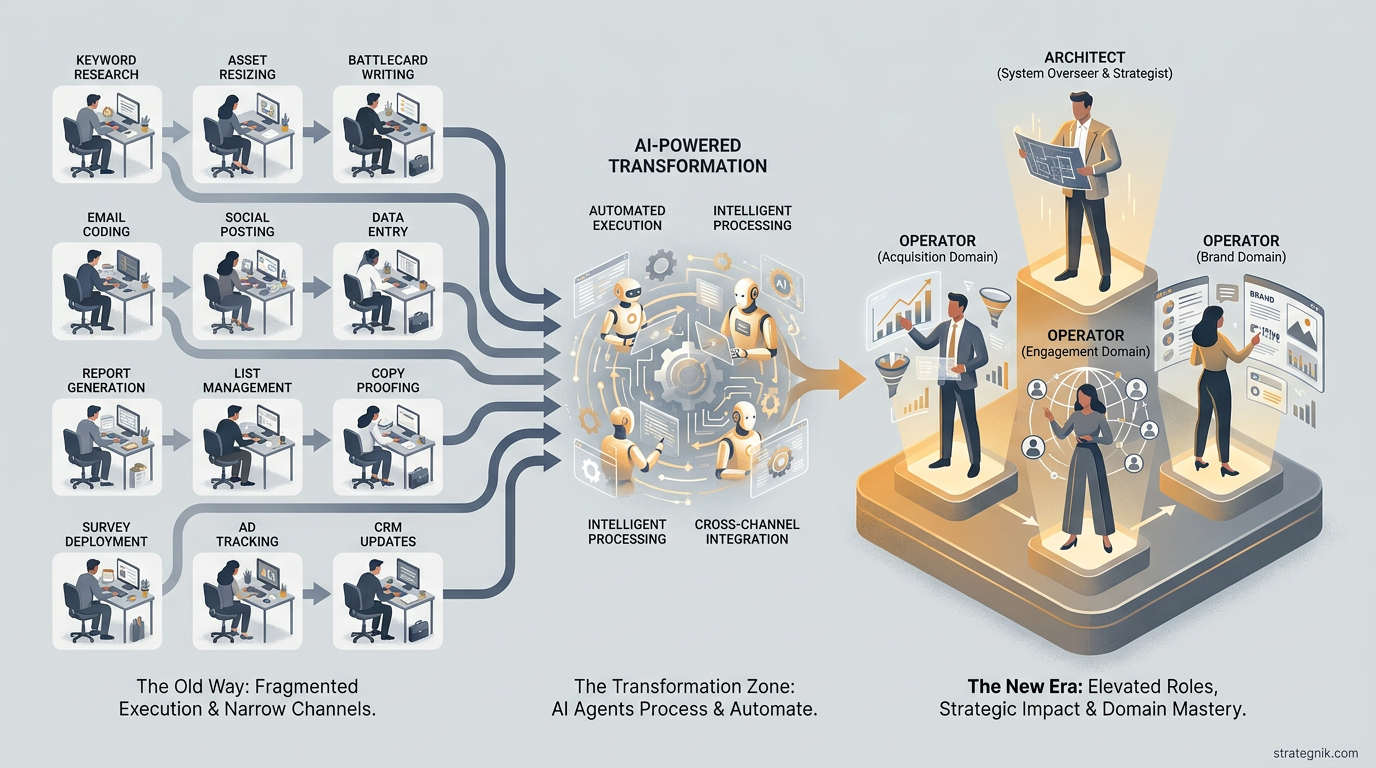
As a CEO, you should be asking: how many people on my marketing team are doing work that AI now does as well or better? Not “could theoretically do” — actually does, today, with commercially available tools. The answer is probably higher than your CMO has told you.
The New Structure: Organized by Outcome
The modern marketing org isn’t organized by channel. It’s organized by outcome — with architect layers underneath that make the whole system work.
Three outcome pods:
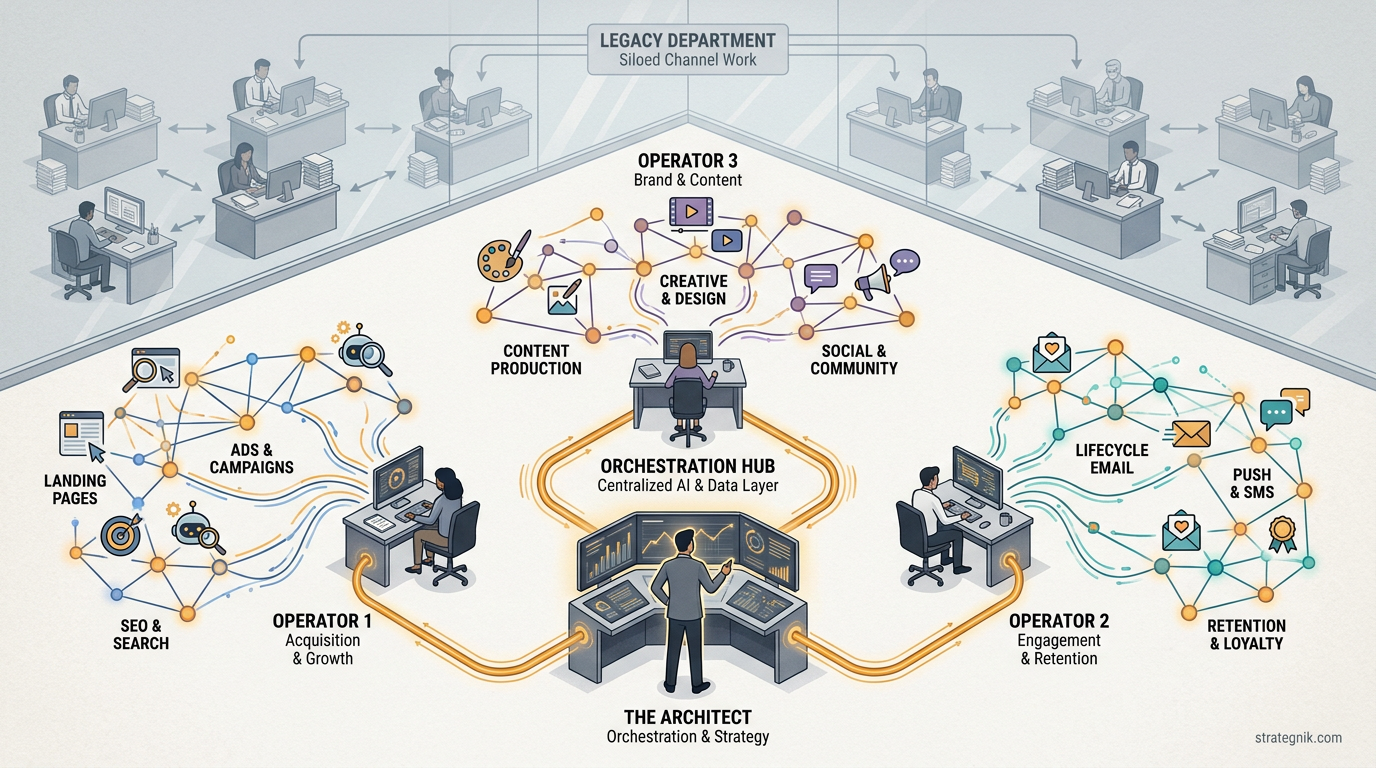
Acquisition owns the top of funnel. Paid, GEO/AEO, landing pages, conversion. This person thinks in pipeline creation and cost of acquisition, not channel-specific metrics. They deploy AI agents to manage the channels and focus their own time on strategy, creative differentiation, and conversion architecture. One person doing the work that used to require a demand gen manager, an SEO specialist, and a paid media buyer — because the execution complexity that justified three roles has been absorbed by tools.
Engagement & Monetization owns the existing customer. Retention, activation, expansion, lifecycle. This role used to be split across CS, lifecycle marketing, and product marketing — all measuring different slices of the same thing: how much value does this customer extract and how do we compound it? Combining them into one owner with AI-powered automation eliminates the handoff gaps where customers quietly churn.
Brand owns brand in market. Creative direction, production, voice. Not brand in the old “awareness campaign” sense — brand as the system that makes everything the company produces feel like it comes from the same mind. This is the role that becomes more important as AI generates more first drafts, because without a governing system, you publish 10x the content at 0.1x the coherence.
Three architect layers that sit across the entire org:
Orchestration — the person or small team that owns workflows, agents, and automation. This function didn’t exist in 2019 because there was nothing to orchestrate. Each channel ran its own playbook. Now the playbooks are interconnected, the agents are cross-functional, and someone needs to design and maintain the system that connects acquisition signals to engagement actions to brand consistency. I’ve written about this as the Chief Marketing Orchestrator role — it’s the single most important new function in marketing.
Creative and Voice System — the architect layer that owns brand guidelines, messaging framework, voice and tone, and ICP definition. This isn’t a person who makes ads. This is the person who builds the system that ensures every piece of output — whether generated by a human or an AI agent — sounds like the same company. Think of it as the constitution that every agent and every team member operates under.
Data — owns infrastructure, decisioning, and signal. Not analytics in the old “here’s a dashboard” sense. Data as the nervous system that tells the pods what’s working, what’s changing, and what to do next. This person builds the feedback loops that make the outcome pods self-correcting rather than reactive. Without this layer, you’re flying the new structure with the old instruments.
The Math CEOs Should Run
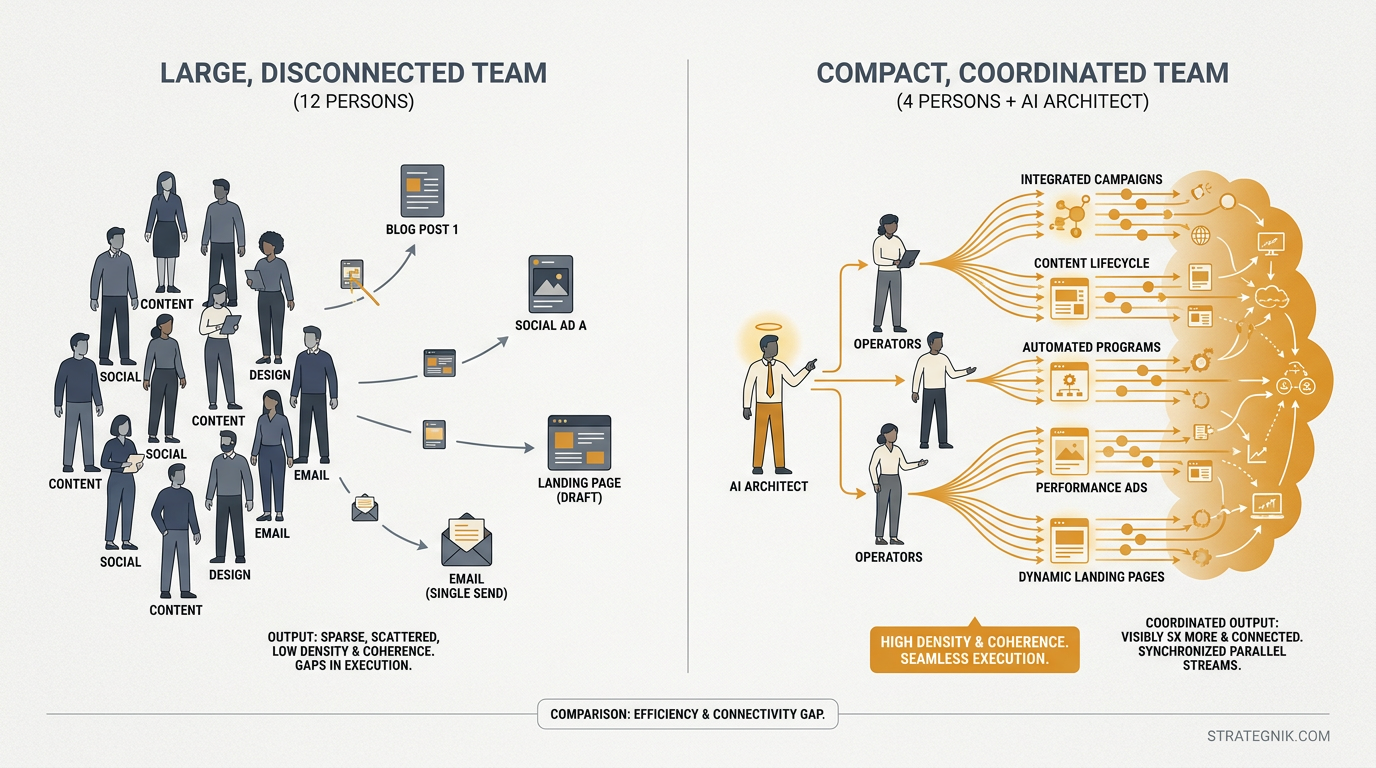
A 2019 marketing team at a Series B company typically ran 8-12 people. PMM, SEO specialist, content writer, designer, demand gen manager, lifecycle/CRM person, brand marketer, marketing ops, a couple of junior hires filling gaps. All-in cost: $1.2M-$1.8M in salary alone, plus tools, plus management overhead.
The 2026 version of that team — producing more output, with better targeting, across more channels — is 4-6 people plus an agent fleet. Three pod leads, an orchestration architect, and one or two specialists in the architect layers depending on where the company’s complexity lives. All-in cost: $800K-$1.1M in salary, plus $50-100K in AI tooling.
That’s not a cost-cutting story. It’s a leverage story. You’re not spending less. You’re getting dramatically more per dollar — and the “more” shows up where it matters: in pipeline, in conversion, in customer expansion. Not in activity metrics that make the team feel busy.
But here’s the part most CEOs miss: the savings aren’t the point. The point is that the new structure is simply better at producing outcomes. Even if it cost the same, you’d want it. The channel model creates handoff friction, metric fragmentation, and strategic incoherence by design. The outcome model eliminates all three. The fact that it also costs less is a bonus, not the thesis.
Why Your CMO Might Resist This
I want to be direct about this because it’s the conversation most CEOs need to have and most consultants won’t touch.
Your CMO may resist restructuring for legitimate reasons or illegitimate ones. The legitimate reason is that the transition is genuinely hard — you’re asking people to change roles, absorb new tools, and operate at a higher altitude, all at the same time. That’s real change management and it deserves real support.
The illegitimate reason is that the old structure is easier to manage. Six direct reports, each running their own channel, each reporting their own metrics — that’s a coordination job, not a strategy job. Some CMOs built their careers on coordination. The new structure requires a CMO who thinks in systems, designs feedback loops, evaluates AI output against market reality, and treats marketing as an engine, not a department. That’s a harder job. Not every CMO wants it.
You need to know which conversation you’re having. If your CMO says “we’re not ready for this” and follows it with a transition plan, you have a leader who gets it. If your CMO says “AI can’t replace my team” and follows it with a defense of the status quo, you have a leader who’s protecting a structure, not building one.
What This Actually Looks Like in Practice
The team that replaces your 12-person department isn’t a skeleton crew. It’s an architect and three agentic operators who produce at a level your current team can’t touch — not because your people aren’t talented, but because the structure they’re operating in won’t let them.
The architect is the person who redesigns the entire marketing engine. They define the outcome pods, build the orchestration layer, design the agent workflows, and establish the creative and voice system that governs everything. This isn’t a consultant who hands you a deck and leaves. This is someone who rewires how your marketing function operates — the data flows, the feedback loops, the decision frameworks — and then runs it.
The three operators each own an outcome domain. The acquisition operator runs paid, GEO/AEO, landing pages, and conversion — not by doing the manual work, but by directing AI agents that handle execution at scale while they focus on strategy, creative angles, and conversion architecture. The engagement operator does the same for retention, activation, and expansion. The brand operator governs creative direction and the voice system.
Four people. Agent-augmented. Producing more coherent, higher-quality output across more channels than your team of 12 — because every hour of human effort is spent on judgment and strategy, not production.
This isn’t theoretical. This is how the best marketing teams are operating right now, and the gap between them and the channel-based model is widening every month.
So What
If you’re a CEO reading this, here’s the test. Pull up your marketing org chart. Count the number of people whose primary value is channel execution — the SEO specialist, the production designer, the PMM who spends most of their time on decks and battlecards. Now ask: what would these people do if AI handled 80% of their production work?
If the answer is silence — if you can’t articulate what strategic contribution they’d make without the execution work — you don’t need more people. You need an architect who can rebuild the machine.
The model was always kind of broken. AI just made it indefensible. And the companies that figure this out first aren’t going to win by a little — they’re going to operate at a level that makes the old model look like it belongs in a museum.
Strategnik builds this. Let’s talk about what your team should look like.
Nick Talbert is the founder of Strategnik, where he helps B2B companies design and execute go-to-market strategies built for how markets actually work. Previously, he held senior marketing leadership roles at numerous B2B technology-forward companies. See full experience.