SaaS marketing had a cheat code for most of its existence: feature launches worked. Ship something your competitor couldn’t match for eighteen months and product marketing could ride the wave for quarters. The campaign built itself around the differentiation, and the differentiation held because the engineering was hard to replicate.
That cheat code is expiring. AI has compressed product development timelines to the point where a well-funded team can rebuild the functional equivalent of most SaaS products in months, not years. The feature you launched last quarter gets matched this quarter. The differentiation you built your campaign around disappears before the campaign finishes running.
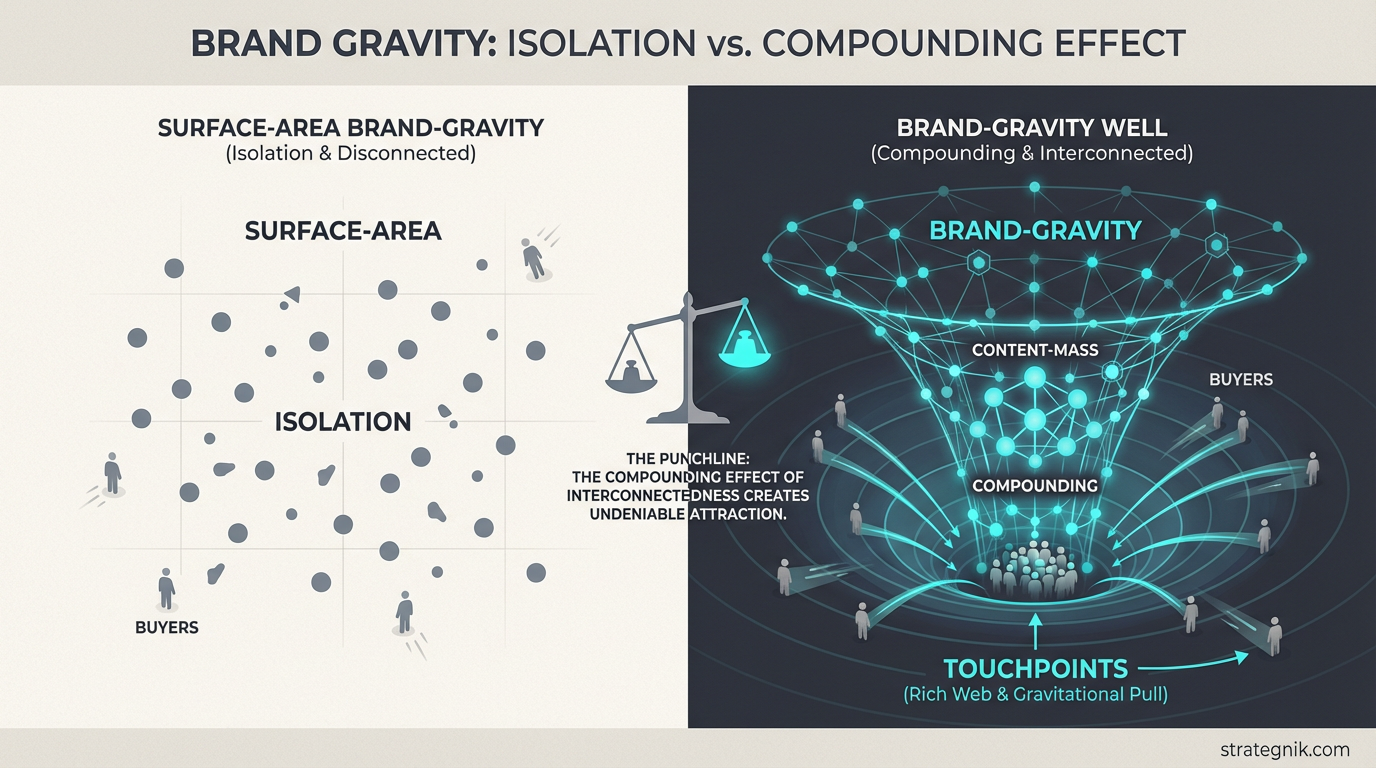
At Strategnik, we describe this using a physics framework. Features used to be a primary source of mass — the accumulated weight that creates gravitational pull toward your product. When a product was hard to replicate, every feature launch added mass to the system. Buyers were pulled toward you because the alternative required building from scratch. When features become easy to replicate, each launch adds less mass. The gravitational pull weakens. And marketing built around feature launches becomes velocity without mass — a treadmill that doesn’t compound.
But the same AI that erodes your product moat is the fastest surface area generation tool marketing has ever had access to. The marketing teams that use it to build brand gravity — the pull your accumulated market presence exerts on buyers — at a speed that was structurally impossible with human-only teams will create mass advantages that compound for years.
And the infrastructure matters as much as the intent. An enterprise AI license distributed across the marketing team doesn’t get you there. A model without your brand knowledge, your customer data, or your competitive positioning produces content that sounds like everyone else’s AI-generated content — correct but generic, on-topic but tonally dead. The system between the model and the marketer is what determines whether AI becomes a surface area engine or a content spam cannon.
This is the second in a three-part series on how SaaS go-to-market teams need to adapt when features stop being the moat. This post covers marketing. The companion pieces cover sales and customer success.
Consider how this plays out at two companies on opposite ends of the GTM spectrum: Gong and Airtable.
Gong built conversation intelligence through a sales-led, top-down motion. Airtable spread through organizations bottom-up via product-led growth. Both face the same structural challenge: the core features of each product are now replicable by AI-native competitors in weeks. Gong’s call recording and transcription is a commodity API. Airtable’s structured database with a clean UI is what every no-code tool ships on day one.
Where the mass actually lives — Gong’s proprietary data moat and Airtable’s operational surface area — is where marketing needs to point. But most marketing organizations at both companies would still instinctively lead with features. That instinct is the problem.
The Treadmill Problem
Most SaaS marketing organizations are still structured around product marketing as the center of gravity. Launch the feature. Write the blog post. Update the battlecard. Brief the analysts. Run the webinar.
That cadence made sense when features were durable. When the replication timeline compresses to weeks, the half-life of every announcement shrinks with it. You’re constantly launching, constantly chasing, and the pipeline impact of each launch keeps diminishing. That’s velocity without mass, and velocity without mass doesn’t compound.
The shift is toward the things that don’t commoditize. Features commoditize. Brand gravity doesn’t. Distribution advantages don’t. Proprietary data doesn’t. The density of your presence across the channels and conversations where buyers make decisions doesn’t. Marketing needs to reorient around these sources of mass — and AI is the tool that makes it possible to build them at the pace the market now demands.
What This Looks Like at Gong
Gong’s durable mass isn’t the call recorder or the deal board. It’s the dataset — millions of sales conversations across thousands of companies, plus the individual customer’s own conversation history that grows more valuable with every call logged.
But if marketing keeps leading with “we launched a new AI insight” or “our transcription is more accurate,” they’re competing on features that every competitor is shipping simultaneously. The mass Gong should be marketing is harder to replicate: the proprietary data advantage that only exists because thousands of sales teams have been feeding their conversations into the platform for years.
AI changes the scale at which Gong can make that data advantage visible and authoritative. The marketing team can use AI to produce research-grade content derived from their aggregated conversation data — content that no competitor can replicate because no competitor has the dataset. “We analyzed 2.3 million sales calls and found that deals where the seller mentions a specific competitor in the first call close at 14% lower rates than deals where they don’t.” That’s not a feature announcement. That’s a data moat turned into a content moat. Every piece of data-derived content reinforces the positioning: Gong doesn’t just record calls, it knows things about selling that nobody else can know.
AI can also power real-time competitive response at a speed that used to require a war room. When a competitor launches a new AI feature and the LinkedIn discourse cycle starts, Gong’s marketing shouldn’t be scrambling to draft a take. An AI-powered workflow can monitor the launch, draft a point-of-view piece grounded in Gong’s proprietary data, route it through a human editor, and publish within hours — reframing the conversation from “whose AI feature is better” to “whose AI has eighteen months of your team’s data training it.”
What This Looks Like at Airtable
Airtable’s brand presence lives in a place most marketers would envy: the product distributes itself. One person signs up, builds a base, shares it with their team, and the tool spreads through the organization without marketing lifting a finger. That’s PLG distribution creating brand touchpoints at the individual workflow level.
The marketing challenge is converting that passive distribution into active surface area — turning grassroots adoption into a gravitational force that pulls the entire organization toward an enterprise commitment before a competitor captures the same users with a shinier free tier.
AI makes this possible at a scale that changes the economics. Airtable’s team can use AI to produce deep, specific workflow content for every use case emerging organically in their user base — not generic “how to use Airtable” guides, but function-specific playbooks: “How to build a content operations pipeline in Airtable that connects to your CMS, triggers Slack notifications for review cycles, and syncs with your analytics dashboard.” Each piece is a surface area touchpoint that validates the use case, deepens the user’s implementation, and makes the tool harder to replace.
AI also enables Airtable to build and ship free tools that extend the brand’s surface area into adjacent workflows: a project staffing calculator, an operations maturity assessment, a workflow automation audit that benchmarks a team’s current process against best practices. Each tool captures data, generates leads, and creates touchpoints that reinforce Airtable’s position as operational infrastructure rather than a spreadsheet alternative. Building one of these tools used to be a quarter-long engineering project. With AI, it’s a two-week sprint. Ship four per quarter instead of one per year and you’ve multiplied your surface area while competitors are still planning their first.
The PLG motion gives Airtable something else that AI can amplify: user-generated social proof at scale. Thousands of teams are building workflows on the platform daily. AI can identify the most compelling use cases from product telemetry, generate case-study frameworks from usage patterns, and arm community managers with data-backed stories that turn organic adoption into marketing fuel. When the content isn’t “Airtable says you should use Airtable” but “here’s how 400 marketing teams are actually running their content operations,” the authority compounds differently.
The AI-Powered Marketing Playbook
Four shifts in how AI changes the motion:
Content velocity as a mass strategy. AI doesn’t just make content faster to produce — it makes comprehensive coverage possible. For Gong, that means producing data-derived research content at a cadence that no competitor can match because no competitor has the dataset. For Airtable, it means producing workflow-specific content for every use case, every persona, every integration combination — so that every conceivable search query about operational workflows surfaces Airtable content. In aggregate, that kind of coverage creates a content mass that dominates the conversation around your category.
Answer engine optimization at scale. AI search is reshaping how buyers discover and evaluate software. The vendors whose content gets cited in AI-generated answers are the ones with the densest, most authoritative content corpus. AI lets you build that corpus at the pace required to maintain presence in a system that retrains and re-indexes continuously. If you’re not in the AI-generated answer, you’re not in the consideration set.
Free tools that compound brand gravity. Engineering-as-marketing used to require engineering resources that marketing couldn’t access. AI has removed that constraint. Marketing teams can now build and ship diagnostic tools, calculators, and interactive assessments on their own. Each tool creates a touchpoint. Each touchpoint generates data. Data compounds into mass. A marketing team shipping one free tool per month builds more surface area in a year than most competitors build in five.
Competitive monitoring that never sleeps. AI agents can track competitor launches, pricing changes, messaging shifts, customer reviews, and hiring patterns continuously — and surface actionable intelligence to the marketing team in real time. When your competitive response time compresses from weeks to hours, you control the narrative instead of reacting to it.
What the Company Needs to Provide
Marketing’s infrastructure problem is different from what sales faces. The sales post in this series covers how sales needs depth on individual accounts. Marketing needs breadth across the entire market — and the ability to maintain quality at volume.
A brand knowledge base the model works from, not around. This is the most important infrastructure investment for marketing, and almost nobody builds it. The model needs to internalize your positioning, your voice, your competitive framing, your messaging architecture, and your brand guidelines — not as a system prompt it half-follows, but as a structured knowledge base it queries on every generation.
Without this, AI-generated content sounds like AI-generated content: correct but generic. The brand knowledge base should include your positioning document, approved competitive narratives, customer proof points with source attribution, voice and tone guidelines with examples of what good and bad look like, and a terminology guide for your category.
For Gong, this means the AI needs to understand the specific language of conversation intelligence, how Gong talks about deal risk versus how competitors talk about it, and which data claims are approved for external use. For Airtable, it means the AI needs to understand the positioning difference between “database” and “operational infrastructure,” how to talk about PLG adoption without sounding like you’re taking credit for something users built themselves, and which competitive frames to avoid.
A content pipeline with human editorial gates. AI-generated content at volume without editorial oversight isn’t a content strategy — it’s a spam cannon. The infrastructure should separate generation from publication with clear gates: AI drafts, a human editor reviews for brand voice and factual accuracy, then publishes. The AI handles research, structure, and the first draft. The human handles judgment: does this sound like us? Is this actually true? Does this say something worth reading?
Companies that skip the editorial gate produce a lot of content that does nothing. Companies that keep it produce less content that does more. The right infrastructure puts the AI on the right tasks and the humans on the right tasks.
Data connections to your product and customer base. The most powerful content marketing isn’t based on general category knowledge — it’s based on proprietary data. For Gong, this is the aggregated conversation dataset that fuels research content no competitor can produce. For Airtable, it’s anonymized usage patterns that reveal how teams actually build workflows — which becomes content that validates use cases and deepens adoption.
The AI should have access to this data so it can generate content grounded in what’s actually happening, not what the category generally looks like. “Teams that connect their Airtable base to Slack and automate status updates see 3x faster project completion” is a content asset no competitor can replicate. The AI turns your proprietary data into a content moat — but only if the data pipeline exists.
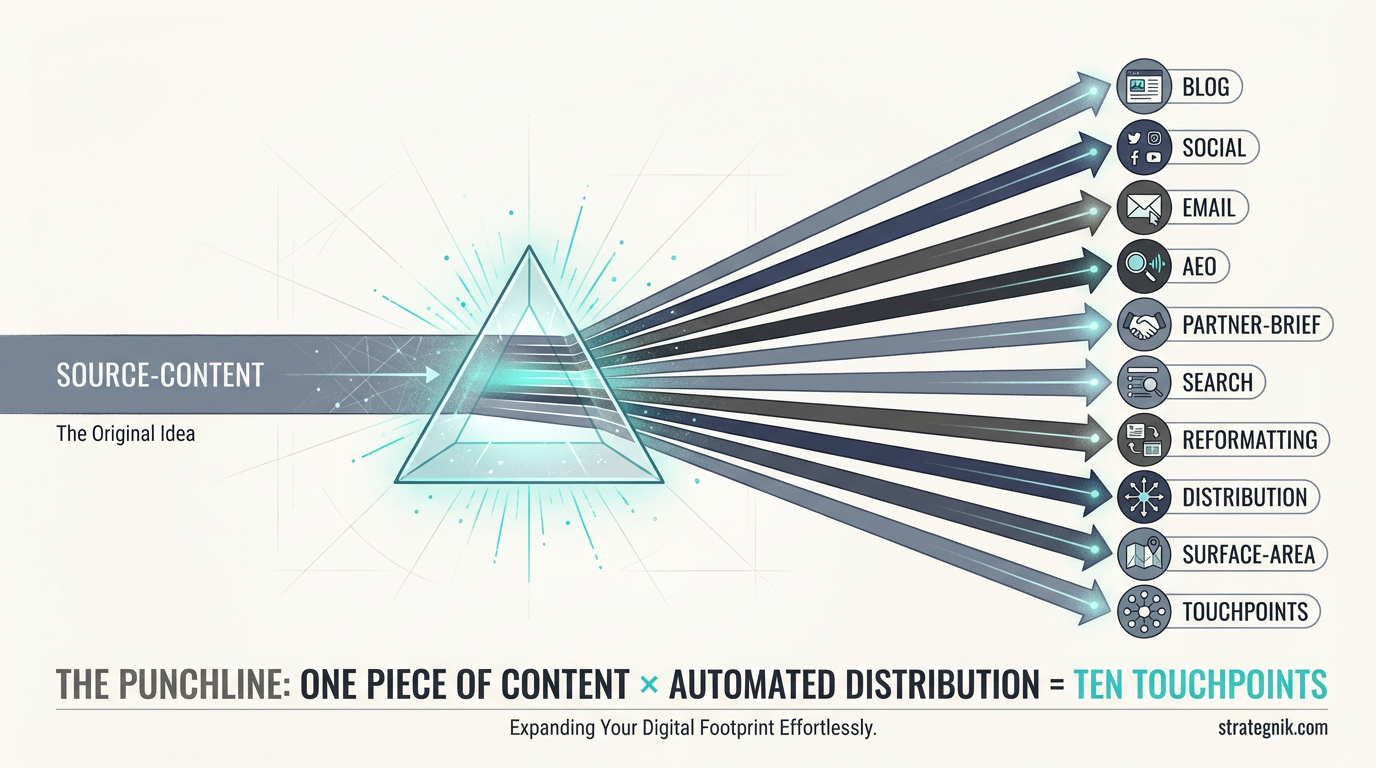
A multi-channel distribution layer. Generating content is half the problem. The other half is getting it into the channels where buyers make decisions. The infrastructure should include automated reformatting — taking a long-form piece and generating social posts, email snippets, partner co-marketing briefs, and search-optimized variants — so that one piece of content becomes ten surface area touchpoints instead of one.
An AEO layer built for how buyers actually find software now. Traditional SEO infrastructure optimized for Google’s index. That’s necessary but no longer sufficient. An increasing share of buyer discovery happens through AI-generated answers. The infrastructure should include monitoring of how your brand appears in AI-generated responses, structured content designed for citation by AI systems, and a machine-readable content layer that makes your authoritative content easy for AI systems to find and reference. If you’re not in the AI-generated answer, you’re invisible to a growing share of your market.
The Compound Effect
Content builds authority, authority earns citations, citations pull in more buyers — and each cycle feeds the next one. That loop existed before AI, but it used to take years to spin up. AI compresses it to months.
For Gong, the compounding is data-driven: every piece of research content derived from the conversation dataset reinforces the positioning that Gong’s data moat is the product, not the recorder. For Airtable, the compounding is distribution-driven: every workflow-specific piece of content deepens a user’s implementation, which generates more usage data, which fuels more content, which attracts more users.
The same principle from the sales post applies here: the foundation model is a commodity. What isn’t a commodity is the brand knowledge base, the proprietary data layer, the editorial pipeline, and the distribution architecture that turn a general-purpose model into a marketing engine that only works inside your company. A competitor can buy the same model. They can’t buy your voice, your data, your customer patterns, or your operational depth.
Features won’t hold the system together anymore. Brand gravity will. And the marketing teams that build the infrastructure to turn AI into a surface area engine — not just a drafting tool — will own their categories while competitors are still debating their content calendar.
This is part two of a three-part series. Read the companion pieces on how sales builds friction when features commoditize and how customer success shifts from retention to mass accumulation.